Chinese hi-tech exports to the US surged following Trump's court tariff defeat
Chinese containerised exports to the US have outperformed those of other Asian origins after tariffs ...


CHRW: OVERVALUEDGM: NEW BIZFDX: GROWING CAUTIOUSDHL: DOUBLE UPGRADEDSV: STOCK MARKET REACTION XOM: OIL INVENTORY WARNINGWTC: EBL DEAL DETAILSWTC: EBL DEALEXPD: 'READ MY LIPS' HON: DEALS ON THE MENUEXPD: NEW RECORD XPO: THE REBOUNDCAT: PAYOUT UP
CHRW: OVERVALUEDGM: NEW BIZFDX: GROWING CAUTIOUSDHL: DOUBLE UPGRADEDSV: STOCK MARKET REACTION XOM: OIL INVENTORY WARNINGWTC: EBL DEAL DETAILSWTC: EBL DEALEXPD: 'READ MY LIPS' HON: DEALS ON THE MENUEXPD: NEW RECORD XPO: THE REBOUNDCAT: PAYOUT UP
Following its investigation into what it concluded was unfair Chinese state support of maritime supply chains, US trade representative (USTR) Jamieson Greer has proposed fees for China-built ships calling at US ports.
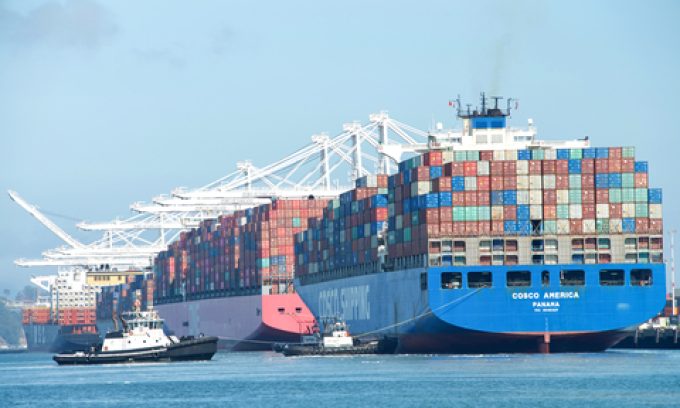
At their most extreme, the new fees could amount to $1.5m per ship call for any containerships built in Chinese shipyards, irrespective of the flag the vessel is sailing under or the nationality of its operator.
Last April, under the Biden administration, then USTR Katherine Tsai launched an investigation into China’s shipbuilding industry, following a petition from five US labour unions – including United Steelworkers and Machinists and Aerospace Workers – that Chinese policies were in contravention of Section 301 of the Trade Act.
Contravening Section 301 paves the way for the US government to apply penalties, and Mr Greer appears set to follow that course.
A position paper released by the USTR over the weekend states: “Based on the information obtained during the investigation, and taking account of public comments as well as the advice of the interagency Section 301 Committee and advisory committees, the US trade representative determined that China’s targeting of the maritime, logistics, and shipbuilding sectors for dominance is unreasonable and burdens or restricts US commerce, and thus is actionable under Sections 301(b) and 304(a) of the Trade Act.
“The dominant positions China seeks, and increasingly achieves, in each sector give it market power over global supply, pricing, and access. In order to create leverage to obtain the elimination of China’s targeting of these sectors for dominance, USTR proposes to take action against certain services of China and also action on a non-discriminatory basis on certain services, including those supplied using Chinese goods,” it adds.
It first proposal is that each vessel operated by a Chinese shipping line pays a “service fee” to dock at a US port, of up to $1m per call, or $1,000 per net ton of the vessel’s capacity.
The second proposal targets ships built in China, which could pay up to $1.5m per US port call, contingent on how many other Chinese-built vessels the operator deploys.
Carriers with 50% or more of their fleet comprising Chinese-built vessels would be charged up to $1m per vessel call; carriers with 25%-49% would be charged up to $750,000 per call; and those in the 0%-24% band up to $500,000 per call.
The USTR is also targeting the newbuilding sector, and proposes a $1m per call fee on shipping lines having “50% or greater of their vessel orders in Chinese shipyards, or vessels expected to be delivered by Chinese shipyards over the next 24 months”; and suggests a similar sliding scale for carriers with the vessel percentages as above.
And after the stick for China, there is a carrot for operators of US-built vessels – of which there are only a handful currently. They could find themselves in receipt of a $1m refund per call, if “the operator is providing international maritime transport services”.
Finally, there is a proposed restriction on carrying US exports, which seeks to gradually increase, over the next decade, the number of shipments carried on US-built ships.
Recent analysis by Linerlytica found: “Chinese-built ships account for 225 of the 1,045 ships currently deployed in the US (excluding Jones Act trades) compared with just 10 ships that were built in the US.”
If enacted, the Section 301 proposals are likely to affect a huge part of the world’s container fleet, and have the potential to temporarily hike shipping costs to US importers, especially if carriers were to introduce surcharges to cover the new fees.
For example, a $1.5m call fee levied on a 14,000 teu – the larger bracket of ships deployed on the transpacific Asia-US west coast services – Chinese-built containership would equate to $107 per teu if that vessel was fully laden.
A spokesperson for China’s Ministry of Commerce said in response yesterday: “The US measures will not only fail to revitalise its shipbuilding industry but will also raise shipping costs on related routes, exacerbate its domestic inflation, reduce the global competitiveness of US goods, and hurt the interests of its port operators and dockworkers.”
The USTR’s Section 301 committee will host a hearing on 24 March in Washington to discuss the proposals.
For uninterrupted access, sign in or sign up to The Daily News, Premium or The Loadstar Enterprise Plan.
Comment on this article
Bill Chua
February 25, 2025 at 6:15 amSurcharges in a perfect world where the mighty rules work. Unfortunately we all live in a dysfunctional earth. So, we expect the exporting countries to slavishly comply. Great thinking.
Dwight Campbell
February 26, 2025 at 11:23 pmI agree with the Chinese.
The US subsidizes everything they can, and when they no longer can, they come back and say they were taken advantage of….