Volatility drives US importers to continue to look for new suppliers
US containerised imports held broadly steady in June, but the underlying sourcing picture suggests importers ...

GM: TRADING UPDATE OUTUPS: REMEMBER THE TAILWINDS PLD: NEW RELEASEPLD: OUCHVW: NEW PARTNERS SOUGHTEXPD: AIRCRAFT ON GROUND SERVICESTSLA: JUST AS VW STRUGGLESBA: NEW BIG ORDERBA: THE ORDERBOOK GROWSPLD: PUSHING FOR A DEAL PLD: TIME TO DEALEXPD: ANOTHER ALL-TIME HIGH CHRW: NEW RECORD DSV: AHEAD OF EARNINGS RELEASE JBHT: NEW HIGHS EVERYWHERE
GM: TRADING UPDATE OUTUPS: REMEMBER THE TAILWINDS PLD: NEW RELEASEPLD: OUCHVW: NEW PARTNERS SOUGHTEXPD: AIRCRAFT ON GROUND SERVICESTSLA: JUST AS VW STRUGGLESBA: NEW BIG ORDERBA: THE ORDERBOOK GROWSPLD: PUSHING FOR A DEAL PLD: TIME TO DEALEXPD: ANOTHER ALL-TIME HIGH CHRW: NEW RECORD DSV: AHEAD OF EARNINGS RELEASE JBHT: NEW HIGHS EVERYWHERE
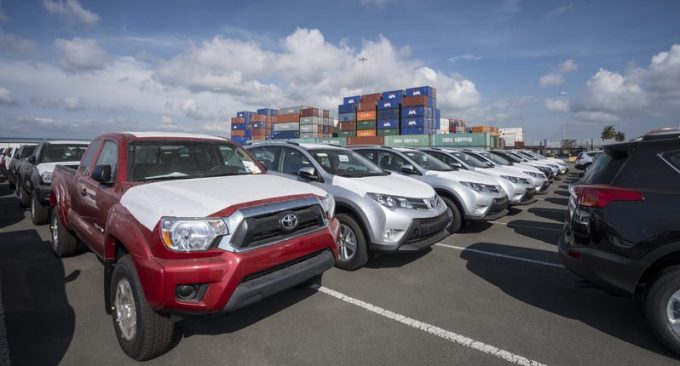
Automotive logistics could be hard hit – with some modal shift to cut costs – now the US has confirmed ‘heavy-handed’ 25% tariffs on imported vehicles.
To be introduced on 2 April, such a tariff would have impacted eight million vehicles last year, and increased their price by some $7,600 per imported car, according to investment bank Jefferies.
It noted: “In its latest salvo, the Trump administration adopted the most heavy-handed and simplest option of applying a 25% duty on all vehicles imported in the US.
“No adjustment for content at this stage, with final assembly in the US the determinant to avoid duty.
“Ford should be less impacted than GM and STLA, given the latter’s higher share of final assembly in units as well as higher-than-average value vehicles in Mexico. [For premium German carmakers] we estimate the value of incremental duty at around 2% of group revenue at BMW, 1% at VW, and 10% for Porsche.”
It added, however, that heavy trucks appear to be exempt.
“From what we’ve seen so far the 25% tariff announcement overnight seems to exclude heavy-duty trucks and appears to allow for a mechanism to net US content, from the value tariffs are applied to. If both of these remain unchanged then this is a better than expected outcome for US trucks. The risk is that broader tariffs (inc trucks) on 2nd April is still possible and macro uncertainty remains,” it said.

Jefferies
However, a second round of tariffs, on auto parts, will come in on 3 May, and “it is this second tranche which will be most far-reaching, given the integration of the US auto industry within regional and global value chains”, explained John Manners-Bell, founder and CEO of Ti Insight.
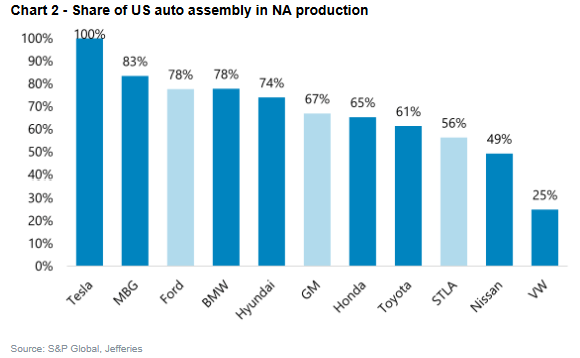
Jefferies
Mexico is the top exporter to the US, followed by South Korea, Japan, Canada, and Germany.
The first tranche is likely to see car prices rise in the US: “Just how much so will depend on whether the additional costs are absorbed by the manufacturers,” said Mr Manners-Bell.
Jefferies predicted: “Before any adjustment or countermeasure, a 25% duty would raise the unit price of imports by around $60bn, $7,600 per imported unit, or $3,800 if spread across all vehicles sold in the US.
“The impact would likely trigger both a shift to locally produced vehicles and higher prices, given the circa-50% weight of imports in total US demand, with pricing adjustments also supported by reduced availability.”
Mr Manners-Bell agreed. He said: “The rising cost of cars and car parts in the US will inevitably suppress sales and consequently production (possibly by up to 30%), impacting transatlantic and transpacific volumes.
“Most at risk though are cross-border flows within North America. Mexico and Canada believe the imposition of tariffs is illegal under USMCA agreements – but it is unclear which organisation or mechanism will rule on this and whether any judgment is enforceable.”
Speaking to The Loadstar today, Sander van der Meer, Geodis’s VP automotive, said European carmakers would be looking to cut costs, leading to modal shift.
“Amid significant cost pressures, there may well be scope for certain automotive customers to shift their freight from air to ocean and potentially save a good deal of money or consolidate shipments and use specific gateways in Europe and benefit from economies of scale,” he explained.
Mr Manners-Bell said the “legitimate” strategy behind the tariffs – to “localise entire supply chains within the US” – would, overall, have negative effects for the US.
“As supply chains are rebuilt, there will be higher costs for US consumers and a risk of lower-quality models as US producers become sheltered from global competition.
“It will take many years for auto manufacturers to adjust to the new environment – factories cannot just be relocated from Asia or Europe to the US overnight.
“Consequently, to avoid the types of disruption we may see, this policy (if it was going to be brought in at all) would have been better phased, to allow all automotive and parts manufacturers to invest in US production facilities.”
However, based on past form and a tendency by the White House to haggle, there is still time for the tariff policy to be adjusted.
“If President Trump’s tariff policy is not amended – and there is a good chance that it will change in some form or other in the next few days – it will be a disaster for the automotive industry and the associated logistics sector,” Mr Manners-Bell told The Loadstar.
For uninterrupted access, sign in or sign up to The Daily News, Premium or The Loadstar Enterprise Plan.
Comment on this article