Maersk returns West Africa service to the Red Sea as Suez comeback gathers pace
Maersk has announced that it is returning a third service to the Red Sea routing, ...

WTC: NO LUCKCHRW: 'NUCLEAR VERDICT'DSV: DEEP CUTKNIN: UPGRADEDKNIN: AI BENEFITSKNIN: NOT WORTH ITPLD: DEAL TIMEKNIN: CONF CALL CLOSING KNIN: PRICING POWER KNIN: MARKET SHARE GAINS IN ROAD KNIN: AI-RELATED COST INFLATION OUTLOOKKNIN: APEX LOGISTICS IPO UPDATEKNIN: QUESTION TIMEKNIN: 'COST REDUCTION PROGRAMME IS ON TRACK'KNIN: CFO REMARKSKNIN: MONETARY IMPACT FROM AI KNIN: AI UPSIDEKNIN: STRONG ROAD UNIT DELIVERY KNIN: AIR LOGISTICS SHINES
WTC: NO LUCKCHRW: 'NUCLEAR VERDICT'DSV: DEEP CUTKNIN: UPGRADEDKNIN: AI BENEFITSKNIN: NOT WORTH ITPLD: DEAL TIMEKNIN: CONF CALL CLOSING KNIN: PRICING POWER KNIN: MARKET SHARE GAINS IN ROAD KNIN: AI-RELATED COST INFLATION OUTLOOKKNIN: APEX LOGISTICS IPO UPDATEKNIN: QUESTION TIMEKNIN: 'COST REDUCTION PROGRAMME IS ON TRACK'KNIN: CFO REMARKSKNIN: MONETARY IMPACT FROM AI KNIN: AI UPSIDEKNIN: STRONG ROAD UNIT DELIVERY KNIN: AIR LOGISTICS SHINES
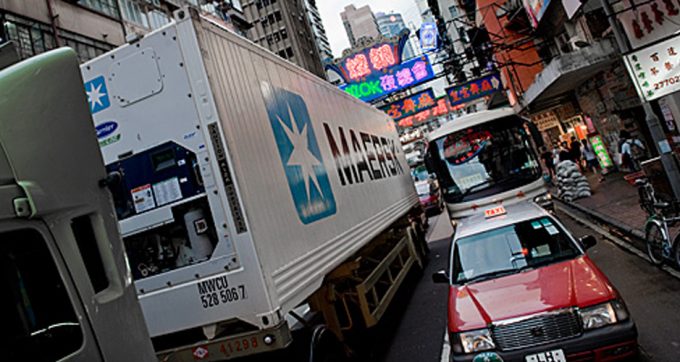
Maersk said the “competition is on”, when asked what the future was for forwarders in the face of the company’s integrator strategy.
Responding to a question from The Loadstar on the eve of a naming event for its latest methanol-fuelled vessel in Rotterdam, Maersk North Europe MD Ole Trumpfheller said Maersk was bidding for the same volumes in the logistics business as forwarders and described it as “healthy competition”, and emphasised Maersk was an integrator rather than a shipping line.
Asked if the carrier was trying to squeeze forwarders out of the logistics business, Mr Trumpfheller answered “yes”.
On the other hand, Maersk has a significant footprint with freight forwarders in its ocean business, and “we want to keep the current share of forwarder cargo on our vessels”, Maersk told The Loadstar.
With the recent appointment of seasoned logistics executive Xavier Urbain to the Maersk board, the forwarding sector is thought to come under renewed focus at the company.
“We are bidding for business and they are bidding for business; it is price and offering that wins,” Mr Trumpfheller continued, stressing that there was nothing underhand in the approach.
“But because we control the assets, we have data and information way ahead of the forwarders. And we can dictate which box is offloaded first,” he added.
Pressed on where this left forwarders, he noted that other carriers were also offering end-to-end solutions, and suggested forwarders would likely become “niche players serving special segments”.
“They don’t like it, that’s for sure, but it’s healthy competition. It’s business,” he said.
“What matters, reliability or pure cost? Forwarders do not control assets so their visibility is limited in that respect.”
Earlier, Mr Trumpfheller, who headed DB Schenker’s contract logistics unit until his move to Maersk last May, suggested that fewer vendors or suppliers in shippers’ supply chains would be beneficial in terms of visibility, flexibility, and hence resilience, in case of a sudden events and disruptions, pointing to what he called a “poly-crisis,” with tariff wars, geopolitical instability, regional instabilities, and the climate crisis.
“In such a poly-crisis, fewer vendors, meaning a less fragmented supply chain, is a good thing,” he said.
“Own the assets, control the entirety of the supply chain. We have the assets, we own them, we control them. We’re not quite DHL, we’ll admit that. But we’re not just a shipping line, we’re an integrator.”
Now, he said, Maersk was also looking towards ownership and therefore control of all its software – a question he claimed automotive manufacturers were also asking of themselves.
This story was updated on 31 March to include additional comments from Maersk on the carrier’s desire to retain its current share of forwarder’s cargo.
For uninterrupted access, sign in or sign up to The Daily News, Premium or The Loadstar Enterprise Plan.
Comment on this article