Middle East premium fades – but AI boom keeps air freight rates aloft
Air freight markets appear to be settling, with capacity largely returned to the Gulf, fuel ...

WTC: 'ONE RECORD'HLAG: EARNINGS GUIDANCE UPGRADE AAPL: GLOBAL SMARTPHONE SHIPMENTS VW: THE IMPACT VW: MASSIVE JOB CUTS CONFIRMEDEXPD: BULLISHCHRW: POSITIONING AHEAD OF EARNINGSAMZN: IN THE NUMBERSAMZN: PEOPLE MATTER UNTILVW: THE LAST CUT IS THE DEEPESTJBHT: GEARING UP VW: BUYING TIMER: BIG VOTE OF CONFIDENCEAAPL: BEARISH HEDGEYE
WTC: 'ONE RECORD'HLAG: EARNINGS GUIDANCE UPGRADE AAPL: GLOBAL SMARTPHONE SHIPMENTS VW: THE IMPACT VW: MASSIVE JOB CUTS CONFIRMEDEXPD: BULLISHCHRW: POSITIONING AHEAD OF EARNINGSAMZN: IN THE NUMBERSAMZN: PEOPLE MATTER UNTILVW: THE LAST CUT IS THE DEEPESTJBHT: GEARING UP VW: BUYING TIMER: BIG VOTE OF CONFIDENCEAAPL: BEARISH HEDGEYE
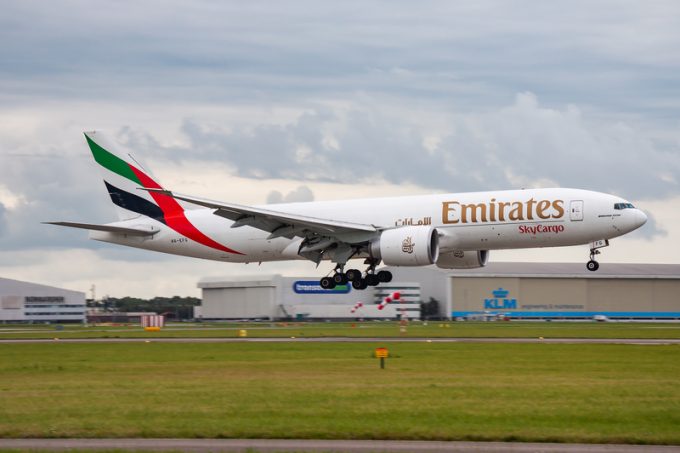
Air freight rates are rising sharply as the Middle East crisis disrupts key Gulf aviation hubs, removing capacity from the market just as Asian factories restart after lunar new year.
Forwarders say the sudden loss of lift through the region – combined with continued disruption to ocean shipping – is tightening space on Asia-Europe lanes and pushing shippers to explore alternative routings, charters, and sea-air options.
Freight rate data is already reflecting the shift: Freightos FAX shows global spot rates jumping sharply in early March after remaining broadly stable through February. The strongest increases appeared on Asia-Europe corridors, particularly from the Indian Subcontinent and South-east Asia, where cargo normally routed through Gulf hubs has been disrupted.
Rates on Middle East-Europe routes have also surged, while transpacific pricing has so far remained relatively stable, suggesting the shock is currently concentrated on east-west lanes that rely heavily on Gulf connectivity.
Forwarders say the spike is being driven by the sudden loss of capacity provided by Middle Eastern carriers.
“Many Middle East carriers – Emirates, Qatar Airways and Etihad – are important freighter operators from the Far East to Europe,” said Kathy Liu, VP of global sales and marketing at forwarder Dimerco. “Right now, because of the situation, that capacity is not available.”
As a result, cargo that would normally transit through Gulf hubs is being redirected through Asian gateways, including Taiwan, Hong Kong, Korea, Japan, and Shanghai.
The tightening is already feeding into pricing, she added. “Rates have already increased around 10%-15% this week.”
The disruption comes at a delicate moment for the market. February rates had followed a typical seasonal pattern, with a modest pre-Chinese New Year mini-peak followed by a lull during the holiday period, before factory production restarted across Asia.
But as production ramps up again, forwarders expect pressure on lift to intensify.
“We expect that maybe in a week or 10 days we will see more backlog cargo,” Ms Liu said.
The Asia-Europe corridor is particularly exposed, because a large share of cargo flows through Gulf hubs, such as Dubai, Doha, and Abu Dhabi, which act as transfer points for east-west trade.
Airspace closures across the region have forced airlines to cancel or reroute flights, adding flight time, fuel burn, and operational costs.
Airlines are already restructuring networks to cope. Emirates said on social media that “Emirates SkyCargo has put all its 777Fs back into service” – but with provisos. It said in a note to customers that it had begun redeploying freighters to operate limited point-to-point services from gateways including Amsterdam, Frankfurt, Liège, and London Stansted, using trucking networks to distribute cargo across Europe, rather than relying on its usual Dubai hub.
But it also warned customers that the disruption constituted a force majeure event, citing armed hostilities and airspace closures affecting the UAE. The carrier said it was unable to operate “usual capacities at the usual rates”, and reserved the right to refuse shipments or vary pricing as conditions changed – a sign of how quickly capacity shortages are feeding into higher air freight costs.
The rapid shift highlights how quickly the outlook for air cargo has changed.
Operational data is also beginning to show the scale of the disruption. Analysis from logistics software provider WiseTech Global found that four in nine logistics organisations using the CargoWise platform had already experienced air freight disruption, affecting around 11,000 shipments.
The company said the disruption was not confined to the Middle East, with rerouted flights and altered shipping rotations already creating knock-on effects across global tradelanes.
“On 21 February, we thought the main talking point for the month would be the US Supreme Court’s ruling to strike down the Trump administration’s emergency tariffs,” said Xeneta chief airfreight officer Niall van de Wouw. “Then, on 28 February, we witnessed the strikes on Iran and the start of everything that has happened since.
“This is the world we are living in, and the reality for businesses facing one new challenge after another.”
With direct lift tightening, forwarders say shippers are already looking for alternative solutions.
Scan Global Logistics said it had seen a surge in requests for hybrid logistics options, including sea-air services and charter flights, as companies try to bypass the disruption.
Among options being explored are sea-air routings via the Maldives, truck-air connections from western China into Central Asian gateways, and sea-air solutions routing cargo via South-east Asia and the US west coast.
However, these workarounds come with longer transit times and higher costs.
The air market could tighten further if disruption to ocean shipping pushes additional cargo into aircraft holds.
Security concerns around the Strait of Hormuz have already forced some container lines to divert vessels or revise rotations, while carriers that had tentatively resumed Red Sea transits have again reverted to Cape of Good Hope diversions.
If maritime disruption persists, forwarders warn that urgent cargo could shift from sea to air, adding further pressure to an already constrained market.
“When ocean freight is impacted for a longer time, then some urgent cargo will move to air freight,” Ms Liu said.
For now, the industry is watching closely to see how long the Middle East disruption lasts. If airspace restrictions persist for several weeks, forwarders expect rate increases to spread beyond Asia-Europe lanes to other corridors.
“The airfreight industry is very flexible and will find solutions,” Ms Liu said. “But the cost will definitely increase.”
For uninterrupted access, sign in or sign up to The Daily News, Premium or The Loadstar Enterprise Plan.

Comment on this article