Box ship attacked, Hormuz shut again, Middle East rates sail past pandemic peak
Gulf importers and their forwarders are once more turning to Middle East landbridge routes after ...

VW: THE IMPACT VW: MASSIVE JOB CUTS CONFIRMEDEXPD: BULLISHCHRW: POSITIONING AHEAD OF EARNINGSAMZN: IN THE NUMBERSAMZN: PEOPLE MATTER UNTILVW: THE LAST CUT IS THE DEEPESTJBHT: GEARING UP VW: BUYING TIMER: BIG VOTE OF CONFIDENCEAAPL: BEARISH HEDGEYE AAPL: THE BEAR CASEFDX: LIFE SCIENCES ORG UNVEILEDWTC: UPS AND DOWNSWTC: ASX ANNOUNCEMENT REGARDING DSV PARTNERSHIP VW: D-DAY
VW: THE IMPACT VW: MASSIVE JOB CUTS CONFIRMEDEXPD: BULLISHCHRW: POSITIONING AHEAD OF EARNINGSAMZN: IN THE NUMBERSAMZN: PEOPLE MATTER UNTILVW: THE LAST CUT IS THE DEEPESTJBHT: GEARING UP VW: BUYING TIMER: BIG VOTE OF CONFIDENCEAAPL: BEARISH HEDGEYE AAPL: THE BEAR CASEFDX: LIFE SCIENCES ORG UNVEILEDWTC: UPS AND DOWNSWTC: ASX ANNOUNCEMENT REGARDING DSV PARTNERSHIP VW: D-DAY
Global air cargo markets are showing increasing signs of stability, with Gulf carriers rapidly rebuilding networks disrupted by the US-Iran conflict and capacity returning across key tradelanes.
Yet despite easing geopolitical tensions and falling fuel prices, freight rates remain stubbornly high.
The latest figures from WorldACD show worldwide chargeable weight rose 1% week on week between 8 and 14 June, while capacity and average rates remained broadly unchanged.
The data suggests the market largely absorbed the fresh flare-up of hostilities in the Middle East, with volumes from the Middle East and South Asia (MESA) region increasing 4% week on week, despite renewed tensions.
The resilience contrasts sharply with the disruption seen earlier this year, when conflict in the Gulf triggered widespread schedule changes, capacity shortages, and soaring rates.
And the recovery of Gulf aviation networks is becoming increasingly visible.
Qatar Airways said it had restored its network to 85% of pre-crisis levels, achieving a target set during the height of the disruption. The carrier’s summer schedule now includes more than 140 daily departures from Doha, serving more than 160 destinations worldwide.
Meanwhile, Etihad Airways CEO Antonoaldo Neves told Reuters the Abu Dhabi carrier expected to be flying around 8% more than a year ago by mid-June, and was ordering additional widebody aircraft as it restored services cut during the conflict.
“The biggest cost we have is an empty plane,” he said, adding that the airline had no plans to reduce flying.
Gulf carriers were among the largest contributors to cargo growth in May, via freighters and widebody aircraft, led by Qatar Airways, which recorded a 28% increase in tonnage, equivalent to an additional 78,200 tonnes. Emirates increased cargo volumes by 17%, while Etihad posted a 6% gain.
The reopening of Gulf networks is also evident on individual routes, according to Rotate data. Hong Kong-Doha widebody and freighter volumes increased 62% month on month, while Doha-Hong Kong traffic rose 43%. Other Gulf-related lanes – in particular Sharjah, which has seen a boost from Hong Kong – also recorded strong gains as carriers restored connectivity and repositioned capacity.
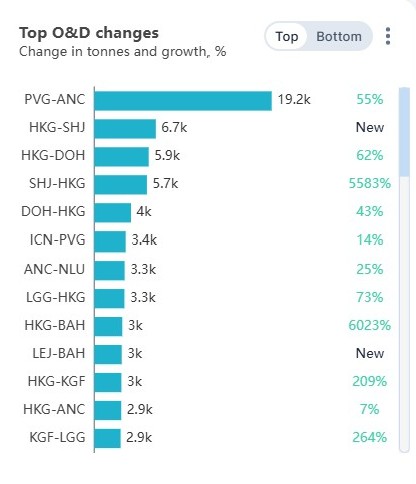
Source: Rotate
Overall, Rotate estimates global air cargo capacity increased 4% month on month in May, reversing a 1% decline in April.

Source: Rotate, freighters and widebodies
Yet while capacity is returning, rates are proving far slower to respond.
According to TAC Index, the global Baltic Air Freight Index gained a further 1.7% in the week to 22 June, leaving it 37.3% higher than a year ago and still above the highest points reached during recent peak seasons.
TAC noted that the sharp fall in crude oil and jet fuel prices following the extension of the ceasefire between the US and Iran had yet to feed through to air freight pricing.

Freightos added: “Jet fuel prices have eased since the prospects of a reopened Hormuz have increased. So far though, air cargo rates have stayed level, though down from earlier highs on most lanes, including for China, South Asia and Southeast Asia cargo flows to Europe. Prices to North America have nonetheless trended upward, possibly buoyed by last chance Amazon Prime Day demand.”
TAC Index said Shanghai outbound rates rose another 3.6% week on week, and remain 43.3% higher than a year ago; Hong Kong outbound rates were little changed, but still stand 41.4% above last year’s level; Frankfurt outbound rates are up 23.8% year on year; while Chicago remains 30.9% higher.
Forwarders continue to report challenging conditions, despite the improving operating environment.
In its latest market update, India’s Ligi Logistics said airfreight markets across India, Bangladesh, Vietnam, China, Hong Kong, Taiwan, Pakistan, and South-east Asia remained under significant pressure, with limited uplift availability, extended booking lead times, and airlines increasingly prioritising contracted and premium cargo.
The forwarder described spot space availability as “very limited”, and said rates remained firm-to-increasing across most major export origins.
WorldACD’s data paints a similar picture. Although global pricing was flat week on week, at $3.23 per kg, average rates remain 34% higher than a year ago. MESA capacity declined 2% week on week after a strong rebound the previous week, and remains below pre-conflict levels, indicating the regional recovery still has further to run.
At the same time, carriers continue to position themselves for future growth.
Cathay Group this week announced that Air Hong Kong would add an A330 converted freighter in the fourth quarter under a long-term lease agreement with ATSG. It follows Cathay Cargo’s recent order for two additional A350Fs, and will be deployed primarily on services to mainland China and other regional destinations.
Cathay’s director cargo, Dominic Perret, said the additional aircraft would support the carrier’s capacity growth plans, strengthen its regional network, and reinforce Hong Kong’s position as a leading air cargo hub.
The result is a market that is becoming increasingly stable, but not yet significantly cheaper.
Check out this week’s News in Brief podcast!
For uninterrupted access, sign in or sign up to The Daily News, Premium or The Loadstar Enterprise Plan.

Comment on this article