Battle for freighter capacity intensifies as airlines reshape networks
A cluster of shocks is forcing freighter operators to finely balance their global capacity – ...

JBHT: NEW HIGHS EVERYWHEREPLD: STRONG DELIVERYJBHT: FAIR-VALUE CONSENSUS ESTIMATE AT ALL-TIME HIGH KNIN: AI TECH ADVANTAGEPLD: TRADING UPDATE ON THE WAY KNIN: UPSIDEJBHT: STRONG TRADING UPDATE DSV: EVERY LITTLE HELPSJBHT: CEO REMARKS WMT: VERTICAL INTEGRATION IN LOGISTICS
JBHT: NEW HIGHS EVERYWHEREPLD: STRONG DELIVERYJBHT: FAIR-VALUE CONSENSUS ESTIMATE AT ALL-TIME HIGH KNIN: AI TECH ADVANTAGEPLD: TRADING UPDATE ON THE WAY KNIN: UPSIDEJBHT: STRONG TRADING UPDATE DSV: EVERY LITTLE HELPSJBHT: CEO REMARKS WMT: VERTICAL INTEGRATION IN LOGISTICS
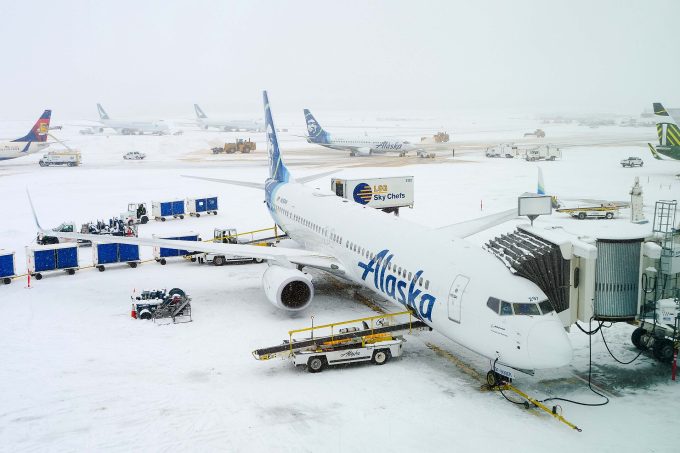
Plans by NorthLink Aviation to develop an ecommerce hub at Anchorage Airport may have faltered, following the US administration’s decision to eliminate the de minimis exemption – but the airport continues to grow cargo volumes.
The combination of rising tariffs, added compliance burdens and longer clearance times may have triggered some ecommerce air cargo flows to slow, or divert to other hubs, in something of a strategic risk for Anchorage’s ambition to become an ecommerce gateway. However, latest figures for the first half show growth of about 3% – even as some carriers cut their capacity to the airport.
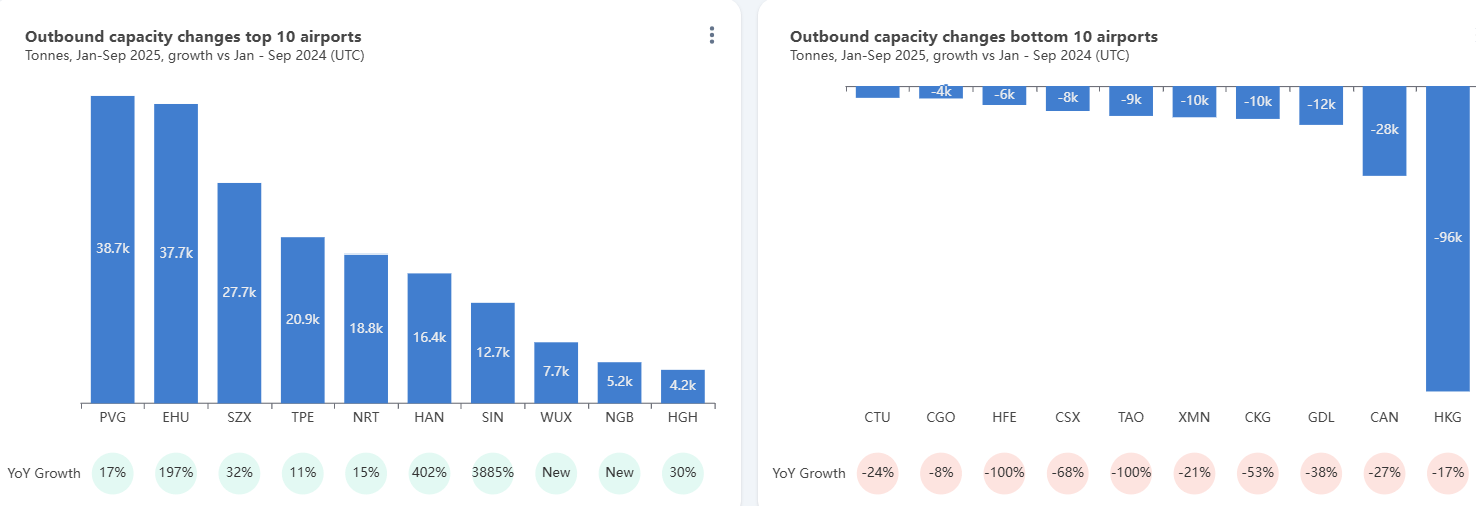
Outbound capacity to Hong Kong has shrunk by 17% in the year to date, over last year; to Incheon, capacity is down 13%, according to Rotate’s live capacity database; but destinations like Hanoi and Ezhou have seen significant growth.
Source: Rotate
But where ecommerce may have weakened, 45% growth to Taipei suggests AI servers may have come to ANC’s rescue. Hanoi and Ezhou are also high on the growth charts for connections to Anchorage.
This was in part confirmed by Sean Dolan, CEO of NorthLink Aviation, who told The Loadstar: “The fact that ANC is seeing record levels of international cargo flight volumes speaks to the crucial role the airport serves when supply chains are moving around – and AI is booming.
“Like everyone else in the air cargo industry, we are working with customers on what the optimal paradigm is for meeting ecommerce needs in an “evolving” regulatory landscape. We continue to make progress on all fronts with the project.
“NorthLink’s focus remains on how we can optimise the flow of cargo globally, using ANC as a hub. FedEx and UPS have been doing this for decades – we want the entire air cargo community to be able to do the same.”
In fact, however, FedEx and UPS have cut back at Anchorage. According to airport figures, FedEx reduced its landings by 12%, while UPS stayed flat, in the first nine months of 2025, over last year. But according to Rotate, FedEx – which in April announced a new route, Singapore-Anchorage – capacity out of Anchorage has fallen some 20% this year, while UPS again stayed flat. Cathay Pacific has also seen capacity declines, of about 9%.

Source: ANC Monthly Cargo Update
But others have taken up the mantle. Kalitta Air has added about 30% capacity this year to Anchorage, and China Airlines is up 50%. Atlas Air, meanwhile, has added about 12% capacity this year – and Polar Air Cargo – which was thought to have stepped out of the market altogether, has grown by 8%. In fact, data shows Polar has landed 384 times in the past year, September to September, using two 777Fs.
Polar Air has not, it seems, melted after all.
Polar was a joint-venture between Atlas and DHL and, following the fraud scandal, both companies said the JV was no longer strategically relevant but Atlas would keep the AOC and take on a couple of aircraft.
When asked why, a spokesperson for Atlas wrote: “The Polar AOC continues to serve select customers. As per our standard protocol, we do not share specific customer information.”
So that’s all cleared up then.
Meanwhile, Atlas Air said last year it was planning to sign a lease for the West AirPark at Anchorage: this does not appear to have happened.
Atlas does have a permit from the airport for “preferential use” of three remote parking spots. But the planned agreement to lease 2.96m sq metres at West AirPark, for 55 years at a cost of $532,785 a year, appears to have come to nothing. The purpose of the land was for aircraft parking and fuelling, cargo offload/load, warehousing, ground handling, technical support, line maintenance, flight-crew operations base, and GSE storage/repair. But the land would have needed significant investment and ground works to operate efficiently, including road re-alignment.
According to public information, Atlas has had a difficult time looking for a lease at the airport, with initial ties to an opaque consortium operating there that had faced some compliance issues – but it has not fallen for the charms of NorthLink, seemingly preferring to go it alone.
Atlas’s response to The Loadstar’s questions on the lease have not added clarity: a spokesperson simply noted: “As the largest operator in ANC, we continue to work closely with ANC on the development of plans to support our long-term needs.”
Those long-term needs may now be harder to define. ANC itself has recognised the changing regulatory environment and the risk to its plans. In the first half-year report, Alaska’s DoT noted: “Over the past several months, evolving tariff policies have been a notable consideration for cargo activity across the Alaska International Airport System.
“While cargo throughput remains strong, shifts in global trade dynamics – particularly in the transpacific market – have prompted some adjustments by carriers and freight forwarders. These developments have reinforced the importance of maintaining operational flexibility and strong industry partnerships to navigate a changing international landscape while continuing to support AIAS’s role as a vital cargo hub.”
Or, as Mr Dolan puts it rather more succinctly: “Air cargo thrives in chaos.”
Which is lucky. Not only has the airport got to contend with new compliance measures in trade, but it is about to hit its highest risk period for disruption: winter’s heavy snowfalls could hit any day, impacting operations and, temporarily at least, perhaps, halting its dreams of becoming an ecommerce hub.
For uninterrupted access, sign in or sign up to The Daily News, Premium or The Loadstar Enterprise Plan.

Comment on this article