Battle for freighter capacity intensifies as airlines reshape networks
A cluster of shocks is forcing freighter operators to finely balance their global capacity – ...

PLD: TRADING UPDATE ON THE WAY KNIN: UPSIDEJBHT: STRONG TRADING UPDATE DSV: EVERY LITTLE HELPSJBHT: CEO REMARKS WMT: VERTICAL INTEGRATION IN LOGISTICSJBHT: HERE WE GOPG: STEADYEXPD: NEW RECORD BA: DELIVERIESMAERSK: BEAR CAMP MUSINGS
PLD: TRADING UPDATE ON THE WAY KNIN: UPSIDEJBHT: STRONG TRADING UPDATE DSV: EVERY LITTLE HELPSJBHT: CEO REMARKS WMT: VERTICAL INTEGRATION IN LOGISTICSJBHT: HERE WE GOPG: STEADYEXPD: NEW RECORD BA: DELIVERIESMAERSK: BEAR CAMP MUSINGS
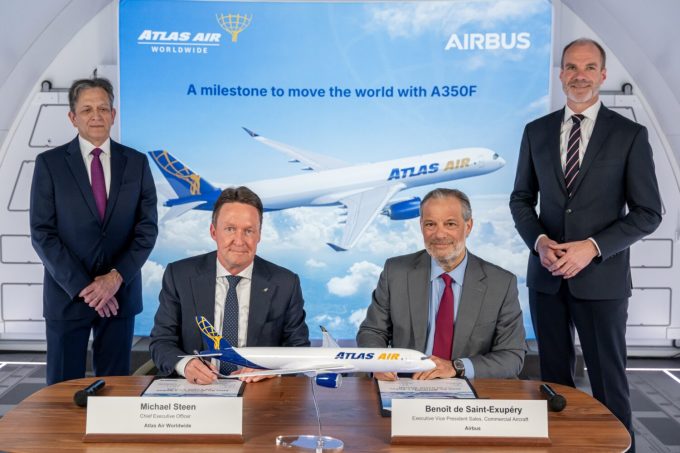
Atlas Air is not looking to ruffle any feathers with its latest order – the largest ever placed for Airbus’ A350 freighters – rather it is intended as means to sensibly position itself in what looks like becoming a capacity-scarce market. But industry observers have expressed surprise at the decision to go with the European manufacturer.
The US carrier announced its first non-Boeing order in style yesterday, inking a deal for 20 A350Fs with an option for 20 more should it wish, but chief executive Michael Steen stressed it should not be read as abandoning the American manufacturer.
Mr Steen told The Loadstar: “This doesn’t preclude us from buying more Boeing aircraft. We’ll definitely do that in the future. I’m very pleased to say we have two very capable OEMs now that can deliver products that we and our customers can benefit from.
“We went with Airbus because it has phenomenal range, good fuel burn and payload capability and versatility. And getting access to aircraft as early as 2029 was important in our decision making – they are going to deliver between 2029 and 2034.”
Pressed on whether he was concerned that going European over American could cause any problems domestically, Mr Steen rejected the assertion, pointing out that Atlas is “the last to operate multiple platforms from different manufacturers”.
But one aviation executive told The Loadstar: “The big surprise is Airbus, I wonder what Trump will have to say about that. We shall see in what way politics gets involved.”
Instead, the CEO seemed more concerned with shoring up capacity in what he predicts will prove to be a capacity-tight market in the not-too-distant future – although The Loadstar has suggested it could be a move to fatten the airline up for a sale.
“There are about 620 or so widebody freighters in the world all operating, and of those probably the 120 or so are older than 30 years, so, you see a retirement rate happening faster now from an industry perspective,” he continued.
“But the OEMs do not have the production capacity to manufacture more than a 1% capacity growth over the next 10, arguably 15 years, whilst demand directionally, will grow somewhere between 3.5% to 5%.
“So, we’re in a situation where widebody capacity will face tremendous pressure and for a significant period of time. This order is going to add capacity that we can deploy with customers, expand our customer base, expand our footprint, create more jobs.”
Despite pointing this looming glut of retirements, Mr Steen noted that Atlas’ average fleet age was younger than the wider industry and thus would not be subjected to the same pressure as its competitors.
Further to which, he said that the decision had been taken following consultations with not only the in-house team but with the existing customers that the carrier intends to place these aircraft with on long-term leases.
Airbus commercial aircraft CEO Lars Wagner said: “Atlas Air’s selection of the latest generation A350F represents a pivotal moment, cementing the A350F’s position as the preferred true all-new-generation freighter for the most demanding cargo operators.”
For uninterrupted access, sign in or sign up to The Daily News, Premium or The Loadstar Enterprise Plan.

Comment on this article