Battle for freighter capacity intensifies as airlines reshape networks
A cluster of shocks is forcing freighter operators to finely balance their global capacity – ...

JBHT: NEW HIGHS EVERYWHEREPLD: STRONG DELIVERYJBHT: FAIR-VALUE CONSENSUS ESTIMATE AT ALL-TIME HIGH KNIN: AI TECH ADVANTAGEPLD: TRADING UPDATE ON THE WAY KNIN: UPSIDEJBHT: STRONG TRADING UPDATE DSV: EVERY LITTLE HELPSJBHT: CEO REMARKS WMT: VERTICAL INTEGRATION IN LOGISTICS
JBHT: NEW HIGHS EVERYWHEREPLD: STRONG DELIVERYJBHT: FAIR-VALUE CONSENSUS ESTIMATE AT ALL-TIME HIGH KNIN: AI TECH ADVANTAGEPLD: TRADING UPDATE ON THE WAY KNIN: UPSIDEJBHT: STRONG TRADING UPDATE DSV: EVERY LITTLE HELPSJBHT: CEO REMARKS WMT: VERTICAL INTEGRATION IN LOGISTICS
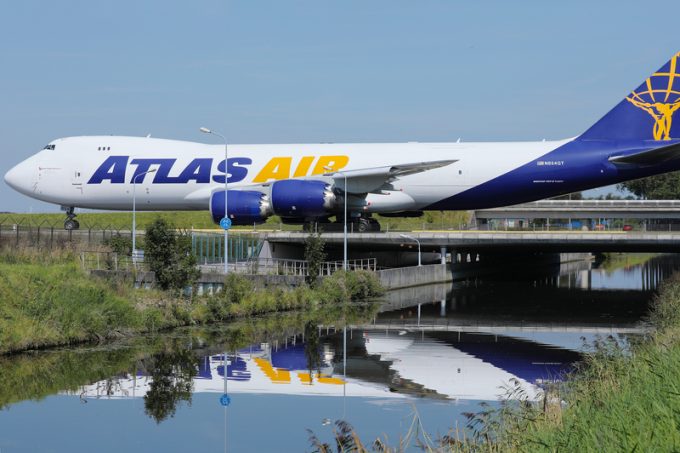
Atlas Air’s order for up to 40 A350 freighters – 20 firm, 20 options – will inevitably be framed as a big Airbus moment. Fair enough – it is.
But that’s not really the whole story. What’s more interesting is how closely this looks like a classic private equity setup.
Atlas has been owned by Apollo and friends since 2022. We learned at the tail-end of last year that Apollo is looking to shed Atlas Air, via a potential $12bn sale: an ambitious price tag for a carrier that was acquired in March 2023 by Apollo for about $3.2bn for the equity, at an enterprise value of some $5.2bn.
There has been no further speculation or chat about a sale, but equally no one is pretending that private equity is in it for the long game. In an interview with The Loadstar yesterday, CEO Michael Steen admitted “we may see changes in our ownership structure”.
And once you look at the order through that lens, a few things start to line up.
First, the model. Atlas already runs with some 90% of its capacity on long-term contracts. Now it says customers were directly involved in the aircraft decision.
That’s not just good planning, it reflects risk being taken out of the equation, an alluring strategy for any potential investor. Predictable revenues, locked-in demand, and a business that behaves less like a cyclically affected traditional cargo airline and a lot more like a contracted service platform.
Then there’s the story Atlas is telling about the market, a capacity narrative it has pushed for a long time. “The OEMs don’t have the production capacity to manufacture more than a 1% capacity growth over the next 10, arguably 15 years, whilst demand directionally will grow somewhere between 3.5% to 5%,” said Mr Steen, causing “tremendous pressure” on supply.
It’s a pretty compelling scarcity narrative, which would nicely underpin a strong exit valuation.
If capacity really is going to be tight for the next decade, owning lift looks like a very good place to be. More to the point, it starts to look like something you can sell at a premium.
And that brings us to Airbus.
The reasoning – efficiency, payload, range – is all fine. But perhaps the key point is delivery from 2029.
In a world where production slots are tight and Boeing’s new freighter timeline is still uncertain, availability matters – and likely more than brand loyalty. Atlas has chosen certainty, and timing is everything if you’re trying to show visible, near-term growth.
Which is exactly what this order does. Crucially, Atlas was clear: this is expansion first, replacement later. These aircraft grow the fleet before older ones are retired.
That’s not simply about maintaining a business – it’s how you behave if you are trying to make it look bigger, stronger and more valuable.
Put together – revenues under contract, customer-backed demand, a tight capacity story, and a fleet that grows before it renews – and it begins to look like a business being dressed for market.
That doesn’t mean a sale is about to drop tomorrow. But it does mean Atlas is being shaped into something that would be easy to sell: predictable, scalable, and plugged directly into a supply-constrained market.
The Airbus order might look like a fleet decision – but it also looks like preparation.
Check out this week’s News in Brief podcast, featuring Xeneta’s Peter Sand and Marco Forgione, director general of the UK’s Chartered Institute of Export & International Trade.
For uninterrupted access, sign in or sign up to The Daily News, Premium or The Loadstar Enterprise Plan.

Comment on this article