dreamstime_s_133898486
© Joshua Olson

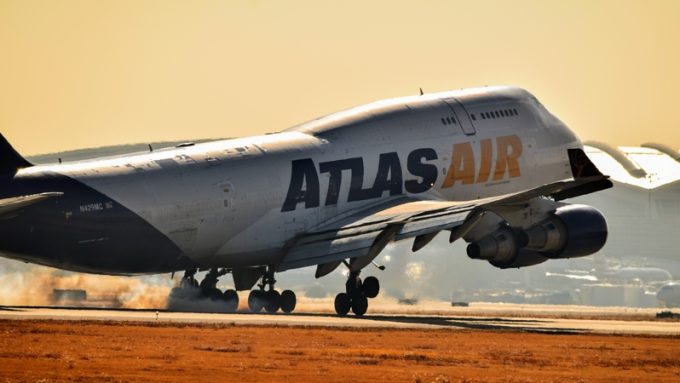
Apollo Global Management is exploring a potential sale of Atlas Air, which could value the carrier at more than $12bn including debt, according to people familiar with the matter, cited by Bloomberg 

Discussions are at an early stage and no formal process has been launched, but that reported high valuation would mark a comfy profit for the PE group, which took Atlas private in 2022 for $5.2bn. 

Apollo argued at the time that public markets had failed to understand the carrier’s business or strategic role. In an Apollo case study, executives described Atlas as having “a tremendous business model” that was “totally misunderstood by the markets”, adding that the company was not being recognised as the global supply chain player it actually is. 

Apollo argued that Atlas Air’s long-term ACMI contracts, charter flying, and aircraft leasing across a mixed fleet provided scale, flexibility, and strategic relevance in global tradelanes it believed was not adequately reflected in its former public valuation. 

Fitch Ratings noted earlier this year that Atlas’s contracts insulated cash flows from the volatility of spot cargo markets. While it pointed to uncertainty in international trade and economic growth, and a possible risk to air cargo demand, it said Atlas’s contractual revenue base and financial flexibility should help soften the impact. 

However, Fitch also noted that Atlas operated in a highly competitive and capital-intensive industry, exposed to global trade cycles, fuel prices, and shifts in cargo capacity. While long-term contracts improve visibility, they do not eliminate cyclicality, particularly for operators of large widebody freighters, where utilisation and yields can move sharply in downturns. 

Fitch wrote in April: “A meaningful, but minority, portion of Atlas’s business is derived from China to US routes and includes shipments for tech and consumer electronics, ecommerce, and other merchandise. Rates outside of transpacific routes could also be affected by changes in overall industry demand and capacity balance.” 

In fact, Atlas Air’s year has been characterised by adapting quickly to new markets. It has cut 3% capacity from Asia Pacific this year, compared with last year. However, it pivoted nicely, showing overall growth, with North American capacity up 12%, Latam up 32%, Europe up 37%, and the Middle East up 106%. 

Its ability to manage swift changes in a difficult – albeit quite strong year – for air cargo, along with the likely shortage in freighters, will be central to whether buyers are willing to support a valuation as high as $12bn. 

There is an inevitable comparison with Air Transport Services Group (ATSG), which was acquired earlier this year by infrastructure-focused investor Stonepeak, in an all-cash deal valued at approximately $3.1bn including debt. Is Atlas really worth four times as much, with comparable fleet sizes, while ATSG also has maintenance, freighter conversions, and handling among its subsidiaries? 

The difference could lie, to some extent, in aircraft type, revenue per aircraft and global reach. Atlas’s concentration in large widebody freighters positions it for long-haul intercontinental cargo flows that command higher yields than mid-size aircraft operations. 

It is also the world’s largest operator of now no-longer produced 747 freighters and, in a market where widebody freighter capacity is constrained, that could justify a premium. However, widebody freighters are expensive to operate and exposed to swings in global trade. And, as The Loadstar Premium notes today, its freight forwarder customers are in quite poor financial health – and Atlas is an expensive habit.

If Apollo proceeds with a sale, Atlas Air could become a test case for how much investors are willing to pay for scale and global relevance in air cargo. The comparison with Stonepeak’s $3.1bn acquisition of ATSG will loom large, no doubt. 

So, who might buy it? It’s expensive for a strategic investor, and quite a large bite to chew – a 100+ strong fleet of widebody freighters is not a game for the faint-hearted or inexperienced. That would leave infrastructure-focused private equity groups such as Stonepeak, Brookfield, Blackstone, KKR, or Carlyle as among the likely candidates, although Stonepeak has already acquired ATSG, and is now focused on setting up a cold chain network in Asia.

A partnership between a financial sponsor and an industrial player, combining capital with operational expertise could work – but either way, $12bn is a pretty punchy opening gambit. 

The good, the bad and the ugly: find out in next week’s Year in Brief podcast which Atlas Air was…

Comment on this article


You must be logged in to post a comment.