Air cargo in new balancing act as rates ease and fuel costs climb
Air cargo carriers are facing an increasingly challenging market, with spot rates beginning to cool, ...

WTC: NO LUCKCHRW: 'NUCLEAR VERDICT'DSV: DEEP CUTKNIN: UPGRADEDKNIN: AI BENEFITSKNIN: NOT WORTH ITPLD: DEAL TIMEKNIN: CONF CALL CLOSING KNIN: PRICING POWER KNIN: MARKET SHARE GAINS IN ROAD KNIN: AI-RELATED COST INFLATION OUTLOOKKNIN: APEX LOGISTICS IPO UPDATEKNIN: QUESTION TIMEKNIN: 'COST REDUCTION PROGRAMME IS ON TRACK'KNIN: CFO REMARKSKNIN: MONETARY IMPACT FROM AI KNIN: AI UPSIDEKNIN: STRONG ROAD UNIT DELIVERY KNIN: AIR LOGISTICS SHINES
WTC: NO LUCKCHRW: 'NUCLEAR VERDICT'DSV: DEEP CUTKNIN: UPGRADEDKNIN: AI BENEFITSKNIN: NOT WORTH ITPLD: DEAL TIMEKNIN: CONF CALL CLOSING KNIN: PRICING POWER KNIN: MARKET SHARE GAINS IN ROAD KNIN: AI-RELATED COST INFLATION OUTLOOKKNIN: APEX LOGISTICS IPO UPDATEKNIN: QUESTION TIMEKNIN: 'COST REDUCTION PROGRAMME IS ON TRACK'KNIN: CFO REMARKSKNIN: MONETARY IMPACT FROM AI KNIN: AI UPSIDEKNIN: STRONG ROAD UNIT DELIVERY KNIN: AIR LOGISTICS SHINES

Container spot freight rates on the main east-west trades all declined over the past week, the surest sign yet that this year’s peak season is past its apex – at least in terms of pricing.
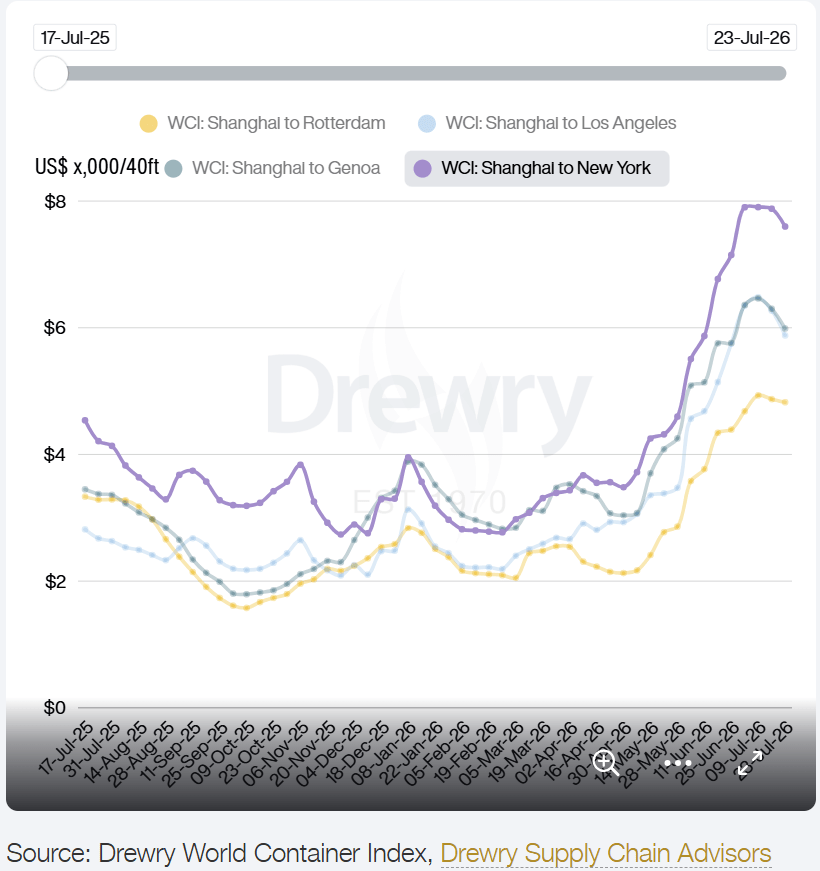
Drewry’s World Container Index (WCI) recorded spot rate declines in the headhaul directions across all three of its main east-west trades.
Source: Drewry
The WCI’s Shanghai-Rotterdam leg dropped 1% week on week, to finish at $4,824 per 40ft, while the Shanghai-Genoa leg saw spot rates decline 5% over the previous week, to end at $5,988 per 40ft.
Forwarders on the trades expect further falls over the coming weeks, with carriers already beginning to offer discounts on spot shipments out of Asia for the remainder of July and into August.
However, this is largely with the caveat that the declines are likely to be gentle, rather than a precipitous price crash.
“While there are rate reductions, they’re still at a steady pace, with carriers continuing to control allocation agreements – albeit with some flexibility,” one forwarder told The Loadstar today.
Today’s Shanghai Containerised Freight Index (SCFI) – which records rates quoted for the forthcoming week and, as such, can indicate the behaviour of the following week’s WCI (as it did last week) – supports this view, showing spot rates to North Europe and the Mediterranean down 3%.
One factor that may have prolonged this year’s peak was the “roll pools” that built up in the China when demand peaked around a month ago, but they appear to have been cleared quicker than many forwarders feared, although loading operations in some Chinese ports were recently affected by Typhoon Bavi.
“There are still a few issues in China main ports which vessels are omitting, although I am hearing carriers’ roll pools are reducing and nearly cleared,” the forwarder added.
Meanwhile, Drewry said carriers had already begun to respond to rate declines with new capacity management.
According to Drewry’s Container Capacity Insight, four blanked sailings are scheduled on the Asia–Europe trade route next week, two more than last week, reflecting an increase in capacity available in the market. With easing demand and increased capacity, Drewry expects rates to decrease slightly next week.
It was a similar picture on the transpacific, where the Shanghai-Los Angeles leg decreased 6%, to $5,878 per 40ft, while the Shanghai-New York route was registered is first decline since the end of April and dropped 4% week on week, to $7,598 per 40ft.
Meanwhile, today’s SCFI shows its Shanghai-US west coast base port route down 3%, and down 2% to the US east coast, indicating further falls could be on their way next week.
Linerlytica said earlier this week: “Transpacific spot rates to the US west coast are easing as additional extra loader capacity has been added, but rates to the east coast are holding up better, with limited new capacity additions.”
US west coast forwarder Freight Right noted that some carriers had offered discounts this week, at around $5,000 per 40ft into the west coast, although “these represent specific carrier promotions rather than a market-wide standard”.
“Carriers recognised that peak-level rates, such as $8,000 per 40ft, were unsustainable long-term, and proactively lowered prices to stimulate volume and maintain vessel utilisation,” it added.
“Urgent demand has cooled significantly as shippers that needed to move peak-season goods ahead of deadlines have already done so, leading to lower overall volume.”
The one question remaining is what impact the new tariff levels announced by the White House last night will have on demand.
“Clarity on impending US tariff policy will be the primary driver over the next one-to-two weeks – a stringent tariff rollout could induce a secondary rush of bookings, whereas mild or delayed updates may prolong the current lull in volume,” Freight Right said.
This could also hit the transatlantic trade, which this week also saw another week of gentle declines, with the WCI’s Rotterdam-New York leg registering in its third week of falls, ending at $2,635 per 40ft, 1% down on the week before.
For uninterrupted access, sign in or sign up to The Daily News, Premium or The Loadstar Enterprise Plan.
Comment on this article