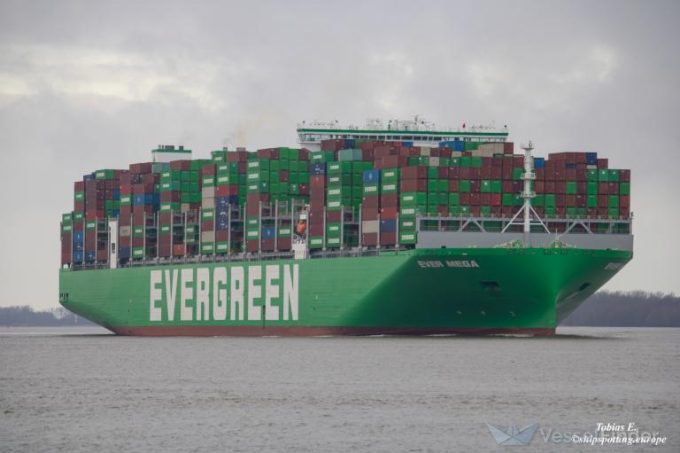
Ever Mega
Photo: VesselFinder

Fresh evidence that a freight rate war between Asia-Europe carriers has got underway emerged today after new Alphaliner analysis showed that capacity into North Europe and the Mediterranean is barely adequate to cater for demand at a time when spot rates appear to be in continuous decline.

According to the liner consultancy, the total 31 Asia-Europe services – comprising both Asia-North Europe and Asia-Mediterranean strings – would require a cumulative 461 vessels for them all to maintain a weekly schedule.

However, its research found that 425 vessels were actually deployed on these strings.

“This means that trade is currently missing 36 vessels that would be needed to guarantee ‘uninterrupted’ weekly sailings on the 31 services,” it wrote today.

In rough terms, assuming that the average capacity of an Asia-Europe vessel is 14,00 teu, this equates to around 500,000 teu of slot capacity that is effectively missing from the market.

Normal liner economics would suggest that strong demand combined with tight capacity should push prices up.

According to the most recent data from Container Trades Statistics, shipments in July from the Far East to Europe were up 9% year-on-year, “which is quite phenomenal really,” CTS chief executive Nigel Pusey told this week’s Loadstar Podcast, “because we don’t see that in GDP in Europe at the moment, and we’ve got all the challenges of going around Africa and not going through Suez.”

But pricing as per the CTS price index, which measures both spot and contract rates paid, declined considerably during the same period.

“This time last year the Far East-Europe freight rate index was 181, and it’s at 96 now – almost half the freight rate,” Mr Pusey added.

Alphaliner argued the decline in rates, which has been particularly steep in recent weeks, was evidence of fiercely competitive carrier pricing strategies.

“Despite the fact that the Red Sea crisis remains far from resolved, and that there is a continuous lack of tonnage, this effect on freight rates has completely evaporated,” it noted.

“Spot rates from Shanghai to North Europe have declined 45% over the past 10 weeks, with double digit decreases in the last three weeks.

“This clearly hints at a rate war between some of the major operators,” it adds.

However, Verspucci Maritime chief executive Lars Jensen said on this week’s NYSHEX podcast that there appeared to be room for the market to further decline.

“Quoted spot rates on the SCFI into Northern Europe are now marginally below the low point in Spring, which was the slack season after Chinese New Year, which also means we are only a few hundred dollars above the low point we saw in December 2023, just before the Red Sea Crisis.

“But it is not quite true that we are completely back to pre-crisis levels, because if we remember back to 2023, Asia-Europe spot rates actually bottomed out somewhere in October 2023 and by the time we came to December they had actually grown 50% because carriers were already in the process of pushing through rate increases just prior to the Red Sea crisis emerging.

“So of course now is a lot weaker than what we have been used to over the last year and a half, but it’s not – at least at this point – a market where the bottom has completely dropped out,” Mr Jensen explained.

The capacity gap from fully staffed Asia-Europe services also varies depending on the grouping, with the Ocean Alliance the most exposed, while the Premier Alliance and Gemini Cooperation have little issue offering weekly sailings.

Asia-Europe trade

Source: Alphaliner

And the analyst said that shippers using the Ocean Alliance’s Asia-North Europe NEU7 string, which is operated by Evergreen vessels, are the worst affected.

“Ocean Alliance faces the biggest challenge to procure tonnage and its Evergreen-operated Far East-North Europe NEU7 is the worst hit.

“The service would need 14 ships to maintain weekly sailings, but it currently has a fleet of only eight vessels, including four recent ‘Ever M-class’ newbuildings of 15,372 teu,” it noted.

Listen to Nigel Pusey from Container Trades Statistics offer his thoughts on European demand

Comment on this article


You must be logged in to post a comment.