FedEx Life Sciences launches to 'meet the demands of next-gen healthcare'
FedEx today launched a dedicated life sciences division, as the pharmaceutical industry moves towards increasingly ...

WTC: 'ONE RECORD'HLAG: EARNINGS GUIDANCE UPGRADE AAPL: GLOBAL SMARTPHONE SHIPMENTS VW: THE IMPACT VW: MASSIVE JOB CUTS CONFIRMEDEXPD: BULLISHCHRW: POSITIONING AHEAD OF EARNINGSAMZN: IN THE NUMBERSAMZN: PEOPLE MATTER UNTILVW: THE LAST CUT IS THE DEEPESTJBHT: GEARING UP VW: BUYING TIMER: BIG VOTE OF CONFIDENCEAAPL: BEARISH HEDGEYE
WTC: 'ONE RECORD'HLAG: EARNINGS GUIDANCE UPGRADE AAPL: GLOBAL SMARTPHONE SHIPMENTS VW: THE IMPACT VW: MASSIVE JOB CUTS CONFIRMEDEXPD: BULLISHCHRW: POSITIONING AHEAD OF EARNINGSAMZN: IN THE NUMBERSAMZN: PEOPLE MATTER UNTILVW: THE LAST CUT IS THE DEEPESTJBHT: GEARING UP VW: BUYING TIMER: BIG VOTE OF CONFIDENCEAAPL: BEARISH HEDGEYE
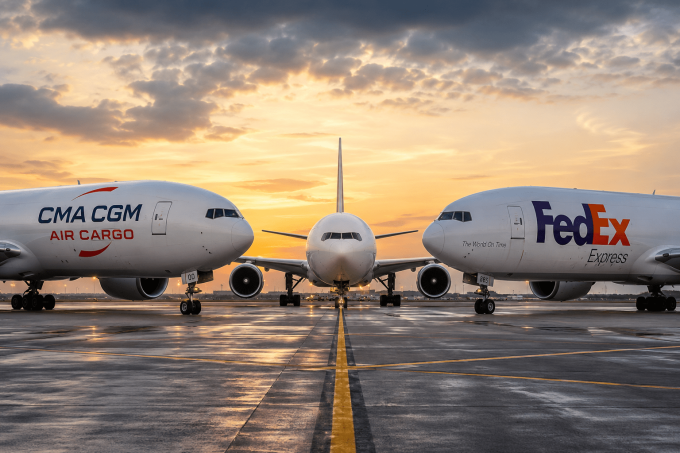
When CMA CGM announced its $1.4bn acquisition of FedEx Supply Chain, most attention focused on the contract logistics business changing hands.
But tucked into the announcement was another important detail: the two companies also expect to enter commercial agreements covering “select air cargo capacity solutions”.
However, neither company has so far explained what that means.
Asked for more detail, FedEx told The Loadstar: “As the PR noted, the companies expect to enter into ocean and air commercial agreements to support our respective strategies.
“At FedEx, we regularly enter into commercial agreements with third parties to support our global network. We have no further information to share at this time.”
CMA CGM did not respond.
In FedEx’s carefully worded answer, the reference to third-party commercial agreements may offer a clue to how the proposed cooperation could work.
An industry source told The Loadstar that FedEx was already a significant buyer of capacity from scheduled airlines, particularly where direct passenger services offered a cheaper and lower-risk alternative to deploying its own aircraft.
A shipment sold to a customer as a FedEx service might, for example, travel between London and New York in the belly of a British Airways or Delta passenger aircraft, with FedEx controlling collection, handling, and delivery at either end.
The customer buys FedEx’s network and service commitment, but does not necessarily know – or even need to know – who operated the flight.
The source said scheduled airlines could offer capacity at extremely low rates, while FedEx could sell the resulting end-to-end movement at express prices. That model gives the integrator access to direct services without assuming the cost and utilisation risk of operating an additional aircraft.
This is hardly a new practice. Integrators have long supplemented their own fleets with block-space agreements, charters, interline arrangements, and capacity purchased from passenger and cargo airlines. But FedEx appears to be giving third-party flying a more prominent role in its wider air freight strategy.
The company last month signed an agreement with China Southern Air Logistics to explore cooperation covering cargo capacity, route networks, fleet resources, operations, and digitalisation. FedEx has also identified international air freight as an area for growth, while indicating that third-party providers could carry less urgent traffic as its own aircraft focus on higher-priority shipments.
The strategy makes the CMA CGM agreement more interesting.
The cooperation may prove to be a relatively conventional arrangement involving space on FedEx-operated flights. But FedEx’s response leaves open the possibility that it could draw on the integrator’s wider network of commercial airline relationships and the procurement of third-party capacity.
Were Ceva Logistics to gain access to that broader pool of lift, the arrangement could be significantly more valuable than a simple agreement to buy space on FedEx freighters.
It would also complement Ceva’s existing forwarding business and CMA CGM Air Cargo’s dedicated fleet (of five 777Fs and one A330F) without requiring CMA CGM to own or operate every aircraft needed to support customers – at a time when the future freighter market is in short supply.
Atlas Air chief commercial officer Richard Broekman recently said the carrier would add no aircraft to its fleet this year because suitable capacity was simply unavailable.
“This year is the first in many, many years that we are not adding aircraft to our fleet, and that’s really just a function of no availability out there,” he said.
Atlas itself has agreed to acquire a 49% stake in Air Atlanta, giving it strategic access to the Icelandic operator’s fleet of 14 widebody freighters, and described the deal as part of its growth strategy in a “structurally constrained widebody freighter aircraft market”.
However, rather than acquiring an entire airline or waiting years for new freighters, companies can seek to control capacity through commercial agreements, purchasing relationships, and network partnerships.
That raises questions for scheduled airlines too. The source argued that airlines’ growing reliance on digital booking platforms and bidding systems risked eroding yields, while leaving freight forwarders and integrators in control of the customer relationship and distribution channel.
If an integrator can buy direct belly capacity cheaply, combine it with collection and delivery, and sell the resulting product at an express premium, it is capturing much of the commercial value from the aircraft’s owner.
In a market where owning more aircraft is increasingly challenging, the competitive advantage may lie in controlling access to the widest possible capacity pool – whether you charge express rates for it, or not.
For uninterrupted access, sign in or sign up to The Daily News, Premium or The Loadstar Enterprise Plan.
Comment on this article