Battle for freighter capacity intensifies as airlines reshape networks
A cluster of shocks is forcing freighter operators to finely balance their global capacity – ...


VW: D-DAYPLD: KEEP PUSHINGDHL: NEW AIR SERVICEDHL: GUIDANCE UPGRADE REACTIONDHL: NEW HIGH TARGET ON THE STREET DSV: EXPECTATIONS RUN HIGH KNIN: DHL GUIDANCE UPGRADE READ-ACROSSKNIN: NEW OPENINGGM: TECH UPSIDEAMZN: BIG DEBT FUNDING ON ITS WAYDHL: 'STELLAR EXPRESS'DHL: UPDATEDHL: STRONG PRELIMINARY UPDATE CHRW: STILL VERY BEARISH
VW: D-DAYPLD: KEEP PUSHINGDHL: NEW AIR SERVICEDHL: GUIDANCE UPGRADE REACTIONDHL: NEW HIGH TARGET ON THE STREET DSV: EXPECTATIONS RUN HIGH KNIN: DHL GUIDANCE UPGRADE READ-ACROSSKNIN: NEW OPENINGGM: TECH UPSIDEAMZN: BIG DEBT FUNDING ON ITS WAYDHL: 'STELLAR EXPRESS'DHL: UPDATEDHL: STRONG PRELIMINARY UPDATE CHRW: STILL VERY BEARISH
Air cargo rates are continuing to climb sharply as disruption in the Middle East intensifies, with capacity constraints, fuel shocks and network shifts combining to reshape global supply chains.
Latest data from WorldACD shows global airfreight rates rose another 10% week-on-week in mid-March, following an 8% increase the previous week, while figures from TAC Index show a further 6.2% rise, underlining the scale and consistency of the upward pressure.
The surge is being driven by a collapse in capacity across the Gulf, traditionally a critical global transit hub, alongside surging fuel costs and mounting operational disruption.
Although volumes from the Middle East & South Asia (MESA) region rebounded by 30% week-on-week, they remain significantly below pre-conflict levels, with Gulf-origin tonnages still around 50% down, said WorldACD. Capacity in the region had fallen by as much as 50% at the height of the disruption and has only partially returned.
The impact is being felt across global markets. TAC Index data shows rates rising sharply from key Asian origins including Shanghai, Hong Kong, Seoul and Bangkok, while outbound pricing from Europe has also surged, with London Heathrow rates still more than 40% higher year-on-year.
Operationally, forwarders are reporting a tightening market. India’s Ligi Logistics said capacity has “tightened further” across India, Bangladesh and Southeast Asia, with several Middle East carriers suspending services and others operating “limited and controlled capacity”. It added that airlines are prioritising contract cargo, issuing short-validity quotes and requiring bookings up to 7–10 days in advance.
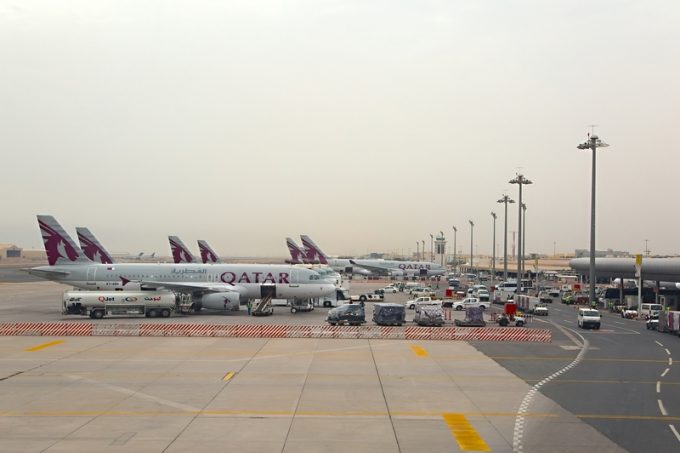
At the same time, airlines are actively removing capacity from the system. Qatar Airways has parked around 20 aircraft in Spain as flying from Doha remains heavily restricted, while Cathay Pacific has cancelled services to Dubai and Riyadh until the end of May.
Instead, capacity is being redeployed onto stronger lanes. Cathay said it was adding flights to Paris, Zurich and London in response to a “surge in market demand to Europe”, reflecting a broader shift in traffic flows away from the Gulf.
Analysts say the disruption could have a severe impact on full-year demand. “We had expected around 5.5% air cargo capacity growth globally this year, but if the war continues for the remainder of the year, full-year global capacity could turn negative – roughly 2% or more. That’s a difference of 7% points.” said Marco Bloemen, founder and MD of Aevean.
He warned that even a short disruption would have lasting effects: “If the war ends next week, global full year growth will still be about one percentage point below expectations. If it continues for a few months, the market will show only moderate gains for the full year.”
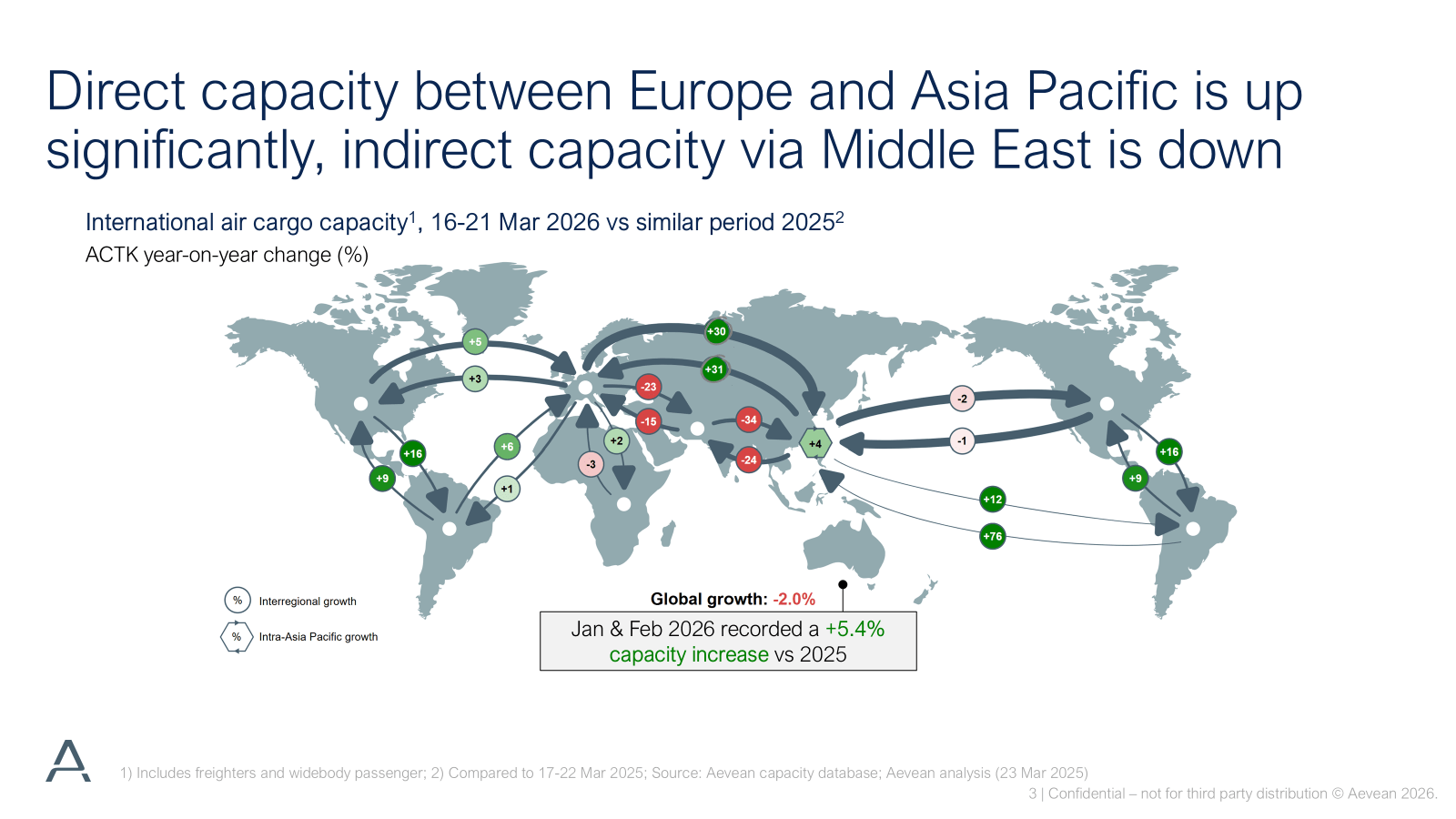
Aevean also pointed to data showing capacity shifts, with alternative transit points emerging as airlines and forwarders work around the loss of Gulf connectivity. According to Aevean, there has been an increase in the use of Turkey and Central Asia as technical stop locations, as carriers bypass traditional Middle East hubs.
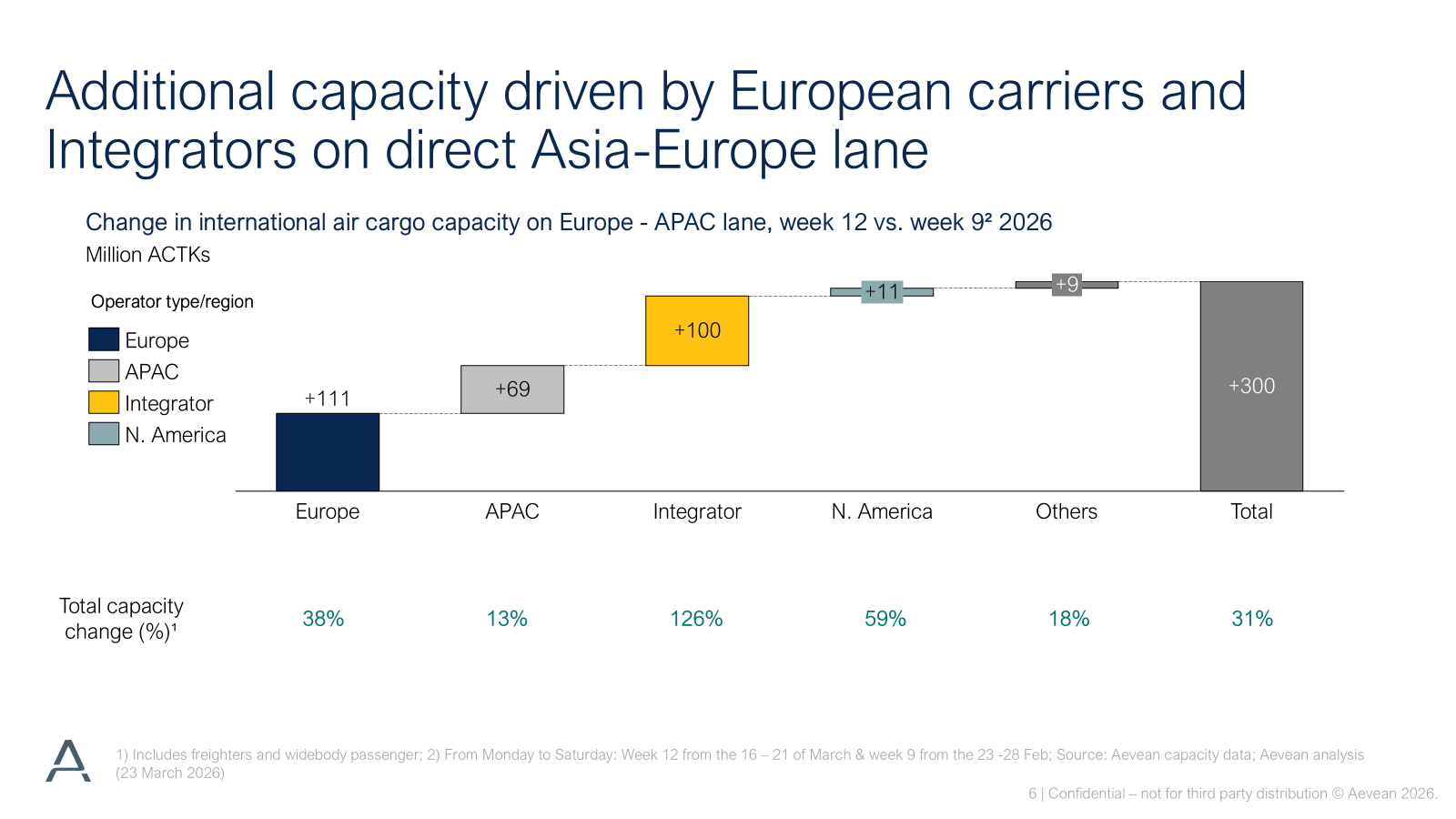
Mr Bloemen added: “Flows to and from the Gulf are declining at double-digit rates, but we’re seeing strong double-digit growth in direct Asia-Europe flights,” noting that the growth on the lane is being driven primarily by integrators and European carriers, rather than Asian airlines.
However, at least one Chinese carrier is beginning to expand its presence on Europe routes, with China Eastern Airlines planning to launch a new Shanghai-Zurich service in June, reflecting a changing competitive landscape shaped by Middle East disruption and the continued closure of Russian airspace to European airlines.
Fuel costs are compounding the pressure. Lufthansa Cargo said “jet fuel markets remain under exceptional pressure”, citing supply disruptions that “cannot be fully offset elsewhere”, as it increased its surcharge for UK customers from £0.95 to £1.17 per kilo. Singapore Airlines Cargo has also announced fuel surcharge increases of up to CNY15 per kilo on long-haul shipments from mainland China.
The disruption is also spreading beyond airfreight. Forwarder Hellmann said sea-air services via Dubai have been “temporarily interrupted” due to the closure of the Strait of Hormuz, with alternative routings via ports such as Khor Fakkan, Fujairah, Sohar and Salalah offering only limited capacity.
Despite some recovery in volumes following the Lunar New Year slowdown, the market remains highly unstable. Backlogs are building as cargo delayed during the initial collapse returns to a system still operating well below normal capacity.
For now, the outlook remains one of sustained pressure, with constrained capacity, rising costs and shifting networks keeping rates elevated and supply chains under strain.

For uninterrupted access, sign in or sign up to The Daily News, Premium or The Loadstar Enterprise Plan.
Comment on this article