Container shipping reliability slips as port congestion takes its toll
The recovery in global container shipping schedule reliability lost momentum last month, although there was ...


PG: STEADYEXPD: NEW RECORD BA: DELIVERIESMAERSK: BEAR CAMP MUSINGSCHRW: HIGHER HIGHS ON THE RADARWTC: 'ONE RECORD'HLAG: EARNINGS GUIDANCE UPGRADE AAPL: GLOBAL SMARTPHONE SHIPMENTS VW: THE IMPACT VW: MASSIVE JOB CUTS CONFIRMEDEXPD: BULLISHCHRW: POSITIONING AHEAD OF EARNINGSAMZN: IN THE NUMBERSAMZN: PEOPLE MATTER UNTIL
PG: STEADYEXPD: NEW RECORD BA: DELIVERIESMAERSK: BEAR CAMP MUSINGSCHRW: HIGHER HIGHS ON THE RADARWTC: 'ONE RECORD'HLAG: EARNINGS GUIDANCE UPGRADE AAPL: GLOBAL SMARTPHONE SHIPMENTS VW: THE IMPACT VW: MASSIVE JOB CUTS CONFIRMEDEXPD: BULLISHCHRW: POSITIONING AHEAD OF EARNINGSAMZN: IN THE NUMBERSAMZN: PEOPLE MATTER UNTIL

Shippers have been warned to prepare for last-minute capacity reductions ahead of October’s Chinese Golden Week holiday, with a subsequent “significant risk to rate stability”.
Market analyst Sea-Intelligence found that transpacific and Asia-Europe scheduled vessel capacity for the 1 to 7 October period is higher than in recent years, with the number of announced blanked sailings “falling short” of historical benchmarks.
But with just five weeks until the annual Chinese holiday begins, shipping lines still have time to make further schedule adjustments.
“As we have seen in recent years, as well as with Chinese New Year, shipping lines during periods of market uncertainty have resorted to last-minute capacity reductions. Current indications point to a similar trend for this year,” said the analyst.
During the first week of October, and the three weeks following, when the downfall in inland volumes reaches ports, capacity on the Asia-North Europe trade is set to be 1.43m teu, 8% up on last year and up 26% compared with the average deployment in 2017-2019.
Just 3.8% of capacity on this trade has been reduced across the four-week period, compared with 15.4% taken out in 2024, and “considerably lower” than the 9.3% average capacity reduction of 2017-2019.
Sea-Intelligence urged that if shipping lines were to match last year’s capacity reductions, an additional 21 sailings would need to be blanked, and to match the average 2017-2019 reductions, an additional 10.
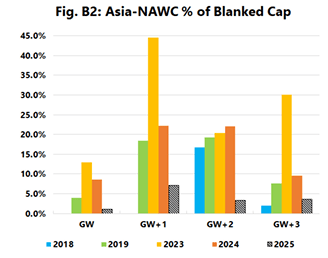
Source: Sea-Intelligence
On the Asia-North America east coast trade, the 926,000 teu currently scheduled across the Golden Week period, up 17% from 2024, would need to be reduced by seven sailings to match last year’s capacity.
And Sea-Intelligence found that on Asia-North Europe, planned capacity was 20% higher than last year, and 10 sailings would need to be blanked to match last year’s Golden Week schedule.
There is a mere 2.7% planned reduction in capacity across the four weeks this year for this trade, lower than both the 14.8% removed in 2024 and the average 14.3% from 2017-2019.
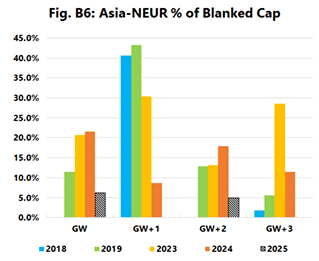
Source: Sea-Intelligence
Alan Murphy, CEO of Sea-Intelligence, said: “Given the current market conditions and the recent tendency for shipping lines to announce capacity reductions closer to the date of departure during periods of market uncertainty, it is highly likely that more blank sailings will be announced for the 2025 Golden Week period.
“Shippers should anticipate these last-minute capacity reductions and plan accordingly,” he advised.
Keith Gaskin, MD and founder of BCO network ShiftX, told The Loadstar one way to mitigate risk was through multiple contracts across carriers.
“We have a blended contract approach, and our members have access to contracts across six carriers, which covers all of the global alliances.
“You may not want to ship everything with one carrier or alliance because there can be blank sailings. If you just went to one carrier, you just have access to their services, and if they have a blank sailing, you could risk suffering delays,” he said.
Although blanked sailings do not contribute to a carrier or alliance’s schedule reliability score, The Loadstar recently reported that carriers had refused to enforce capacity discipline, despite ten consecutive weeks of rate slides.
For uninterrupted access, sign in or sign up to The Daily News, Premium or The Loadstar Enterprise Plan.

Comment on this article