Clear-up after toxic gas leak sees some Antwerp quays reopen
Antwerp’s Deurganckdok port area partially reopened today after an emergency services clean-up following Tuesday night’s ...


JBHT: NEW HIGHS EVERYWHEREPLD: STRONG DELIVERYJBHT: FAIR-VALUE CONSENSUS ESTIMATE AT ALL-TIME HIGH KNIN: AI TECH ADVANTAGEPLD: TRADING UPDATE ON THE WAY KNIN: UPSIDEJBHT: STRONG TRADING UPDATE DSV: EVERY LITTLE HELPSJBHT: CEO REMARKS WMT: VERTICAL INTEGRATION IN LOGISTICS
JBHT: NEW HIGHS EVERYWHEREPLD: STRONG DELIVERYJBHT: FAIR-VALUE CONSENSUS ESTIMATE AT ALL-TIME HIGH KNIN: AI TECH ADVANTAGEPLD: TRADING UPDATE ON THE WAY KNIN: UPSIDEJBHT: STRONG TRADING UPDATE DSV: EVERY LITTLE HELPSJBHT: CEO REMARKS WMT: VERTICAL INTEGRATION IN LOGISTICS
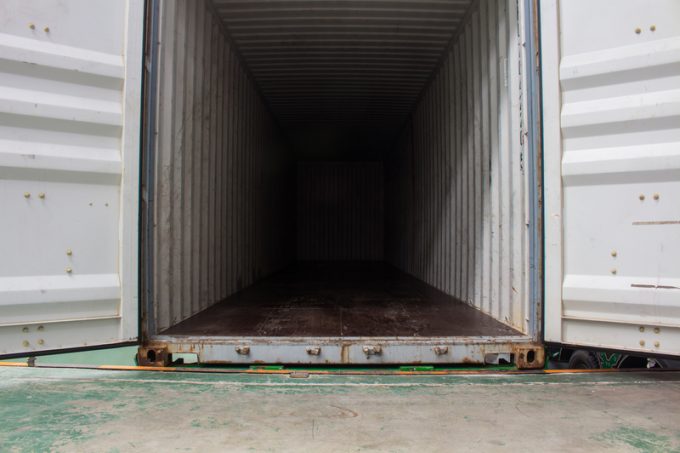
Global container trade imbalances have worsened significantly, driving up both operational costs and the carbon footprint of shipments, according to new analysis from Sea-Intelligence based on Container Trade Statistics (CTS) data.
Using a 12-month rolling average to smooth seasonal volatility, the consultancy found that empty containers requiring repositioning have surged by 50% over the past seven years, from 3m teu per month to 4.5m teu.
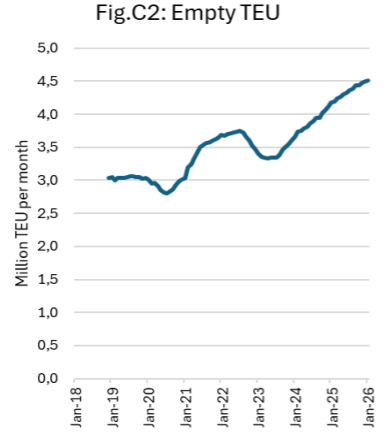
Graph: Sea-Intelligence
However, Sea-Intelligence stressed that “the absolute number needs to be seen in the context of the amount of full teu being shipped”. When measured as a share of loaded volumes, empty containers have risen from around 22% pre-pandemic to 28% by January 2026.
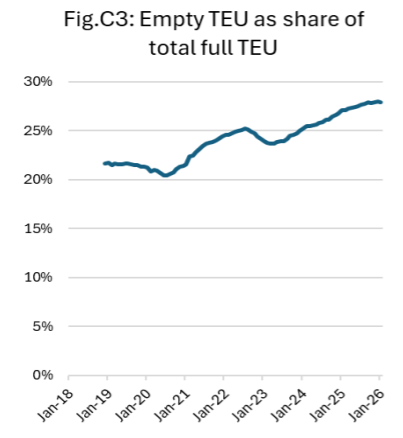
Graph: Sea-Intelligence
The imbalance becomes even more pronounced when factoring in distance. Measured in teu-miles, empty container movements increased from 32% of full teu-miles pre-pandemic to 42% in January 2026. Sea-Intelligence also modelled a Suez-normal scenario and found that “for all practical intents and purposes, there is now no real distortion from the Red Sea crisis”.
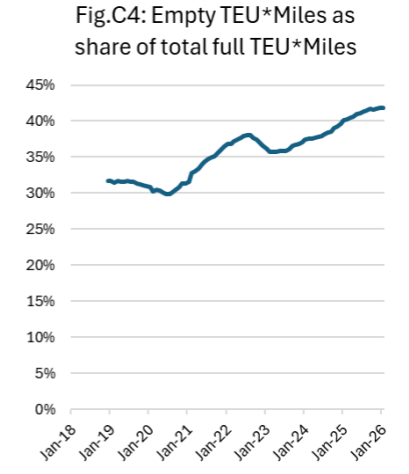
Graph: Sea-Intelligence
And the growing imbalance has direct financial and environmental consequences.
“An increased trade imbalance means head-haul cargo needs to cover a proportionally larger part of the cost,” the analyst noted, adding that it also increases the emissions burden of loaded cargo. It calculated that the “footprint” of a loaded teu-mile has risen by 8% compared with 2019, purely due to imbalances, and warned that shippers are effectively facing higher costs and emissions even before other factors are considered.
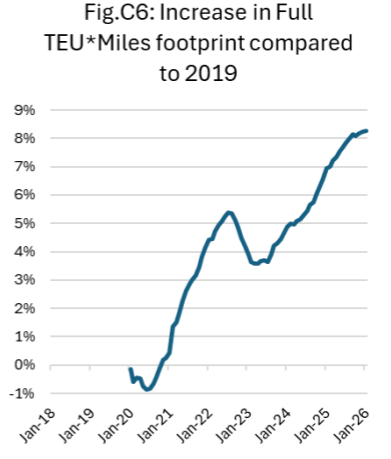
Graph: Sea-Intelligence
The rapid growth of trade imbalances, it concluded, also means that for every 10 full containers, there are more than 4 empties in need of repatriation globally, and this is creating operational issues for carriers and ports.
The port of Rotterdam’s director of containers, Hanna Stelzel, told The Loadstar that this trade imbalance, especially on Asia-Europe trades, creates operational issues in terms of empty container repositioning at the ports.
“We do see that there’s a growing number of empty containers that’s being repositioned and empty repositioning is not a good sign for the economy, and the handling of more empty containers in the system and between different terminals is an operational challenge,” she said.
According to Ms Stelzel, Rotterdam has taken “logistical and infrastructural” initiatives to support this.
“The actual infrastructural connection between different terminals is a relevant one. This is why we had built a container exchange route to have like an extra line that services all the deep-sea container terminals. We have built it, we will add the last two deep sea container terminals. That can be helpful especially in times of empty repositioning.”
She also noted logistical improvements such as the usage of night-time hours, how barges can play a better role, and how can the existing capacity be used at a larger scale is something Rotterdam is focused on “to keep the system running and reliable”.
Meanwhile, the empty container challenge is proving to be a major knock-on effect of the Hormuz crisis.
Ocean carrier Maersk advised it was implementing temporary empty-container return arrangements effective immediately and until further notice due to impacted navigation and port operations in and around the Strait of Hormuz.
It detailed that for existing and new import shipments into the UAE, Qatar, Saudi Arabia (Jubail), Iraq and Oman (Duqm), empty containers will not be accepted at their usual return locations.
Instead, empties should be returned only to designated depots including Salalah & Sohar in Oman and Jeddah in Saudi Arabia.
The carrier also advised there would be “limited acceptance” at surrounding depots, subject to a drop off charge (DRP) and their “empty acceptance” status.
These include Abu Dhabi, accepted only with a DRP of $600 per teu, Bahrain at $3000 per container, Kuwait is accepting empties with DRP $2500 per container, and Dammam and Jubail depots in Saudi Arabia at $2200 per teu applied.
Watch our recent episode of News in Brief to catch up with the latest supply-chain news, and subscribe so you never miss an update!
For uninterrupted access, sign in or sign up to The Daily News, Premium or The Loadstar Enterprise Plan.

Comment on this article