Poland starts to make its presence felt as an ecommerce gateway
Poland’s rapid emergence as one of Europe’s largest logistics hubs is cementing its position as a key ...


DHL: NEW HIGH TARGET ON THE STREET DSV: EXPECTATIONS RUN HIGH KNIN: DHL GUIDANCE UPGRADE READ-ACROSSKNIN: NEW OPENINGGM: TECH UPSIDEAMZN: BIG DEBT FUNDING ON ITS WAYDHL: 'STELLAR EXPRESS'DHL: UPDATEDHL: STRONG PRELIMINARY UPDATE CHRW: STILL VERY BEARISH PLD: 'MOST PREFERRED'ZIM: DEAL OR NO DEALWTC: MOMENTUMDAC: PAYOUTMAERSK: RETURN TO SUEZ
DHL: NEW HIGH TARGET ON THE STREET DSV: EXPECTATIONS RUN HIGH KNIN: DHL GUIDANCE UPGRADE READ-ACROSSKNIN: NEW OPENINGGM: TECH UPSIDEAMZN: BIG DEBT FUNDING ON ITS WAYDHL: 'STELLAR EXPRESS'DHL: UPDATEDHL: STRONG PRELIMINARY UPDATE CHRW: STILL VERY BEARISH PLD: 'MOST PREFERRED'ZIM: DEAL OR NO DEALWTC: MOMENTUMDAC: PAYOUTMAERSK: RETURN TO SUEZ
Airfreight rates out of China to Europe have soared, between 30% and 50%, according to one Chinese forwarder.
Rates quoted today for Air China and China Cargo Airlines from China to Amsterdam, for example, have gone up, from $2.2per kg for 1,000kg+ on 10 September, to $3.15 today, a 43% rise in two weeks. To Charles de Gaulle, rates in the same weight category have soared 49%, to $2.89/kg.
Rates tend to rise before China’s Golden Week holiday, which starts on Wednesday, with factories expected to close on Tuesday.
Airfreight has also been hit by Super Typhoon Ragasa, which resulted in hundreds of flight cancellations this week, and while China-Europe rail has been disrupted, airfreight space is expected to be tight.
But will these rates last, or is it simply a Golden Week/typhoon/rail disruption holy trinity causing the filip?
The impact of the typhoon is in the data: global freighter capacity over the past 72 hours, compared with a week earlier, was down 8%, with a 12% drop on the transpacific eastbound, down 8% to Europe and 19% down to the Middle East. It hasn’t fully ramped up yet, with the past 24 hours (over a week ago) still down 1% globally, and 4% to the Middle East, although transpacific eastbound is up 2%, and to-Europe capacity is up 3%.
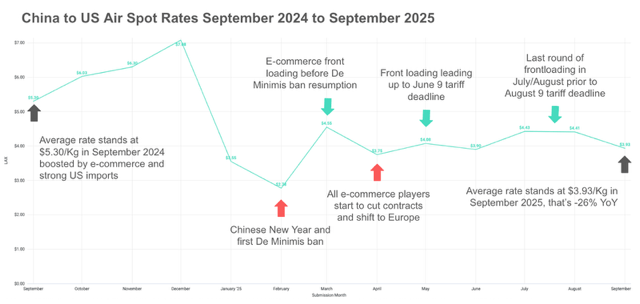
“The expectation is that there will be a short, muted – with limited rate hike – peak of one month, from 15 October to Thanksgiving (27 November) to the US, and 1 November to 10 December for Europe,” said a spokesperson for Flexport.
Source: Flexport
“The decrease in de minimis effectively took 5% of global demand out of the market. But there are demand events that will still drive a peak: ecommerce from Asia to Europe is still growing and taking capacity; the Apple launch; and other seasonal product launches.
“And there are unexpected events that will still drive a peak and add to congestion in Asia,” Flexport added, citing the typhoon in Hong Kong, and the China-Europe rail disruption after Poland closed its border. Dimerco noted the “soaring demand for AI hardware” as a driver for airfreight growth.
The increase in ecommerce to Europe has changed trade flows, noted Trade & Transport Group this week. Pointing to lower growth at major airports in Europe, founder Frederic Horst explained: “The shift away from the major hubs has been a result of a change in traffic mix – away from general cargo to more cross border ecommerce.
“Belgium, Hungary and some other eastern European countries have positioned themselves as business-friendly entry points for this type of traffic, most of which moves on freighters. Growth in cross-border ecommerce traffic from China into Europe has been particularly strong in the first eight months of this year.”
He added: “But the shift appears to have also impacted some of the flows of general cargo. Overall EU trade by air in traditional consolidator type freight is also up by about 6% so far this year, with air trade to and from the Americas and Middle East/South Asia even up by 9% and 12%, respectively.
“China to EU air exports are up 9% – while other Asian origins appear to be weaker. Traffic data indicate that these volumes are also bypassing traditional volumes.”
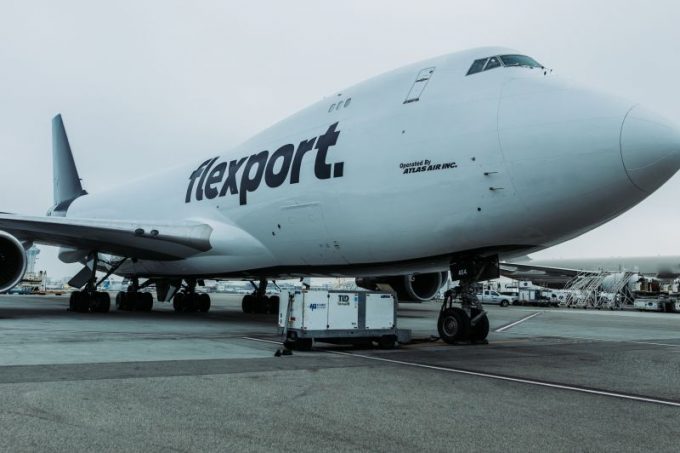
In capacity news, Magma Aviation said this week it had received another 747F, which appears to be operated by Atlas Air. Flexport, meanwhile, which has capacity on three Atlas Air 747s, saw one aircraft taken out of service in August and is now in Taipei.
Flexport explained: “The aircraft was taken out of our regular schedule on 8 August due to an AOG incident on the plane. When this happens, Atlas provides us with a replacement to keep flying our operations, so our schedule has not been affected and we fly our regular routes.”
The forwarder is holding a webinar next week on how to limit the use of airfreight, but insisted this drive was not capacity related.
“Airfreight won’t go away – we will continue to serve those customers. However, we’re always looking for ways to save customers money and optimise their mix,” said a spokesperson.
Listen to this clip of Michael Douglas, customs technology consultant at ALS, on the benefits of AI in customs processes
This article is © The Loadstar. Reproduction, rewriting, or derivative use requires a license. Contact [email protected] for licensing enquiries.

For uninterrupted access, sign in or sign up to The Daily News, Premium or The Loadstar Enterprise Plan.
Comment on this article