Container rate rally has more legs than bears assume
Precision needed on what drives box rates


WMT: VERTICAL INTEGRATION IN LOGISTICSJBHT: HERE WE GOPG: STEADYEXPD: NEW RECORD BA: DELIVERIESMAERSK: BEAR CAMP MUSINGSCHRW: HIGHER HIGHS ON THE RADARWTC: 'ONE RECORD'HLAG: EARNINGS GUIDANCE UPGRADE AAPL: GLOBAL SMARTPHONE SHIPMENTS VW: THE IMPACT VW: MASSIVE JOB CUTS CONFIRMEDEXPD: BULLISH
WMT: VERTICAL INTEGRATION IN LOGISTICSJBHT: HERE WE GOPG: STEADYEXPD: NEW RECORD BA: DELIVERIESMAERSK: BEAR CAMP MUSINGSCHRW: HIGHER HIGHS ON THE RADARWTC: 'ONE RECORD'HLAG: EARNINGS GUIDANCE UPGRADE AAPL: GLOBAL SMARTPHONE SHIPMENTS VW: THE IMPACT VW: MASSIVE JOB CUTS CONFIRMEDEXPD: BULLISH
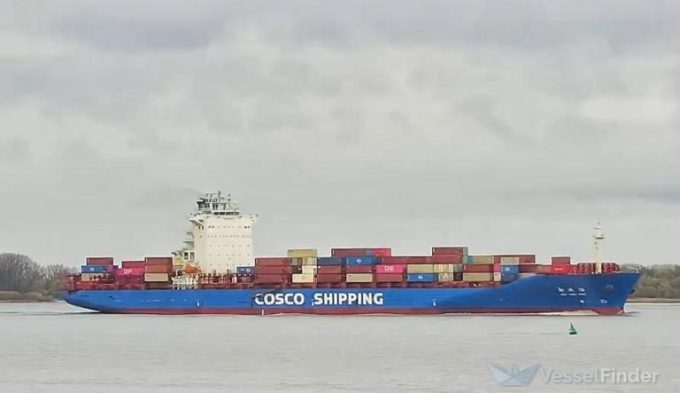
Cosco Shipping is adding yet another Asian connection to its already-expansive Indian network as the Chinese carrier searches for more regional trade growth opportunities amid increasingly volatile demand conditions.
From early next month, Cosco will begin calls out of Nhava Sheva port (JNPA) in West India on an independent string linking Malayasia, Singapore and Indonesia.
The SE1 service will have a port rotation of Nhava Sheva-Port Klang-Singapore-Surabaya-Jakarta-Nhava Sheva.
It will initially deploy three mid-size containerships, beginning with the departure of the 4,250-teu Xin Tai Cang on 8 October, according to JNPT port sources. Estimated transit times are: seven days to Port Klang, 10 days to Surabaya and 13 days to Jakarta.
“The service will target both dry and reefer cargo,” onae Cosco India source told The Loadstar. “We have already picked up a good number of export bookings for the first call.”
Trade between India and Indonesia by value stood at some $28bn in fiscal year 2024-25, and both sides have pledged to expand bilateral trade volumes to $50bn soon.
According to industry sources, Cosco is scouting for a vessel-sharing partner to enhance the service to a fixed-day weekly rotation. It reportedly failed to strike a service agreement with CMA CGM, its Ocean Alliance partner, despite having a number of existing joint service arrangements.
According to the Xeneta-owned eeSea Liner database, the CMA charters slots on Cosco’s Far East-India/Middle East CI1 service and on Cosco-subsidiary OOCL’s Far East-India/Middle East CIX3 service;
Cosco and OOCL load on CMA CGM’s India-US east coast Indamex service through slot charter arrangements, and it has become a vessel provider on the French carrier’s India/Middle East-Europe EPIC service, following the departures of Hapag-Lloyd and ONE from the VSA last year.
Both carriers are also vessel providers on the joint Middle East/India-Europe Medex service that continues to route via the Suez Canal.
Cosco is already the dominant Asian carrier covering Indian trades, followed by Wan Hai , PIL, RCL, and TS Lines, which participate in jointly operated Far East-India/Middle East services.
However, challenging the traditional Asian trade leaders, a new crop of cargo-hungry regional carriers – including SeaLead, CULines, Sinotrans (Sinolines) and SITC – has opened multiple services out of Indian ports along the east and west coasts, injecting significant weekly capacity into the market.
Additionally, Chinese newcomers CULines and Sinotrans have signalled expansion plans to cement Indian operations in anticipation of sustained trade growth.
“As a major global economy, India holds immense market potential,” Shanghai-based CULines recently said, while inaugurating a subsidiary entity in India.
“CULines will continue to invest resources to optimise its route network … injecting vitality into regional shipping development,” it added.
Similarly, Sinotrans is considering adding new port pairs in South-east Asia, Africa and the Persian Gulf to its Indian coverage.
The latest volume data from Container Trades Statistics (CTS) shows varying fortunes for the Far East-Middle East/India trades, with strong eastbound growth tempered by erratic volumes ex-India.

Source: Container Trades Statistics
For the first seven months of the year, Far East-Middle East/India volumes were 6.2m teu, up 33% year on year, while on the backhaul leg, the trade amounted to 1.7m teu, a 5.5% year-on-year decline.
Freight rates, however, have not matched this growth in trade, and the July CTS price index for Far East-Middle East/India was 38.5% below the rate in July 2024, likely reflecting the significant increases in capacity seen this year.
You can contact the writer: [email protected]
For uninterrupted access, sign in or sign up to The Daily News, Premium or The Loadstar Enterprise Plan.

Comment on this article