Ocean spots and demand hold steady, but waves may be building
Container freight spot rates on the transpacific and Asia-Europe trades showed moderate gains this week, ...


WMT: VERTICAL INTEGRATION IN LOGISTICSJBHT: HERE WE GOPG: STEADYEXPD: NEW RECORD BA: DELIVERIESMAERSK: BEAR CAMP MUSINGSCHRW: HIGHER HIGHS ON THE RADARWTC: 'ONE RECORD'HLAG: EARNINGS GUIDANCE UPGRADE AAPL: GLOBAL SMARTPHONE SHIPMENTS VW: THE IMPACT VW: MASSIVE JOB CUTS CONFIRMEDEXPD: BULLISH
WMT: VERTICAL INTEGRATION IN LOGISTICSJBHT: HERE WE GOPG: STEADYEXPD: NEW RECORD BA: DELIVERIESMAERSK: BEAR CAMP MUSINGSCHRW: HIGHER HIGHS ON THE RADARWTC: 'ONE RECORD'HLAG: EARNINGS GUIDANCE UPGRADE AAPL: GLOBAL SMARTPHONE SHIPMENTS VW: THE IMPACT VW: MASSIVE JOB CUTS CONFIRMEDEXPD: BULLISH
Beijing has unveiled retaliatory measures in response to the US Trade Representative’s (USTR) port fees for Chinese-built vessels and Chinese carriers.
China’s state news agency, Xinhua, reported that the state council had decided to amend its regulations governing international maritime transport.
“If any country or region takes, or assists/supports taking, discriminatory prohibitions, restrictions, or other similar measures against operators, vessels, or crews engaged in the People’s Republic of China’s international maritime transport and its auxiliary services, except where relevant treaties or agreements provide full and effective remedies, the Chinese government shall, according to actual circumstances, take necessary countermeasures.
“Such measures may include, but are not limited to:
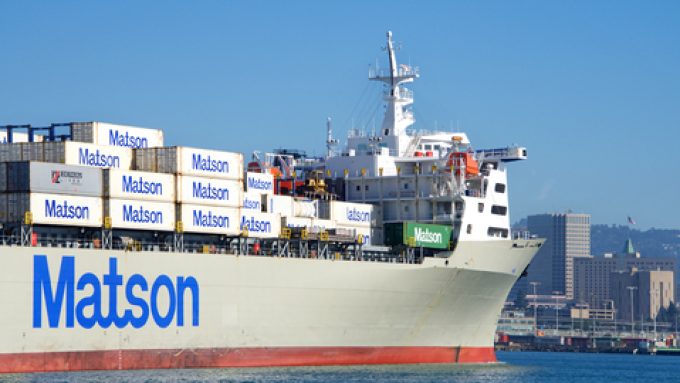
The most obviously affected carrier would be Hawaii-headquartered US shipping line Matson, which, along with Seaboard Marione, was given a clear exemption from the USTR fees.
Matson runs two transpacific services, the express MAX service on a Shanghai-Ningbo-Long Beach rotation, and the CLX service. which incorporates a Jones Act element, with a port rotation of Long Beach-Honolulu-Guam-Naha-Ningbo-Shanghai.
The CLX service deploys five US-flagged and -built vessels of between 2,300 teu and 3,600 teu, while MAX also deploys five, of between 4,200 teu and 4,860 teu, according to the Xeneta-owned eeSea liner database.
This raises a potentially interesting question of howand retaliatory measures are intended to work. Under the USTR fee structure, vessels under 4,000 teu are exempt, which in theory would mean the ships on Matson’s CLX service would not be subject to retaliation while its vessels on the MAX service would.
Meanwhile, the wording of the final regulatory change is frustratingly vague for liner network and supply chain planners, as it potentially leaves scope for US shippers and their 3PLs to be affected.
The USTR port fees are set to be introduced under its 301 legislation on 14 October, and are set to applied in response to what the US has deemed to be the Chinese government’s unfair support of its own maritime industry.
Chinese carriers – registered in China and Hong Kong, but not Taiwan – will be levied $50 per net ton for any ship calling at the US, while China-built vessels will face a $120 per teu fee.
The fees will increase over the following three years.
If you’re struggling to keep up with the constant supply chain news, listen to The Loadstar’s News in Brief for a quick and informative rundown on the latest!
For uninterrupted access, sign in or sign up to The Daily News, Premium or The Loadstar Enterprise Plan.

Comment on this article