Spot freight rates preview: the Fortnight Brace suggests a flat week
Acid test: 15 July


VW: D-DAYPLD: KEEP PUSHINGDHL: NEW AIR SERVICEDHL: GUIDANCE UPGRADE REACTIONDHL: NEW HIGH TARGET ON THE STREET DSV: EXPECTATIONS RUN HIGH KNIN: DHL GUIDANCE UPGRADE READ-ACROSSKNIN: NEW OPENINGGM: TECH UPSIDEAMZN: BIG DEBT FUNDING ON ITS WAYDHL: 'STELLAR EXPRESS'DHL: UPDATEDHL: STRONG PRELIMINARY UPDATE CHRW: STILL VERY BEARISH
VW: D-DAYPLD: KEEP PUSHINGDHL: NEW AIR SERVICEDHL: GUIDANCE UPGRADE REACTIONDHL: NEW HIGH TARGET ON THE STREET DSV: EXPECTATIONS RUN HIGH KNIN: DHL GUIDANCE UPGRADE READ-ACROSSKNIN: NEW OPENINGGM: TECH UPSIDEAMZN: BIG DEBT FUNDING ON ITS WAYDHL: 'STELLAR EXPRESS'DHL: UPDATEDHL: STRONG PRELIMINARY UPDATE CHRW: STILL VERY BEARISH
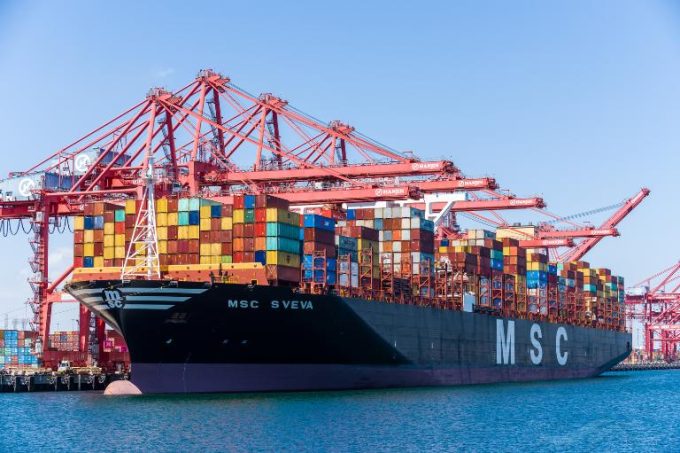
A series of container freight spot rate hikes and general rate increases implemented on 15 June prompted another week of double-digit price rises on the transpacific and Asia-Europe trades.
This week’s World Container Index (WCI) from Drewry saw the spot rate on its Shanghai-Rotterdam leg surge 15% week-on-week to finish at $4,342 per 40ft, while the Shanghai-Genoa route was up 12% to $5,756 per 40ft.
“Strong peak season demand due to frontloading of cargo ahead of the expected 1 July bunker fuel adjustment, enabled carriers to successfully implement surcharges,” Drewry noted.
However, the WCI’s current Shanghai-Rotterdam rate is well shy of the $6,000 per 40ft FAK level that MSC introduced on 15 June, although marginally closer on the Shanghai-Genoa, where its new FAK was $6,500 per 40ft.
The world’s largest container line has announced a further FAK hike on 1 July of $7,500 per 40ft to both North Europe and Mediterranean ports, which is quite aggressive compared to the $6,300 per 40ft on Asia-North Europe announced by CMA CGM, also for 1 July.
The timing of the next round of FAK hikes also suggests that the remaining weeks of this year’s peak season will be characterised by double-digit spot rate rises on a fortnightly basis, with the interim weeks either flat or seeing low single-digit rises.
Indeed, today’s Shanghai Shanghai Containerised Freight Index (SCFI) – which records rates quoted for the forthcoming week, and as such can indicate the behaviour of the following week’s WCI (as it did last week) – recorded a 2% gain on the Shanghai-North Europe leg and 3% on Shanghai-Mediterranean.
“We are expecting increases for the first half July and expect the rates to peak in July before they start to soften again – but I don’t expect them to go as high as MSC hopes for,” one European forwarder told The Loadstar today.
And while current capacity on both Asia-North Europe and Asia-Mediterranean trades is tight – according to Drewry’s Container Capacity Insight, only three blank sailings have been announced on Asia-Europe next week – there had been fears that the decision pf the Gemini partners to shift capacity from North Europe to the Mediterranean could leave Northern European shippers squeezed.
However, the forwarder added that “the shift of some capacity to the Med is welcome, but any effect on the North Europe routes, I think, will be short lived as things start to calm down”.
The closure of the Strait of Hormuz has also been a key factor, data from ocean and air freight intelligence platform Xeneta shows:

Source: Xeneta
In the past week alone, rates on its XSI platform jumped up by 29% on Far East to US west coast and 25% to the US east coast.
The WCI moved in the same direction, although more moderately – its Shanghai-Los Angeles was up 10% week-on-week to $5,142 per 40ft, and Shanghai-New York rose 15% to $6,769 per 40ft.
“Shippers are frontloading imports ahead of bunker fuel surcharge increases in July and fears over available capacity, with many being told ships are full on trades out of Asia for weeks in advance,” Xeneta chief analysts Peter Sand said.
“Shippers who manage to get their boxes on board are paying a premium to do so,” he added.
However, one interesting dynamic is that next week will see six blank sailings the transpacific, according to Drewry, “reflecting capacity management by carriers”, and could suggest lines see some demand weakness on the long-term horizon and are already acting to maintain rate levels.
“Shippers should abandon expectations for a quick rate correction – carriers have just successfully pushed rates into the $6,000–$7,000-plus range and will be highly resistant to lowering them, likely citing ongoing market uncertainty to justify keeping current fuel surcharges and base rates intact,” US west coast freight forwarder Freight Right said.
“Furthermore, because booking backlogs are already stretching lead times out significantly, with some agents quoting the beginning of July as the earliest available space, shippers must plan and book several weeks in advance to secure equipment and vessel space,” it added.
This article is © The Loadstar. Reproduction, rewriting, or derivative use requires a license. Contact [email protected] for licensing enquiries.

For uninterrupted access, sign in or sign up to The Daily News, Premium or The Loadstar Enterprise Plan.
Comment on this article