TSMC says AI demand can run to 2030 – lifting the outlook for air cargo
The AI infrastructure boom looks set to keep air cargo demand elevated for years, after ...

PLD: TRADING UPDATE ON THE WAY KNIN: UPSIDEJBHT: STRONG TRADING UPDATE DSV: EVERY LITTLE HELPSJBHT: CEO REMARKS WMT: VERTICAL INTEGRATION IN LOGISTICSJBHT: HERE WE GOPG: STEADYEXPD: NEW RECORD BA: DELIVERIESMAERSK: BEAR CAMP MUSINGS
PLD: TRADING UPDATE ON THE WAY KNIN: UPSIDEJBHT: STRONG TRADING UPDATE DSV: EVERY LITTLE HELPSJBHT: CEO REMARKS WMT: VERTICAL INTEGRATION IN LOGISTICSJBHT: HERE WE GOPG: STEADYEXPD: NEW RECORD BA: DELIVERIESMAERSK: BEAR CAMP MUSINGS
Air cargo supply chains are scrambling to reroute freight across the Middle East by road, as disrupted flight schedules and closed airspace continue to disrupt global logistics networks.
Forwarders say they are securing as much trucking capacity as possible across the region, particularly in Saudi Arabia, as shipments are redirected from disrupted Gulf hubs towards airports that remain operational.
The sudden shift has turned road transport into a critical workaround, with freight being redistributed by truck between countries and airports as airlines slowly restore their networks.
At the same time, the disruption is feeding rapidly into pricing. Freightos FAX data shows rates from southern Asia to North America have climbed 36% since 5 March, while southern Asia–Europe rates have surged 54% since 3 March, reflecting tightening capacity across several tradelanes.
With flight schedules across the Gulf reduced and airspace restrictions complicating routings, logistics companies are increasingly relying on road transport to keep cargo moving.
DHL Global Forwarding said it had been booking significant trucking capacity to reposition cargo between airports and logistics hubs. Much of that effort has focused on Saudi Arabia, where trucking companies are thought to have been better able to obtain cross-border permits and move vehicles between Gulf states than operators based in the UAE.
But moving air freight by road across borders has not proved straightforward.
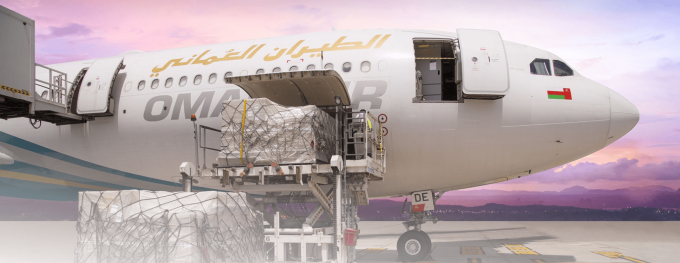
Mike Duggan, head of cargo at Oman Air, said airlines and forwarders were exploring ways to move cargo from the UAE into Oman to connect with flights from Muscat, but the process has been slowed by customs and border congestion.
“The trucking is the problem… moving cargo in bond across the border is the difficulty,” he explained, noting that border authorities are currently focused on managing passenger flows and processing customs paperwork.
Oman Air is therefore exploring whether it might introduce a short-haul freighter shuttle between Dubai and Muscat, if trucking proves too slow or complicated.
Mr Duggan added that express and perishables shipments were also flowing through Muscat, with at least one major supermarket chain exploring the possibility of flying UAE-bound perishables into Oman, as a contingency if airports in the Emirates were disrupted.
The disruption has elevated Muscat as one of the few Gulf hubs continuing to operate normally.
Oman Air has added extra flights from Muscat to cities including London, Amsterdam, Rome, Milan, Istanbul, Bangkok, Kuala Lumpur, Mumbai, and Jeddah, while also introducing an additional daily widebody flight to London Heathrow that is generating extra cargo capacity.
“We’re trying to get the message out there that Muscat is operating ‘business as usual’,” Mr Duggan said, adding that demand for cargo capacity on European routes had been particularly strong.
The airline is also looking at accelerating plans to introduce dedicated freighters earlier than originally planned, although aircraft availability remains tight.
Operational data suggests Gulf aviation is only gradually recovering after a dramatic collapse in flights in early March.
Before the disruption, Emirates was operating more than 530 flights a day and Qatar Airways close to 600, but by 1 March those numbers had plunged to just 24 Emirates flights and three by QA.
Since then, Emirates has steadily rebuilt its schedule, reaching around 280 daily flights by 8 March, while Qatar Airways remains far more limited.
The Doha-based carrier said its scheduled operations remained temporarily suspended, pending the full reopening of Qatari airspace, although limited corridors had allowed a small number of flights to operate.
Under the restricted schedule, Qatar Airways plans services to destinations including London Heathrow, Delhi, Beijing, Madrid, and Nairobi in the coming days.
Regional airspace monitoring also highlights the uneven recovery. Dubai International Airport is operating hundreds of flights daily, but under “limited” conditions, while Muscat remains fully active, and airports in Bahrain and Kuwait remain closed.
Beyond the Middle East, the disruption is also prompting some shippers to reassess their transport strategies.
Logistics providers say companies are increasingly exploring long-distance road transport between China and Europe via Central Asia, a corridor offering transit times of around 14 to 18 days – faster than sea freight, but more predictable than the disrupted air cargo networks.
While air freight remains essential for urgent shipments, the current troubles are again highlighting the importance of flexible supply chains, capable of switching between transport modes when key aviation hubs are disrupted.
Check out today’s News in Brief podcast!
For uninterrupted access, sign in or sign up to The Daily News, Premium or The Loadstar Enterprise Plan.

Comment on this article