Airbus steps up its push for the A350 freighter as first flight nears
Airbus has shed new light on the strategy behind its A350 freighter, as first flight ...

WTC: NO LUCKCHRW: 'NUCLEAR VERDICT'DSV: DEEP CUTKNIN: UPGRADEDKNIN: AI BENEFITSKNIN: NOT WORTH ITPLD: DEAL TIMEKNIN: CONF CALL CLOSING KNIN: PRICING POWER KNIN: MARKET SHARE GAINS IN ROAD KNIN: AI-RELATED COST INFLATION OUTLOOKKNIN: APEX LOGISTICS IPO UPDATEKNIN: QUESTION TIMEKNIN: 'COST REDUCTION PROGRAMME IS ON TRACK'KNIN: CFO REMARKSKNIN: MONETARY IMPACT FROM AI KNIN: AI UPSIDEKNIN: STRONG ROAD UNIT DELIVERY KNIN: AIR LOGISTICS SHINES
WTC: NO LUCKCHRW: 'NUCLEAR VERDICT'DSV: DEEP CUTKNIN: UPGRADEDKNIN: AI BENEFITSKNIN: NOT WORTH ITPLD: DEAL TIMEKNIN: CONF CALL CLOSING KNIN: PRICING POWER KNIN: MARKET SHARE GAINS IN ROAD KNIN: AI-RELATED COST INFLATION OUTLOOKKNIN: APEX LOGISTICS IPO UPDATEKNIN: QUESTION TIMEKNIN: 'COST REDUCTION PROGRAMME IS ON TRACK'KNIN: CFO REMARKSKNIN: MONETARY IMPACT FROM AI KNIN: AI UPSIDEKNIN: STRONG ROAD UNIT DELIVERY KNIN: AIR LOGISTICS SHINES
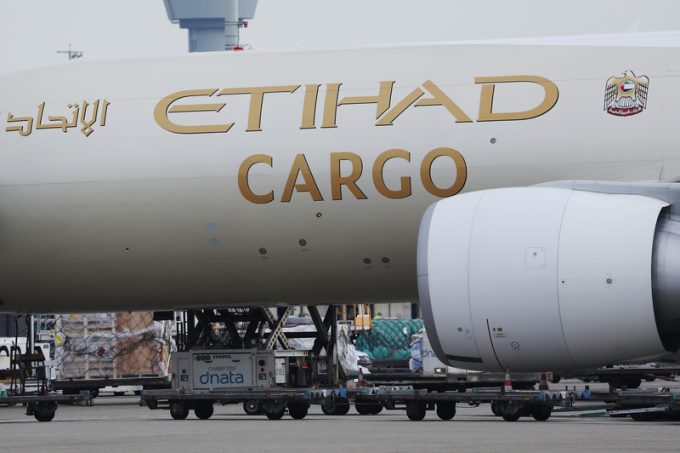
News that Etihad Cargo has ordered another three A350Fs, on top of its initial order for seven, underlines the pace of growth at the carrier.
In the year to date over last year, Etihad has added some 10% capacity to its widebody line-up. In July, for example, it received two 787s and one A350-1000.
Compared with its regional peers, it is much smaller, but growing faster, and its recently announced nine-month results showed cargo revenue rose by 8%, reaching AED3.2bn ($875m), “driven by increased capacity and volumes”.

And there is a benefit to the carrier’s current size, says Stanislas Brun, chief cargo officer.
“Other airlines are not afraid of us because we are not too big,” he explained. “We have a huge interline connection with other airlines. And I believe in that. I am not planning to fly in South America – but we can work there on an interline agreement. And other airlines know that we are not hitting on their territory.
“We are using their networks, they are using our network, so it’s a fair exchange; together we can be stronger. So it’s also a good benefit for us not to be so big, because, through interlines, we are providing quite a lot of solutions in different parts of the world.”
Etihad is already providing solutions via its own network – and, in common with most other carriers, is responding to new trade flows through South-east Asia, which has seen Etihad put chartered freighters into countries such as Bangladesh and Cambodia.
“This is part of my strategy, travelling quite a lot to meet customers and discuss their needs, which often generates some opportunities,” Mr Brun told The Loadstar.
Etihad Cargo offers about four charter slots per month and, added to last-minute availability, it could mean seven to eight freighter charters a month on top of its scheduled network, which now includes East Midlands Airport (EMA) in the UK.
“We stopped flying to Madrid because it makes more sense to fly to EMA in London. We’ve been looking for a base in the UK. Heathrow, forget it, it’s not possible. And Stansted has a curfew, which East Midland doesn’t.
“Operating with a curfew is too restrictive; you can spend too much time on the ground, if there is a delay.”
Etihad is also eyeing further networks in Africa: one freighter already serves Johannesburg, Nairobi and Amsterdam, but it wants a larger network there, via partnerships.
“We are getting closer to Ethiopian, but I’m working on other partnerships to have the capacity to deliver and to pick up in Africa,” he explained.
One of the potential pitfalls of interline agreements is the varying standards between airlines, but Mr Brun says technology is the answer.
“The standards are not always the same, and very often, when you are doing interline, you have an issue in terms of communication, and status. That’s why we are correcting that with our SmartTrack, allowing us to have the location of our shipments wherever they are, every 30 minutes. “
SmartTrack provides Etihad customers with real-time shipment visibility, using smart labels with GPS, cellular, wi-fi and Bluetooth to track all aspects of the shipment’s condition and location.
“It’s definitely helping; we know where our shipment is, and we can let our customers know. And that allow us to have a better connectivity and trust. Technology is bridging the gap.”
One market where Etihad needs no help is the UAE, where it has solid domestic volumes that account for more than one quarter of its business. And there are some high-yielding shipments.
“They are opening four museums in two months in Abu Dhabi and Al Ain, including a natural history museum and the Guggenheim.
“It’s probably the only place on earth where you will have four big museums open. And being the official carrier of the UAE, we carry all this art from the world to here. For the natural history museum, we are carrying a T-Rex, called Stan, like me.” He pointed out that this was delicate cargo needing very careful handling.
And then there is food. He said: “When you look at what we do out of Hong Kong, seven, eight freighters a week, half of it stops in Abu Dhabi. This is typically food: they are developing some vertical farming in Al Ain, but we still need to import about 90% of our food.”
Aside from the growth in Abu Dhabi’s import demands, Mr Brun says the carrier has another advantage over its nearest rival, Emirates. Abu Dhabi has a double runway, allowing two operations at the same time. DXB’s runways are interconnected, “you need to cross one to enter the other”.
Etihad now has 115 aircraft, with six freighters, but its Dubai Air Show order, which starts delivery in 2027, will add 32 widebodies to its fleet, including A350-1000s and A330-900s, of which some will be on lease. The order follows an earlier one this year for 28 Boeing widebodies.
“We will be more than doubling in the next five years,” said Mr Brun. “And the new facilities, temperature-controlled 90,000 sq metres at Abu Dhabi airport, will be ready in 2027.”
And it looks as if Etihad will be ready too. Its special products have enjoyed significant growth this year – whether it’s horses and cars – up 65%, or pharma, up 10%
“It’s about focus, it’s about making sure that we adapt, and continue to talk with the customer.”
For uninterrupted access, sign in or sign up to The Daily News, Premium or The Loadstar Enterprise Plan.
Comment on this article