Middle East premium fades – but AI boom keeps air freight rates aloft
Air freight markets appear to be settling, with capacity largely returned to the Gulf, fuel ...

WTC: 'ONE RECORD'HLAG: EARNINGS GUIDANCE UPGRADE AAPL: GLOBAL SMARTPHONE SHIPMENTS VW: THE IMPACT VW: MASSIVE JOB CUTS CONFIRMEDEXPD: BULLISHCHRW: POSITIONING AHEAD OF EARNINGSAMZN: IN THE NUMBERSAMZN: PEOPLE MATTER UNTILVW: THE LAST CUT IS THE DEEPESTJBHT: GEARING UP VW: BUYING TIMER: BIG VOTE OF CONFIDENCEAAPL: BEARISH HEDGEYE AAPL: THE BEAR CASE
WTC: 'ONE RECORD'HLAG: EARNINGS GUIDANCE UPGRADE AAPL: GLOBAL SMARTPHONE SHIPMENTS VW: THE IMPACT VW: MASSIVE JOB CUTS CONFIRMEDEXPD: BULLISHCHRW: POSITIONING AHEAD OF EARNINGSAMZN: IN THE NUMBERSAMZN: PEOPLE MATTER UNTILVW: THE LAST CUT IS THE DEEPESTJBHT: GEARING UP VW: BUYING TIMER: BIG VOTE OF CONFIDENCEAAPL: BEARISH HEDGEYE AAPL: THE BEAR CASE
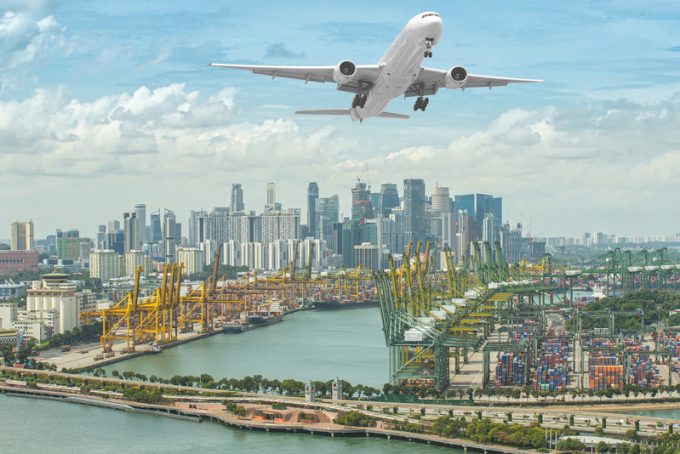
Huge airfreight demand growth from south-east Asia is changing the environment, with more capacity coming in, new hub models – and an eye on further investment.
German forwarder Rhenus yesterday outlined its plans in the region, and said it “will continue to identify strategic investment opportunities in Southeast Asia and the overall APAC region”, having set up airfreight gateways in Singapore, Thailand and Malaysia.
“Despite weaker external demand, elevated tariffs, and persistent policy uncertainty, Asia is expected to remain the biggest driver of global growth, contributing about 60% in 2025 and 2026,” stated Rhenus.
“Trade lanes between Asia and the world are seeing growth as well, as manufacturers prioritise south-east Asia for their sourcing needs.”
Air cargo in south-east Asia is certainly seeing considerable growth.
Ryan Keyrouse, CEO of Rotate, told delegates at Tiaca’s ACF last week: “As a result of the tariffs, within weeks, the networks shifted. First, the US shifted. China went down 30%. South-east Asia went up 48%. China found other markets for those exports, so growth to Europe, growth to south-east Asia…”
That growth has driven new capacity into the region.
“The amount of the world’s cargo coming out of Asia is more than 50%,” said Stanislas Brun, head of cargo at Etihad. “So we need to make sure that we have the right focus on the source. It’s not only about China and Hong Kong any more.”
He pointed to Vietnam, which Etihad freighters have served for more than a decade, but a six times a week passenger flight on a 787 launched this month to Hanoi, giving it an extra 130 tonnes per week of capacity.
Vietnam has seen 84% growth in January to July this year over last year, with 228,000 tonnes of cargo, most of which goes indirectly via north-east Asia, but with some direct routes. Atlas, for example, has added 122% extra capacity, while China Airlines has added 70%.

Source: Rotate
To the US, Vietnamese air exports rose 19% in April to July this year over last year, according to Aevean.

Source: Aevean
Aevean also showed huge growth out of Taiwan, owing to its status as semi-conductor capital, with between 60 and 80% of the world’s chips made there.
And although there are moves afoot for the US to boost its own server production and chip manufacturing, “when I look at the dynamics in the Taiwan market, I just don’t see that as a big thing, honestly,” said Asok Kumar, CEO of Taiwanese forwarder Morrison Express.
“If you look at the market as a whole, the highest rates out of Asia on the transpacific is no longer China, it’s no longer Vietnam – it’s actually Taiwan to US. Publicly stated, $8 to $9 in the ad hoc market, I don’t know where else you can find that.”
And then there is Cambodia. Mr Brun said: “Cambodia is really doubling exports year after year. Not only garments, but also shoes. And you also see some tech coming, although not necessarily high tech. Thailand is a very good example, where you have strong growth since Covid, there is more and more production.”
Tariffs have of course been a key driver of the changes to Asian trade. Tariffs are now broadly similar across China and south-east Asia – with some notable exceptions – with China’s reciprocal tariff, plus fentanyl fee, in effect bringing it to 19% (click to expand the table below).
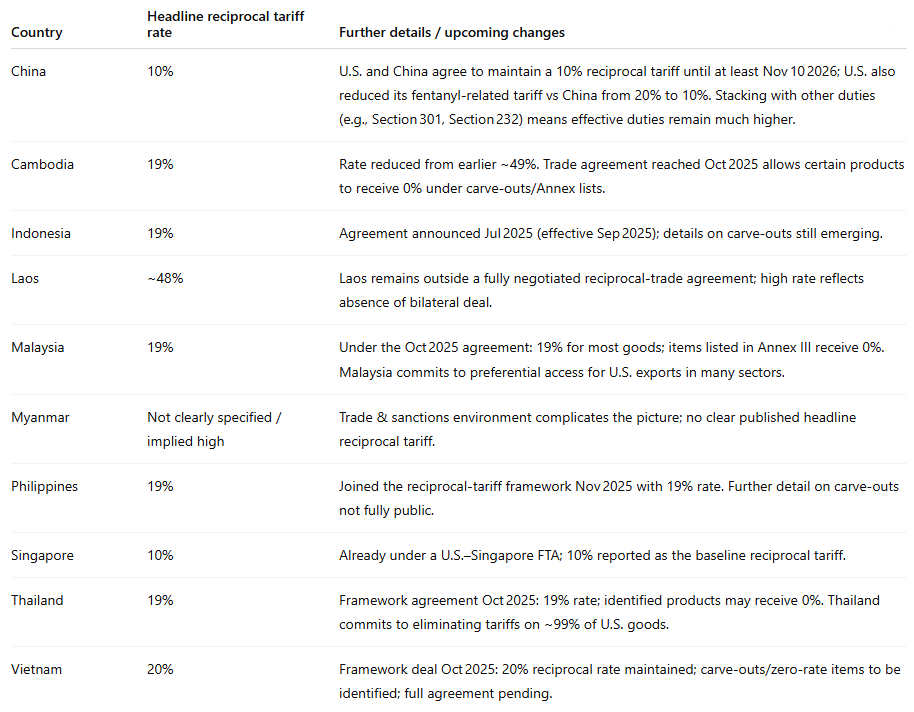
Despite more even tariffs through the region, it is expected that demand from south-east Asia will remain as companies have now developed their China +1 sourcing models. However, much of the capacity out of south-east Asian countries is not direct, which has led to a shift in the way Asian airlines operate.
“If you look at the carriers that have grown in capacity, it’s China Cargo, China Southern, and a bunch of other Chinese carriers,” said Mr Keyrouse. “It’s really interesting – Chinese carriers have historically just flown point-to-point, as there’s so much demand in their home markets. But these carriers now have a hub model. They’re going from south-east Asia, still going to the US, still going to Europe. They’re operating hub models.”
Rhenus said that its hubs will boost key corridors, with Kuala Lumpur handling inbound cargo from Europe, and outbound to Oceania; Singapore taking on inbound cargo from Asia and Oceania, and outbound to the Americas; and Bangkok managing outbound cargo to Europe, and working as a multimodal hub for intra-Asia.
The forwarder explained: “According to IATA, air freight volumes, as of September 2025, saw the Europe/Asia corridor grew by 12.4% year-on-year, reflecting a strategic shift in trade flows toward south-east Asia as cities such as Bangkok and Kuala Lumpur increase in importance as key inbound and outbound hubs for European cargo.”
Joachim Hanssen, CEO APAC, Rhenus Air & Ocean, explained: “With recent global developments, including the China +1 strategy, more businesses are set to include the south-east Asian region as an increasingly important piece of their global logistics plans.”
Check out what Etihad Cargo’s Stanislas Brun had to say on southeast Asia
For uninterrupted access, sign in or sign up to The Daily News, Premium or The Loadstar Enterprise Plan.

Comment on this article