DSV sparks rethink on freight software – but AI may pose the real challenge
When DSV revealed it was developing its own technology platform and moving away from CargoWise, ...
DHL: ASSET POWERCAT: TIME TO SELLMAERSK: UPGRADEMAERSK: ANOTHER UPGRADE HITS THE WIRES MAERSK: FLATTISH MAERSK: REACTION TO GUIDANCE UPGRADEMAERSK: SHIPPING GURU INSIGHTGXO: ROLLOVER WINMAERSK: EVERY LITTLE HELPSHLAG: EUROGATE DEALAAPL: SUPPLY CHAIN HURDLESVW: DECISION TIME VW: UPDATE
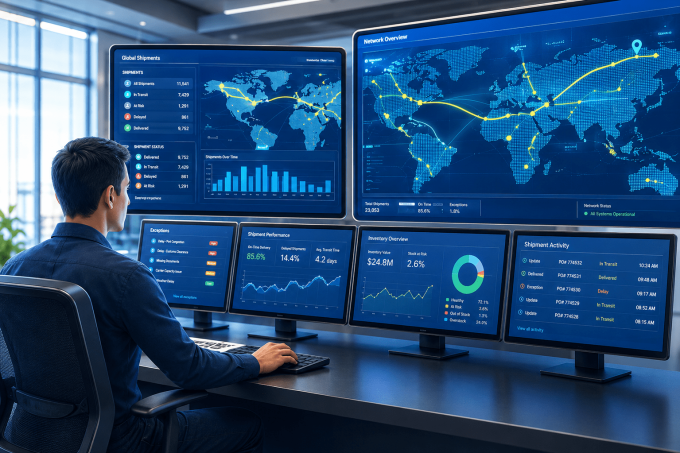
For more than a decade, much of the supply chain technology sector has competed on one angle: visibility. Knowing where freight is, when it will arrive, and where disruptions are emerging has become standard for shippers and logistics providers alike.
But as time has progressed, visibility, which came to the fore in the chaos of Covid, is no longer enough; and one of the sector’s biggest visibility providers agrees.
FourKites, which built its reputation on real-time shipment tracking, is repositioning itself around what it describes as autonomous execution – using AI not simply to identify problems, but to book freight, process documentation, manage inventory and resolve exceptions with minimal human intervention.
“Visibility tells you a problem exists. Execution resolves it,” Stephen Dyke, director of strategic solutions at FourKites, told The Loadstar. “Every dashboard alert without an automated action is an unrecovered cost.”
The company’s strategy became clearer with the launch earlier this year of Booking Connect and enhanced Inventory Twin capabilities. Rather than treating visibility as the end product, both applications use real-time supply chain data to trigger AI-driven decisions and operational workflows. Inventory shortages can automatically generate stock transfer recommendations, which then flow directly into Booking Connect, where AI selects a carrier, completes the booking, and initiates shipment tracking, all within the same platform.
Booking Connect also ingests carrier contracts, compares negotiated rates, automates documentation, and manages booking exceptions, with users retaining approval over financial commitments where required.
Mr Dyke argues this marks a fundamental shift in how supply chain software is judged.
“This shift directly addresses the coordination tax – the trillions wasted when humans are forced to act as the manual API between fragmented systems.”
According to FourKites, customers are already seeing measurable gains. One consumer goods manufacturer recovered roughly half the time previously spent on track-and-trace while improving tracking quality by 20% within four weeks. A food producer eliminated two to three hours of manual coordination each day for every logistics manager while reducing OTIF and detention penalties, and finance teams have reported detention and demurrage savings of some 30%.
The implications extend well beyond visibility platforms.
Ocean booking, document collection, proof-of-delivery management, and routine exception handling have traditionally relied on large operational teams. FourKites believes those tasks increasingly become the responsibility of specialist AI agents, leaving people to manage only higher-value exceptions and commercial decisions.
“The traditional control tower – historically a room of people manually tracking and reconciling shipments – is effectively obsolete,” said Mr Dyke. “By automating the grunt work, execution runs 24/7, freeing up strategic teams to focus on driving service, cost, and risk outcomes.”
That thinking is beginning to emerge elsewhere across the industry.
Speaking recently to The Loadstar, Rhenus Air & Ocean chief executive Jan Harnisch described AI less as a replacement for operators than as a way of embedding intelligence into complete workflows, allowing staff to focus on exceptions and customer relationships.
Mr Harnisch argued that “the models will become increasingly interchangeable”, meaning competitive advantage would increasingly come from orchestration, workflows, governance, and data rather than the AI model itself
“The real value comes when AI is embedded into full workflows, supported by the right data, systems, governance, and business ownership,” he said. “It cannot be only an IT topic. It must be linked to how we run the business.”
He predicted that, within five years, shipment operators would spend much of their time managing only those consignments that required human intervention after AI had handled routine execution.
Start-ups are pursuing the same objective from a different direction.
UK-based FreightSuite has developed an AI-native transport management system designed to automate quotation generation, document processing, shipment administration, and invoicing. The company says its platform already matches incoming emails and documents to the correct shipment without human intervention around 90.7% of the time, while customers have reported handling significantly more jobs per employee.
“Our vision is to allow forwarders to move the most amount of cargo using the smallest number of people,” co-founder Samuel Moore told The Loadstar.
For freight forwarders, the shift could prove significant. If routine operational work increasingly becomes automated, competitive advantage may depend less on manually coordinating shipments and more on handling complex exceptions, customer relationships, and commercial decision-making.
Visibility is unlikely to disappear. But as AI becomes capable of acting on supply chain data rather than simply presenting it, the next battleground for freight technology may no longer be who can see a disruption first, but who can resolve it fastest.
For uninterrupted access, sign in or sign up to The Daily News, Premium or The Loadstar Enterprise Plan.
Comment on this article