ChatGPT Image Jun 26, 2026, 12_26_11 PM
AI-generated

When DSV revealed it was developing its own technology platform and moving away from CargoWise, many in the freight forwarding industry assumed the move was only possible for the world’s largest forwarder.

But according to Kristjan Lillemets, who was chief product officer at Magaya at the time of this interview, DSV’s decision has had a far wider impact than simply prompting speculation over whether more companies might build their own transport management systems.

Instead, it has fundamentally changed the questions freight forwarders are asking.

“The idea ‘can I take what I consider my secret sauce and do that part myself?’… that’s the chatter we’ve been hearing recently,” Mr Lillemets told The Loadstar.

Rather than asking whether they should replace their core software altogether, forwarders increasingly want to decide which parts of their business should remain unique and which should continue to be handled by established software providers.

“I think everybody is considering moving to more of a combination of ‘I buy the core pieces, but I do want the flexibility to build around it’,” he said.

The shift has accelerated as AI develops at extraordinary speed. But while much of the industry’s attention has focused on new AI models and eye-catching demonstrations, Mr Lillemets believes many companies are concentrating on the wrong challenge.

“I think the forwarder market and the forwarder software market still has no idea what’s happening with AI,” he said. “The understanding of what was possible nine months ago would be severely outdated today.”

That does not mean forwarders should rush to build everything themselves. In fact, Mr Lillemets believes the opposite.

“We haven’t seen customers… considering leaving us for an in-house built solution,” he said. “What it has sped up is customers asking ‘I want you to manage our data, I want you to manage our core workflows… but let us build around it’.”

The traditional “build versus buy” debate, he argues, is becoming obsolete.

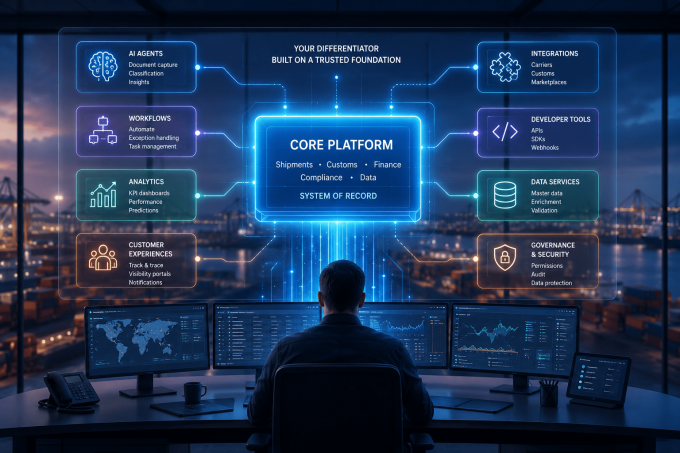
Forwarders still need robust systems of record to manage shipments, customs, finance, and compliance. What they increasingly want is the freedom to develop their own AI-driven workflows, integrations, and customer experiences on top of those foundations.

“The foundational systems at the bottom still need to be solid,” he said. “The tip of the iceberg is what we see customers build.”

The approach appears to be resonating. Following WiseTech’s introduction of CargoWise Value Packs, Magaya has seen increased interest from the market.

“We’ve definitely seen more inbound [requests],” said Mr Lillemets. “I think reliability and predictability in a software partner is critical.

“It’s not that charging for value is wrong as a concept… but it’s also about execution of these kinds of changes, treating your customers as partners, treating them with respect.”

He added: “We’ve seen increased interest since December. Maybe it’s a coincidence.”

Yet Mr Lillemets believes the industry’s next challenge will have little to do with software licensing. Instead, it will be deciding how to deploy AI economically.

Today’s demonstrations often rely on the largest and most capable language models, but he believes many companies have yet to consider whether that approach is commercially sustainable.

“If we all keep using the frontier models for everything, then I think that’s where the ROI question… is going to present itself in a pretty obvious and painful way soon.”

In future, software providers and freight forwarders alike will need to decide which tasks genuinely require the most advanced models and which can be handled by smaller, cheaper, or locally deployed alternatives.

“It’s all about finding the right capability for the job.”

The first applications are already becoming obvious.

“If somebody is still looking at a paper or a PDF and punching fields into a form, that is going away.”

But eliminating manual data entry is only the beginning.

Mr Lillemets believes the greatest gains will come from helping operators decide what deserves their attention each day: identifying risks, recommending actions, highlighting exceptions, and drawing on far more information than any individual could process manually.

“We need to be able to dramatically increase… the recommendations of what you should do.”

That view is echoed by Australian freight forwarder Neolink, another company investing heavily in automation and AI. Director Sean Crook recently told The Loadstar that, despite the excitement surrounding generative AI, traditional automation had so far delivered the greatest operational benefits.

“Automation, to be honest, has probably been even bigger for us than AI,” he said.

For Mr Lillemets, the industry’s biggest challenge may ultimately prove to be neither technology nor cost. As AI removes more repetitive work, customers are telling Magaya they are making operators more productive, rather than replacing them.

“What they quote is not that ‘I’ve been able to reduce headcount’, but that ‘my operators now are this much more productive’.”

The more difficult question is what happens next.

If AI increasingly performs the routine tasks that have traditionally taught new recruits the fundamentals of freight forwarding, how does the industry develop the next generation of operators?

Indeed, Mr Lillemets pointed to a concern recently raised by logistics adviser Wolfgang Lehmacher: “How is the next generation supposed to learn?”

It is a question that may ultimately prove more significant than whether forwarders build or buy their next piece of software.

Comment on this article


You must be logged in to post a comment.