Box ship buying spree is over, says Braemar, lines must be more selective
The surge in orders for small and mid-sized containerships has largely addressed the structural capacity shortfall that ...

EXPD: AIRCRAFT ON GROUND SERVICESTSLA: JUST AS VW STRUGGLESBA: NEW BIG ORDERBA: THE ORDERBOOK GROWSPLD: PUSHING FOR A DEAL PLD: TIME TO DEALEXPD: ANOTHER ALL-TIME HIGH CHRW: NEW RECORD DSV: AHEAD OF EARNINGS RELEASE JBHT: NEW HIGHS EVERYWHEREPLD: STRONG DELIVERYJBHT: FAIR-VALUE CONSENSUS ESTIMATE AT ALL-TIME HIGH KNIN: AI TECH ADVANTAGEPLD: TRADING UPDATE ON THE WAY
EXPD: AIRCRAFT ON GROUND SERVICESTSLA: JUST AS VW STRUGGLESBA: NEW BIG ORDERBA: THE ORDERBOOK GROWSPLD: PUSHING FOR A DEAL PLD: TIME TO DEALEXPD: ANOTHER ALL-TIME HIGH CHRW: NEW RECORD DSV: AHEAD OF EARNINGS RELEASE JBHT: NEW HIGHS EVERYWHEREPLD: STRONG DELIVERYJBHT: FAIR-VALUE CONSENSUS ESTIMATE AT ALL-TIME HIGH KNIN: AI TECH ADVANTAGEPLD: TRADING UPDATE ON THE WAY

Feeder operators’ growth is outpacing that of the mainliners, with one carrier seeing capacity fuelled by thriving regional expansion.
The world’s largest common feeder operator, X-Press Feeders, reported 13% year-on-year fleet growth in September, 5% ahead of the global liner fleet’s average growth across the same period, according to a recent Alphaliner report.
In comparison with the 22,500 teu added by Singapore headquartered X-Press, main rival Unifeeder added just 12,500 teu with a growth rate of 9%, still 1% ahead of the global average.

Source: Alphaliner
Alphaliner reiterated that one of the reasons for the rapid feeder growth was the Red Sea crisis, which forced most mainline operators to avoid the Suez Canal and “rely more heavily on third-party feeder operators”.
But it reported that another boost in capacity for X-Press Feeders had come from regional expansion.
And Jonathan Roach, container market analyst at maritime consultancy Braemar, told The Loadstar “extraordinary external events” were reshaping the liner industry and creating “structural support for regional vessel demand”.
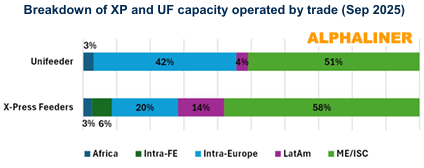
According to Alphaliner data, X-Press Feeders’ surge in capacity was mainly driven by “thriving” Latin America (LatAm) and Middle East/Indian Subcontinent (ME/ISC) trades
X-Press’s LatAm trade grew 53%, 9,200 teu above September 2024. At the same time, it deployed 8,700 teu more in the ME/ISC trade, up 8%.
It currently operates 26,800 teu across 19 vessels on the trade, according to Alphaliner.
“Latin America stands out as X-Press Feeders’ key expansion area. This growth was delivered by the launch of five new regional loops, primarily serving Central America,” said the analyst.
Source: Alphaliner
Meanwhile, Denmark-based Unifeeder saw its largest capacity injection come closer to home, adding 11,000 teu on its intra-Europe trade. Its intra-Med affiliate Unimed Feeder Services added 10 vessels, accounting for 9,700 teu of new slots.
Alphaliner said: “Despite the difference in growth rates, the two largest feeder operators maintain a similar footprint in terms of trade capacity distribution, with both deploying more than 50% of their fleet in the ME/ISC trade.
“However, while the intra-European service segment is the second main pillar for Unifeeder, X-Press gained ground in the LatAm market, where it added five new loops in just one year.”
Unifeeder has also dipped its toe into the LatAm market, increasing its presence by 61% from September 2024. However, its footprint remains comparatively smaller than X-Press Feeders, which is five times larger in the LatAm service segment.
Mr Roach added that, as US trade protectionism redirected cargo flows, the demand for feeder and regional tonnage would continue.
He said: “A roughly 35% fall in US imports from China in H1 25 has been offset by strong, double-digit growth from South-east Asian suppliers… That shift increases intra-Asia repositioning needs – more empty-container moves, more short regional sailings – and so sustains demand for feeder and regional tonnage.
“Meanwhile, as some China-based manufacturers pivot to new markets, we’re likely to see more China-Asia cargo flows too.”
Mr Roach concluded: “Feeder and regional vessel demand remains robust – the charter market has reflected that strength through 2024–25.”
Listen to this clip of Nigel Pusey, CEO of Container Trade Statistics, on how alternative sourcing could be driving intra-Asia demand:
For uninterrupted access, sign in or sign up to The Daily News, Premium or The Loadstar Enterprise Plan.
Comment on this article