Rate rises loom as port congestion hits four-year high
Congestion in container ports has crept up to a four-year high, with nearly 3.7m teu, ...


HLAG: EARNINGS GUIDANCE UPGRADE AAPL: GLOBAL SMARTPHONE SHIPMENTS VW: THE IMPACT VW: MASSIVE JOB CUTS CONFIRMEDEXPD: BULLISHCHRW: POSITIONING AHEAD OF EARNINGSAMZN: IN THE NUMBERSAMZN: PEOPLE MATTER UNTILVW: THE LAST CUT IS THE DEEPESTJBHT: GEARING UP VW: BUYING TIMER: BIG VOTE OF CONFIDENCEAAPL: BEARISH HEDGEYE AAPL: THE BEAR CASEFDX: LIFE SCIENCES ORG UNVEILEDWTC: UPS AND DOWNSWTC: ASX ANNOUNCEMENT REGARDING DSV PARTNERSHIP
HLAG: EARNINGS GUIDANCE UPGRADE AAPL: GLOBAL SMARTPHONE SHIPMENTS VW: THE IMPACT VW: MASSIVE JOB CUTS CONFIRMEDEXPD: BULLISHCHRW: POSITIONING AHEAD OF EARNINGSAMZN: IN THE NUMBERSAMZN: PEOPLE MATTER UNTILVW: THE LAST CUT IS THE DEEPESTJBHT: GEARING UP VW: BUYING TIMER: BIG VOTE OF CONFIDENCEAAPL: BEARISH HEDGEYE AAPL: THE BEAR CASEFDX: LIFE SCIENCES ORG UNVEILEDWTC: UPS AND DOWNSWTC: ASX ANNOUNCEMENT REGARDING DSV PARTNERSHIP

European gateways are lagging behind the EU’s 2030 shore-power mandate, but the key ports remain bullish they can be “largely compliant” when the deadline hits.
A recent study by DNV on behalf of Transport&Environment (T&E) found that, of the 31 ports studied, only four have installed or contracted more than half of the onshore power supply (OSP) connections required to meet the EU 2030 Alternative Fuels Infrastructure Regulation (AFIR) mandate.
OPS would allow docked ships to plug into the local electricity grid, replacing the use of fossil-fuel auxiliary engines and reducing emissions.
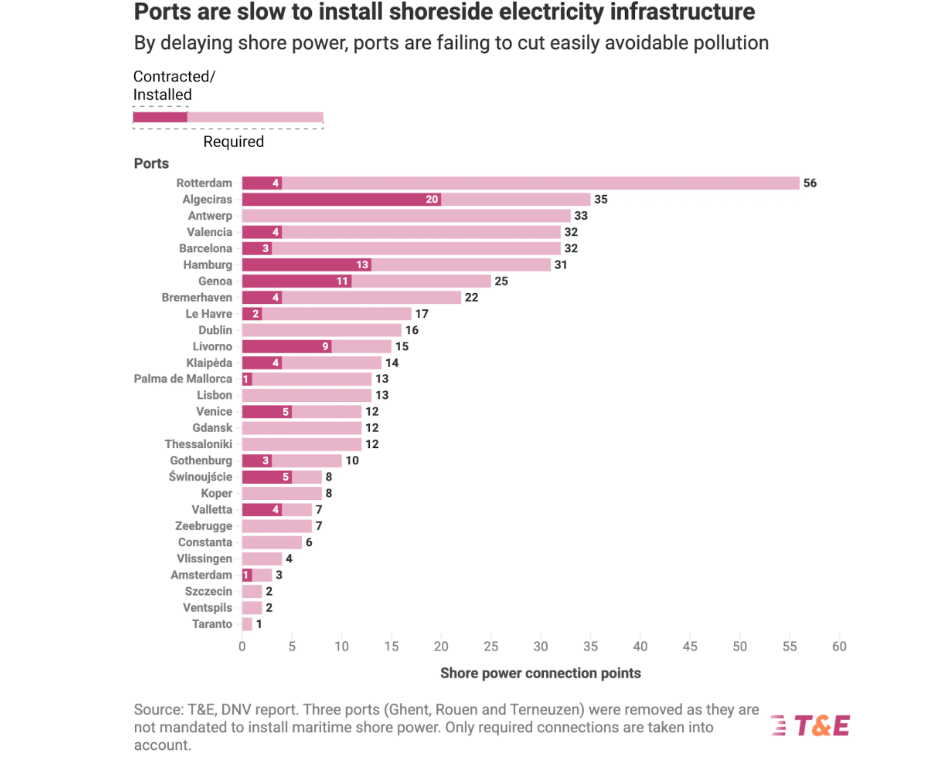
Graph: DNV and T&E
As illustrated, the port of Antwerp is among those that have not installed or contracted any of its 33 required shore power connection points.
Port of Antwerp-Bruges told The Loadstar: “While Belgium and the port of Antwerp-Bruges may appear to lag behind some ports that have benefited from early and substantial public investment (eg, Hamburg), we are making a decisive move to scale up deployment in the coming years.”
Indeed, the ports of Algeciras and Hamburg account for a “disproportionately large share of installed OPS connections”, according to T&E, and these ports together account for 19 out of 34 of all installed containership OPS connections.
Port of Antwerp-Bruges highlighted that AFIR placed the obligation not on port authorities, but on EU member states to ensure OPS infrastructure is in place.
It explained that in Belgium, the responsibility to meet this target is distributed across multiple stakeholders, including the Flemish government, terminal operators, electricity distribution system operators, and port authorities.
However, the port authority assured it was “actively supporting and facilitating the rollout”, and recently introduced a start-up subsidy for terminal operators that commit to installing shore power at their berths by 2028.
Six OPS projects across different terminals have already received funding from Flanders and/or the EU, with commissioning planned for 2026 and 2027.
And according to Port of Antwerp-Bruges, “a clear regulatory framework is being developed by the Flemish government, covering roles, responsibilities, and conditions for OPS deployment” and “work is ongoing to reduce taxes and levies on electricity used for shore power, making it more attractive for shipping lines and terminal operators”.
The port authority concluded: “The pace is picking up, and collaboration across public and private actors is key. We are fully committed to making OPS the standard in our port – not only to comply with regulations, but to support the energy transition in the maritime sector.
“With government support, private investment, and a growing regulatory framework, we are confident in meeting the 2030 objectives.”
Another major port T&E notes is lagging is Rotterdam. Ryan Cornelisse, programme manager of shore power, told The Loadstar the port “has a different view on the uptake of shore side electricity”.
He explained: “T&E/DNV are correct in saying that only a limited number of OPS-connection points have been installed/contracted. However, specifically in Rotterdam, a lot of projects are currently in the planning/procurement phase.”
For Rotterdam’s container segment, there are seven terminals and 75 berths, of which only one is equipped with OPS connection points, but Mr Cornelisse assured there were a further 61 connection points planned across the berths.
“We are quite confident that the port of Rotterdam will be largely compliant with EU Legislation in 2030 when the obligation starts,” he concluded.
T&E pointed out that ports were “uniquely positioned to lead the green shipping transition”, adding: “The 2030 mandate presents an opportunity not only to meet regulatory requirements, but also to actively cut pollution and emissions, improve public health and enhance energy resilience. With only limited progress to date, ports should step up and accelerate OPS deployment.”
Overall in member states, only 11% of required connection points for containerships are in place or under contract, compared with 41% for passenger ferries and 35% for cruise ships.
And T&E noted that even if all ports met their required OPS mandate by 2030, this still left a large share of port-emissions unaccounted for.
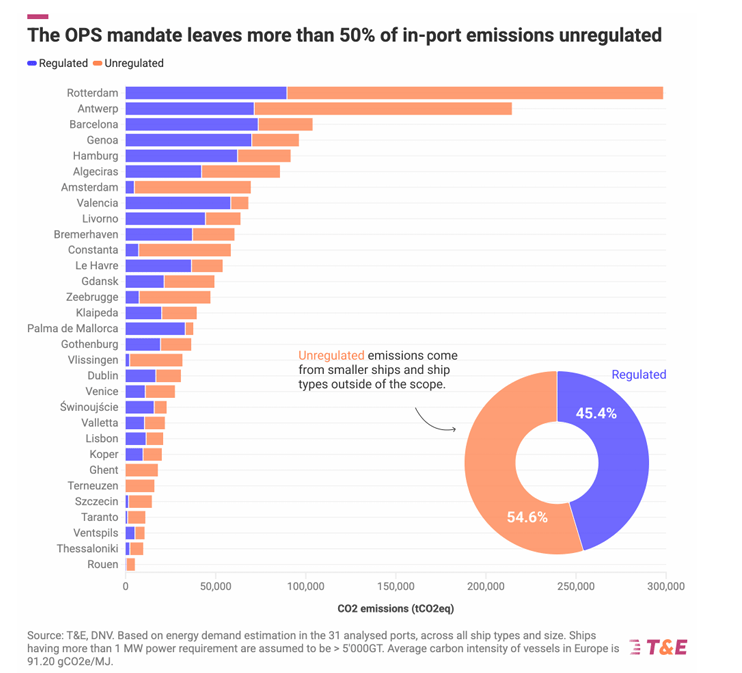
Graph: DNV and T&E
It is lobbying for an expansion of shore power requirements, to include a broader range of ships at berth, including smaller and currently excluded vessel types, as part of future revisions to AFIR and FuelEU Maritime.
For uninterrupted access, sign in or sign up to The Daily News, Premium or The Loadstar Enterprise Plan.

Comment on this article