Clear-up after toxic gas leak sees some Antwerp quays reopen
Antwerp’s Deurganckdok port area partially reopened today after an emergency services clean-up following Tuesday night’s ...

JBHT: NEW HIGHS EVERYWHEREPLD: STRONG DELIVERYJBHT: FAIR-VALUE CONSENSUS ESTIMATE AT ALL-TIME HIGH KNIN: AI TECH ADVANTAGEPLD: TRADING UPDATE ON THE WAY KNIN: UPSIDEJBHT: STRONG TRADING UPDATE DSV: EVERY LITTLE HELPSJBHT: CEO REMARKS WMT: VERTICAL INTEGRATION IN LOGISTICS
JBHT: NEW HIGHS EVERYWHEREPLD: STRONG DELIVERYJBHT: FAIR-VALUE CONSENSUS ESTIMATE AT ALL-TIME HIGH KNIN: AI TECH ADVANTAGEPLD: TRADING UPDATE ON THE WAY KNIN: UPSIDEJBHT: STRONG TRADING UPDATE DSV: EVERY LITTLE HELPSJBHT: CEO REMARKS WMT: VERTICAL INTEGRATION IN LOGISTICS
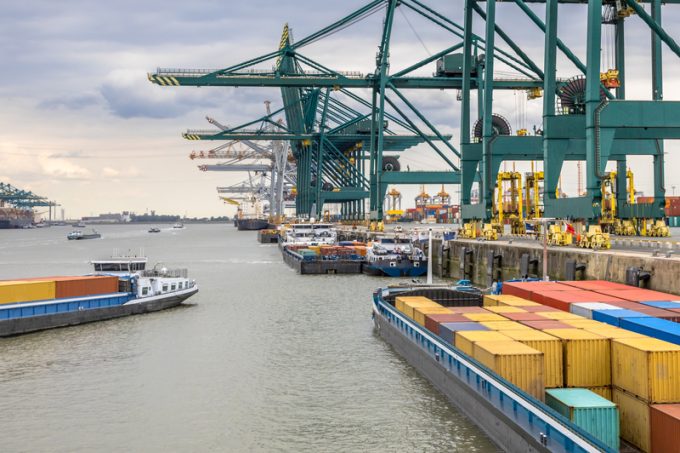
North Europe’s largest container hub ports are losing market share, the first-quarter throughput figures released today by Antwerp-Bruges indicate.
The port authority reported Q1 container throughput of 3.4m teu, a 2.6% decline on the first quarter of last year, as bad weather interrupted shipping, and an extended strike across the two ports took their toll.
“The start of the year was marked by extreme weather conditions. A snowstorm and prolonged cold spell in January, followed by severe storms in the Bay of Biscay until mid‑February, disrupted shipping and terminal operations,” the port said. “A four‑day strike against pension reform also had a significant impact.
“The interruption of the nautical chain led to the diversion of several vessels to other ports and to planned call-sizes that could only be partially handled due to a lack of spare terminal capacity,” it added, revealing a loss of around 100,000 teu due to the disruptions.
However, it also added that the second half of the quarter had seen volumes bounce back.
“From mid‑February, and particularly in March, volumes recovered, again highlighting the need for additional container handling capacity,” it said.
Yesterday, The Loadstar reported that container volumes at Antwerp’s chief rival, Rotterdam, had seen 0.3% increase in the first quarter, compared with the year before, to reach 3.37m teu, showing that despite Antwerp’s overall decline, it had resumed its place as Europe’s largest container port.
Ironically, that title had been reclaimed by Rotterdam for the full-year 2025, when it handled 14.2m teu compared with the 13.63m teu handled by Antwerp.
Antwerp Port Authority also noted this year’s three-month figure “should be seen against the backdrop of a relatively strong start to 2025, when the restructuring of container alliances generated high inbound volumes”.
However, the throughput figures of both ports stand in stark contrast to the latest volume data from Container Trades Statistics, which, although currently only covering January and February, show a 5.2% volume increase for overall European imports and exports over the year before.
And the growth in containerised imports has been explosive, CTS said, adding: “Europe recorded strong import growth, up 21% year on year and 12% year to date, despite a slight 3.8% month-on-month decline.
“This growth continues to be driven by accelerating Far East exports, with this trade alone up over 45% year on year,” CTS said.
This would suggest that both hubs have lost cargo to other ports in the region.
Notwithstanding the relatively weak first-quarter performance, Antwerp port authority interim CEO Rob Smeets said the gateway needed to continue its expansion plans.
“This quarter’s results show how strongly external factors are currently influencing port activity and the wider economy. We are seeing the impact of geopolitical tensions, disruptions in supply chains and the difficult position of European industry.
“At the same time, this underlines the importance of a robust and agile port infrastructure. By continuing to invest in capacity, sustainability and efficiency, we are strengthening our role as a reliable link in international trade – even in an increasingly complex environment,” he argued.
And, as with Rotterdam yesterday, Antwerp-Bruges warned that the full effect of the conflict in Iran had yet to filter through to the port.
“The direct impact of the conflict in the Middle East remained limited in the first quarter, due to longer sailing times via the Cape of Good Hope. The decline in imports from and exports to and from the Persian Gulf, of respectively 12% and 49%, during this period can largely be attributed to weather‑related disruptions,” it explained.
For uninterrupted access, sign in or sign up to The Daily News, Premium or The Loadstar Enterprise Plan.
Comment on this article