Logistics and resilience are key as Saadé warns supply chain disruption is 'new normal'
CMA CGM chairman and CEO Rodolphe Saadé has outlined how the French shipping giant is ...

GM: TRADING UPDATE OUTUPS: REMEMBER THE TAILWINDS PLD: NEW RELEASEPLD: OUCHVW: NEW PARTNERS SOUGHTEXPD: AIRCRAFT ON GROUND SERVICESTSLA: JUST AS VW STRUGGLESBA: NEW BIG ORDERBA: THE ORDERBOOK GROWSPLD: PUSHING FOR A DEAL PLD: TIME TO DEALEXPD: ANOTHER ALL-TIME HIGH CHRW: NEW RECORD DSV: AHEAD OF EARNINGS RELEASE JBHT: NEW HIGHS EVERYWHERE
GM: TRADING UPDATE OUTUPS: REMEMBER THE TAILWINDS PLD: NEW RELEASEPLD: OUCHVW: NEW PARTNERS SOUGHTEXPD: AIRCRAFT ON GROUND SERVICESTSLA: JUST AS VW STRUGGLESBA: NEW BIG ORDERBA: THE ORDERBOOK GROWSPLD: PUSHING FOR A DEAL PLD: TIME TO DEALEXPD: ANOTHER ALL-TIME HIGH CHRW: NEW RECORD DSV: AHEAD OF EARNINGS RELEASE JBHT: NEW HIGHS EVERYWHERE
The recovery of air cargo operations in the Gulf has been thrown into fresh uncertainty as the US and Iran exchanged a new wave of strikes this week, prompting another temporary closure of Kuwait airspace and fears of renewed disruption across the region.
Kuwait briefly suspended air traffic last week after its airport was hit, but has now resumed normal flight operations, highlighting the continuing fragility of the operating environment for airlines and logistics providers.
The latest escalation comes as carriers and freight operators had begun restoring services across the region, following a period of relative stability after a ceasefire was agreed in April.
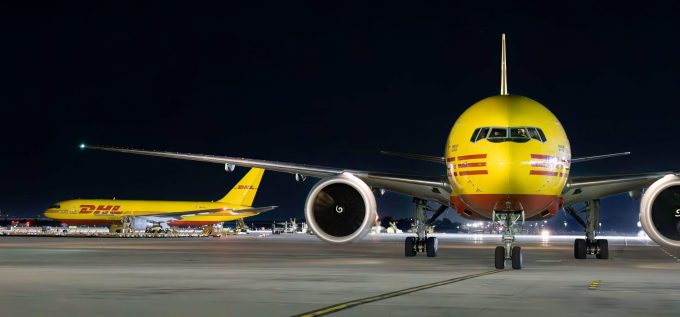
DHL said its regional air operations had recovered significantly in recent weeks, with transit times and service performance nearing pre-conflict levels.
“Transit times, which had extended to five-to-seven days during the disruption, have largely returned to near pre-conflict levels of 24 to 48 hours. Service performance is now close to normal in many markets, with key hubs, including Bahrain, restored.
“Of course, some constraints in airfreight remain, including limited capacity in certain countries, occasional schedule disruptions, and rising operational costs,” a spokesperson told The Loadstar.
Contingency planning has been at the heart of DHL’s response to the crisis. During the height of the disruption, the company established backup hubs in Riyadh and Muscat to maintain connectivity across the region.
In April, it launched a thrice-weekly 747 freighter service between Liège and Jeddah, dedicated to pharma and life science shipments, with onward distribution across the GCC by road. Following the reopening of regional airspace, the Gulf destination has since switched from Jeddah to Dubai World Central.
Asked how dependent DHL was on the bellyhold capacity provided by European passenger airlines that have yet to fully return to the Gulf, the spokesperson said the company’s network was largely insulated from those constraints.
“DHL’s regional network is built for resilience and relies primarily on its own dedicated freighter fleet, limiting dependence on belly cargo capacity from passenger airlines. While belly capacity provides a complementary buffer under normal conditions, it represents only a small share of total capacity.”
Indeed, while Gulf carriers Emirates, Etihad Airways and Qatar Airways have largely restored operations, many European and international airlines remain reluctant to return.
British Airways has pushed back resumption of Dubai passenger services until 25 October, extending a suspension originally expected to end on 1 July. Under the revised schedule, flights to Dubai, Tel Aviv, Bahrain, and Amman will remain suspended, while frequencies to Doha and Riyadh are being reduced.
The decision suggests that security concerns remain elevated despite the partial recovery in regional operations. Passenger demand has also yet to fully recover from the prolonged period of instability.
On the cargo side, Lufthansa Cargo confirmed to The Loadstar that it had postponed Frankfurt-Tel Aviv freighter operations again, with no flights to Tel Aviv, freighter or passenger, until at least 15 June due to the security situation.
Air France resumed passenger services to Riyadh last week, but a spokesperson confirmed that other destinations in the Gulf and wider Middle East remained suspended. Air France-KLM-Martinair Cargo continues to avoid Dubai on freighter services to and from Hong Kong.
For the cargo sector, the latest flare-up serves as a reminder that, despite the impressive resilience shown by airlines and logistics operators in recent months, the region remains vulnerable to sudden operational shocks.
Airspace closures have become shorter and less disruptive than during the initial weeks of the conflict, but the renewed exchange of hostilities between Washington and Tehran is unlikely to encourage European carriers to accelerate their return to the region.
Instead, airlines appear content to wait for a new sustained period of stability before restoring networks that can be withdrawn at a moment’s notice by geopolitical events.
For uninterrupted access, sign in or sign up to The Daily News, Premium or The Loadstar Enterprise Plan.
Comment on this article