LATAM pushing ahead with transatlantic expansion
LATAM Airlines is continuing its transatlantic expansion at the end of this month with the ...

VW: THE IMPACT VW: MASSIVE JOB CUTS CONFIRMEDEXPD: BULLISHCHRW: POSITIONING AHEAD OF EARNINGSAMZN: IN THE NUMBERSAMZN: PEOPLE MATTER UNTILVW: THE LAST CUT IS THE DEEPESTJBHT: GEARING UP VW: BUYING TIMER: BIG VOTE OF CONFIDENCEAAPL: BEARISH HEDGEYE AAPL: THE BEAR CASEFDX: LIFE SCIENCES ORG UNVEILEDWTC: UPS AND DOWNSWTC: ASX ANNOUNCEMENT REGARDING DSV PARTNERSHIP VW: D-DAY
VW: THE IMPACT VW: MASSIVE JOB CUTS CONFIRMEDEXPD: BULLISHCHRW: POSITIONING AHEAD OF EARNINGSAMZN: IN THE NUMBERSAMZN: PEOPLE MATTER UNTILVW: THE LAST CUT IS THE DEEPESTJBHT: GEARING UP VW: BUYING TIMER: BIG VOTE OF CONFIDENCEAAPL: BEARISH HEDGEYE AAPL: THE BEAR CASEFDX: LIFE SCIENCES ORG UNVEILEDWTC: UPS AND DOWNSWTC: ASX ANNOUNCEMENT REGARDING DSV PARTNERSHIP VW: D-DAY
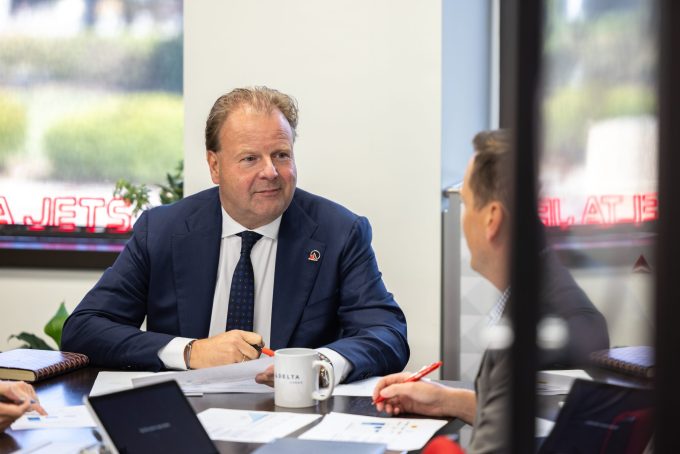
When Peter Penseel joined Delta as president of cargo, he walked into an airline with a strong passenger pedigree and a cargo business that had had something of a lacklustre few years – and therefore something to prove.
“First of all, I think it was clear that Delta had a strong foundation, and there was an opportunity to elevate cargo’s strategic role even further,” he said. Cargo had “always been a part of Delta’s business”, but Mr Penseel saw “significant potential to define a sharper long-term vision for how it could contribute greater to the company’s success”.
Before saying yes, he wanted to understand how serious Delta really was. “When they asked me if I was interested, the first question I wanted to understand was the level of commitment to building Delta Cargo into a world-class commercial and operational function.”
With Delta’s balance sheet and network, he believed the pieces were already there. “With Delta’s global network and strong financial position, I knew that focusing and aligning around a clear strategy, we could accelerate the success of Cargo in meaningful ways.”

That strategy needed a focal point. “My goal from day one was to create a ‘North Star’ that would guide how we grow, operate, and show up for our customers.”
Instead of criticising the past (Delta Cargo has had many iterations over the past decade or so, as well as a large handful of different leaders with varying powers), Mr Penseel focused on the future. ]
“Rather than focusing on what may not have existed before, I believe leadership starts with demonstrating what is possible. You begin by showing through strategy and results how cargo can be a significant contributor to the airline.”
His first months were spent listening – to staff, senior leadership, and customers. “I began with some clear evaluation, starting to listen to what people are feeling. Where are they? How do they feel working for Delta?”
He also wanted to position cargo more clearly within the wider airline. Speaking with senior leaders, he asked how cargo could “further complement Delta’s passenger business”.
Externally, the questions were just as direct. “How do customers perceive it? Who are our customers? Why do some work with us and some not?” Those conversations, he said, were essential to shaping execution.
None of it works without people. “People are the airline’s most important asset.” The organisation, he said, responded positively to “the new energy that I was bringing and the clear vision on how to develop Delta Cargo into a stronger operation”.
However, the way Delta is organised is, perhaps, still not the most advantageous for Mr Penseel. One source close to the airline noted that parts of the cargo team were still not under the cargo department’s control. It first restructured in 2014 to align its operations and sales more closely with the passenger side, putting cargo operations under Airport Customer Service and sales into Global Sales. Then, in 2020, it subsumed the cargo department into Delta’s commercial arm. The airline is not particularly transparent about its current set-up, saying simply: “Delta Cargo is the air freight division of Delta Air Lines.”
No doubt attempting to wrestle it all back into its own division is a priority for Mr Penseel.
Even so, the results so far have been tangible. Delta Cargo recently announced third-quarter results showing “19% growth year over year”, and Mr Penseel does not underplay that achievement. “Double digit growth is an extraordinary achievement for our team and a clear indicator that our strategy is working.”
A source close to United Cargo thinks Delta is on the up, in part from taking some of United Cargo’s business – a Dutch battle between Mr Penseel and compatriot Jan Krems, the also-charismatic leader of United Cargo.
So, does it take a Dutchman to run a US air cargo business? “No, I think there are very good Americans,” he laughs. “It’s simply coincidence that Jan and myself ended up in our roles. The Dutch are just known for being good traders and with an entrepreneurial spirit.”
Mr Penseel is chasing his rival, and Delta has started to catch up, with double-digit percentage growth instead of United’s single-digit growth. But United’s reported quarterly cargo revenues are around double Delta’s, in part perhaps because United has historically more widebody capacity and long-haul routes.
For Mr Penseel, as a former head of Qatar Airways Cargo, is it hard to shift thinking at a large, established passenger airline?
“No, I don’t think so,” he believes. Culture matters, but so does adaptability. “When you join Delta, you embrace the Delta culture. You learn how the organisation operates.”
His background has helped with credibility, especially with freight forwarders – he was COO airfreight for Ceva Logistics between 2020 and 2024 – a particularly spikey period in logistics – but he also cut his teeth at DHL Global Forwarding and UTi Worldwide. In fact, he’s spent far more of his career in forwarding than at airlines.
“I’ve worked in both parts of the industry at a senior level, so I’ve dealt with big freight forwarding companies and big carriers. I’ve sat on both sides of the table.”
That experience matters when relationships are under strain. “Tough discussions are good discussions, if they’re respectful, open, and honest, you always jointly find the solution.” Without that openness, he warns, “then the relationship is on a PowerPoint, and not a real, genuine relationship”.
Meanwhile, recent shifts in trade policy have had a real impact.
“De minimis and tariff policies have impacted our industry. At Delta Cargo, we saw major volume declines, especially in ecommerce. However, in some cases, one might see up to 60% decline in volume along with shifts in capacity, impacting flows that are coming from somewhere in the world.
“And that’s the nice part of being with an airline. We have our network which allows us to adapt. The goal is to always optimise our network and fill our aircraft with the right mix of business to make money.”
Volatility, he argues, is now part of the job. “That’s the dynamic world we are in, and that’s why I like it; that’s what keeps me alive, because I love it.”
Despite the surge in interest in freighters over recent years, Delta has no plans to acquire any. The economics are unforgiving.
“You have to seriously assess the amount of the investment; how many you would need to be successful, and how many can you fill for a period of 20 years when you don’t even know what will happen in the next six months? You can’t just have a freighter network when the yields are nice and make good money. You’re dependent on your freighter movements, and if you only operate freighters, it’s tough.”
Instead, Delta focuses on selling its network (which, if Mr Penseel had a choice, would include more routes to China and South-east Asia, unsurprisingly). “If you have less capacity to offer, what you want to do is sell a network.”
Asked which metric matters most, Mr Penseel’s answer is immediate: “Dollars.”
He explains: “Bottom line, that’s the only thing that counts,” adding that without financial contribution, cargo has limited influence. “If you can quantify the contribution cargo is delivering to the overall business of Delta, that makes your voice at the table stronger.”
The ambition is not scale for its own sake. “We will never be the biggest cargo provider in the world, but we want to be the best.” And that includes knowing when to say ‘no’.
“Sometimes the right answer is ‘not at this time’, because overpromising can jeopardise the relationship.”
Personally, Mr Penseel is still deeply motivated. “I love to win. I hate to lose because I am proud of what I do, I’m proud of the team that’s working with me, and I love to show that it’s possible.”
Looking ahead, his ambitions remain tied to Delta. “I would love to end my career here and make Delta Cargo even bigger, more recognised.”
When he joined, he told the airline: “You need a poster boy, somebody who takes the lead to promote the brand.” Being the poster boy for Delta is internal as much as external. It means proving to forwarders that Delta really is a serious player.
But it also means proving to the passenger business that cargo belongs at the top table – not through rhetoric, but through results, realism and, ultimately, dollars.
This article is © The Loadstar. Reproduction, rewriting, or derivative use requires a license. Contact [email protected] for licensing enquiries.
For uninterrupted access, sign in or sign up to The Daily News, Premium or The Loadstar Enterprise Plan.

Comment on this article