FedEx-CMA CGM deal hints at new battle for air cargo capacity
When CMA CGM announced its $1.4bn acquisition of FedEx Supply Chain, most attention focused on the contract logistics business ...

EXPD: AIRCRAFT ON GROUND SERVICESTSLA: JUST AS VW STRUGGLESBA: NEW BIG ORDERBA: THE ORDERBOOK GROWSPLD: PUSHING FOR A DEAL PLD: TIME TO DEALEXPD: ANOTHER ALL-TIME HIGH CHRW: NEW RECORD DSV: AHEAD OF EARNINGS RELEASE JBHT: NEW HIGHS EVERYWHEREPLD: STRONG DELIVERYJBHT: FAIR-VALUE CONSENSUS ESTIMATE AT ALL-TIME HIGH KNIN: AI TECH ADVANTAGEPLD: TRADING UPDATE ON THE WAY
EXPD: AIRCRAFT ON GROUND SERVICESTSLA: JUST AS VW STRUGGLESBA: NEW BIG ORDERBA: THE ORDERBOOK GROWSPLD: PUSHING FOR A DEAL PLD: TIME TO DEALEXPD: ANOTHER ALL-TIME HIGH CHRW: NEW RECORD DSV: AHEAD OF EARNINGS RELEASE JBHT: NEW HIGHS EVERYWHEREPLD: STRONG DELIVERYJBHT: FAIR-VALUE CONSENSUS ESTIMATE AT ALL-TIME HIGH KNIN: AI TECH ADVANTAGEPLD: TRADING UPDATE ON THE WAY
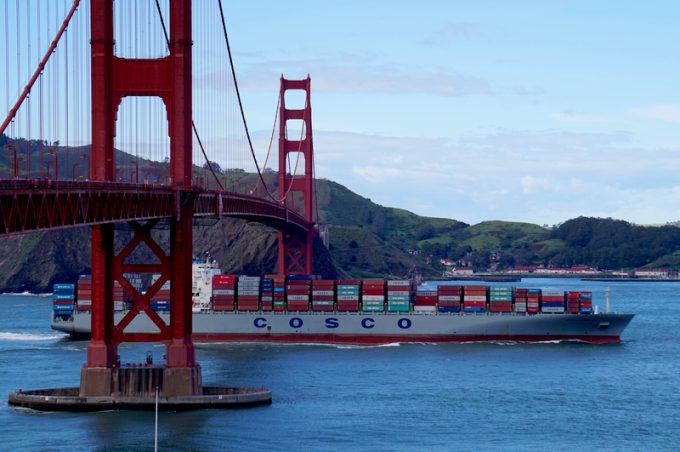
Cosco Shipping Lines and Hede Shipping, the only Chinese liner operators active in the transpacific lane, have not reassigned any of their all-China-built ships from US port calls. In the next six months, the pair will incur port fees of up to $1.02bn and $40m, respectively, according to Linerlytica’s analysis.
By Alphaliner’s estimates, Cosco’s transpacific capacity stands at some 700,000 teu, and the Chinese state-controlled operator is the third-largest transpacific operator, behind CMA CGM and Maersk Line. All 70 of Cosco’s ships on the transpacific are Chinese-built, according to Linerlytica.
It is understood that Cosco is hoping the Chinese government can resolve trade tensions with US president Donald Trump’s administration. This is despite the US Trade Representative saying that the fees will be progressively increased from April 2026. Mr Trump is attempting to tackle China’s economic dominance, especially in shipping and shipbuilding.
Hede, owned by state-owned Tangshan Port Group, launched transpacific services in late 2024, and now has a dozen vessels amounting to some 30,000 teu of transpacific capacity.
While MSC, Maersk and Premier Alliance members are taking steps to redeploy their China-built vessels from the US, CMA CGM and ZIM have so far not budged.
CMA CGM has more than 60 ships on the transpacific, with total capacity of over 700,000 teu. Fewer than 10 of the ships are China-built.
ZIM has 40 ships plying the transpacific and has a capacity of just under 400,000 teu. Approximately 10 of these vessels are China-built.
Linerlytica calculates that CMA CGM and ZIM face potential bills of up to $37m and $35m, respectively, in the first six months of the fee implementation.
The consultancy said: “The USTR 301 service fees will not hit the transpacific carriers equally when it comes into effect in mid-October, with Cosco set to bear the brunt of the port charge. Amongst the non-Chinese carriers, most of them will be fully exempt from the fee, with CMA CGM and ZIM being the only main exceptions although their exposure to the USTR fee is only a fraction of what Cosco will incur.”
Forwarder DSV told media this week that a number of shipping lines did not seem to be passing the cost on to customers. It added: “We still do not know how the announced fees will be implemented in practice, and this creates uncertainty among our customers.”
Listen to The Loadstar Podcast’s most recent episode with data and insight from Container Trades Statistics’ CEO Nigel Pusey
For uninterrupted access, sign in or sign up to The Daily News, Premium or The Loadstar Enterprise Plan.
Comment on this article