A 'super' El Niño a major threat to LatAm's perishable exports
Meteorologists have been warning of the likely impact of the weather on perishables exports from ...


VW: THE IMPACT VW: MASSIVE JOB CUTS CONFIRMEDEXPD: BULLISHCHRW: POSITIONING AHEAD OF EARNINGSAMZN: IN THE NUMBERSAMZN: PEOPLE MATTER UNTILVW: THE LAST CUT IS THE DEEPESTJBHT: GEARING UP VW: BUYING TIMER: BIG VOTE OF CONFIDENCEAAPL: BEARISH HEDGEYE AAPL: THE BEAR CASEFDX: LIFE SCIENCES ORG UNVEILEDWTC: UPS AND DOWNSWTC: ASX ANNOUNCEMENT REGARDING DSV PARTNERSHIP VW: D-DAY
VW: THE IMPACT VW: MASSIVE JOB CUTS CONFIRMEDEXPD: BULLISHCHRW: POSITIONING AHEAD OF EARNINGSAMZN: IN THE NUMBERSAMZN: PEOPLE MATTER UNTILVW: THE LAST CUT IS THE DEEPESTJBHT: GEARING UP VW: BUYING TIMER: BIG VOTE OF CONFIDENCEAAPL: BEARISH HEDGEYE AAPL: THE BEAR CASEFDX: LIFE SCIENCES ORG UNVEILEDWTC: UPS AND DOWNSWTC: ASX ANNOUNCEMENT REGARDING DSV PARTNERSHIP VW: D-DAY

Global cargo theft is escalating in both scale and complexity, with trucks accounting for the vast majority of incidents, according to new data from TT Club and BSI Consulting.
BSI’s 2025 report, published yesterday, notes that trucks account for around 70% of cargo thefts worldwide.
And losses are mounting sharply. Visibility and risk management firm Overhaul estimates truck cargo theft in the US alone totalled approximately $725m last year – a rise of nearly 60% year on year.
“Theft is way, way up, and it’s only getting worse. And the way cargo is being stolen is getting more strategic and more sophisticated all the time,” said Logan Hendrickson, Overhaul’s senior director of product marketing.
While road freight remains the primary focus for criminals, other modes are also seeing significant increases.
TT Club and BSI noted that railfreight theft in the US jumped from 4% to 10% of incidents in a single year, while sea piracy reached its highest level in nearly a decade, surging 85% in the first half of 2025 alone.
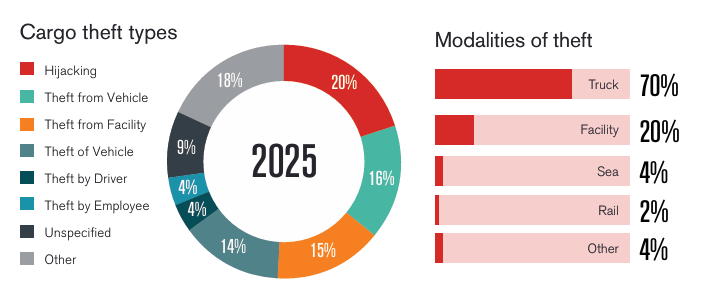
Source: TT Club and BSI Consulting
They warned of “a deepening and increasingly complex global cargo theft crisis”, driven by organised criminal networks deploying “ever more sophisticated tactics” across road, rail, sea, and digital channels.
Geographically, Brazil, Mexico, India, the US, Indonesia, Chile, China, Germany, and South Africa reported the highest number of incidents. Ecuador, however, saw one of the sharpest increases, with theft nearly doubling amid rising gang violence in coastal regions.
Food and drink products were the most frequently stolen commodities, followed by agriculture, electronics, automotive parts, construction materials, and metals.
Notably, insider involvement remains a persistent issue, at 22% of global incidents said to be ‘inside jobs’. Technology-enabled theft is also on the rise, and criminals are increasingly exploiting cybersecurity vulnerability, using fraudulent documentation, impersonation, and complex schemes such as fictitious pick-ups and ‘double brokering’.
In Europe, facility-based theft is becoming more prevalent, with warehouses accounting for 33% of incidents. Germany, Italy, and the UK are among the hardest-hit countries. In the UK, cargo theft losses reached $149m in 2024, while a $9m smartphone heist at Heathrow Airport last year ranked among the most significant single incidents.
Asia has seen a sharp rise in maritime crime, particularly in the Strait of Malacca and Singapore, where piracy incidents surged 281% year on year. Meanwhile, theft of rare earth minerals has emerged as a new trend in China.
Mike Yarwood, MD of loss prevention at TT Club, said: “Our 2025 findings make clear that cargo theft is no longer a static or predictable threat. Criminal networks are adapting faster than ever, exploiting new commodities, new technologies, and new vulnerabilities across the entire supply chain.”
He added that “proactive, intelligence-led mitigation” was essential to protect cargo against theft. And Jim Yarbrough, global supply chain solutions director at BSI Consulting, believes “dynamic, intelligence-driven” theft demands an “equally dynamic response”.
He said: “Organisations must match that sophistication with robust, flexible risk strategies.”
Recommendations include commodity-specific risk assessments, enhanced GPS tracking, stricter oversight of load boards, greater use of scanning technology, and improved cross-agency intelligence sharing.
Overhaul also highlighted the growing sophistication of carrier fraud, warning that traditional compliance-based checks are no longer sufficient.
“Five years ago, most carrier fraud was relatively straightforward. Fake motor carriers, expired insurance, unregistered operators. The industry recognised the problem, built tools to catch it. While the industry was building better walls around the registration process, the threat evolved around those walls,” said Jordan Knight, senior director of product engineering.
He explained: “A bad actor buys a legitimate carrier through an underground sale, they inherit real authority, insurance and operating history, passing every compliance check because they are compliant on paper. Then they pick up your load and disappear.
“Chameleon carriers that shut down and reemerge under a new company at the same address with the same phone number, organised rings running five or six carriers that share officers, equipment and contact information. These aren’t amateurs. These are professionals who have studied our vetting processes and built their operations to pass them.”
Mr Knight advised that carrier fraud prevention must go beyond traditional “attestation-based” checks that verify a carrier’s documents and identity at registration. Therse are no longer sufficient on their own.
He urged adding “observation-based” methods that assess real-world behaviour at key stages, such as booking, pick-up, transit, and delivery.
In particular, he highlighted the critical moment of custody transfer at the dock, where mismatches between the booked and arriving carrier could definitively expose fraud.
Inside the industry’s AI shift
Complete The Loadstar’s ‘State of AI in the Supply Chain’ survey — and receive the full report and data before release.
For uninterrupted access, sign in or sign up to The Daily News, Premium or The Loadstar Enterprise Plan.

Comment on this article