Shippers welcome new ocean capacity, but it won't stop price increases
In the absence of carrier-led price hikes, container spot rates largely flattened on the transpacific ...


MAERSK: ANOTHER UPGRADE HITS THE WIRES MAERSK: FLATTISH MAERSK: REACTION TO GUIDANCE UPGRADEMAERSK: SHIPPING GURU INSIGHTGXO: ROLLOVER WINMAERSK: EVERY LITTLE HELPSHLAG: EUROGATE DEALAAPL: SUPPLY CHAIN HURDLESVW: DECISION TIME VW: UPDATE XOM: EARNING GROWTHWTC: REBOUND ON WEAKNESSCHRW: BENCHMARKINGDHL: UPGRADEDEXPD: QUOTE OF THE WEEKVW: MASSIVE JOB CUTS
MAERSK: ANOTHER UPGRADE HITS THE WIRES MAERSK: FLATTISH MAERSK: REACTION TO GUIDANCE UPGRADEMAERSK: SHIPPING GURU INSIGHTGXO: ROLLOVER WINMAERSK: EVERY LITTLE HELPSHLAG: EUROGATE DEALAAPL: SUPPLY CHAIN HURDLESVW: DECISION TIME VW: UPDATE XOM: EARNING GROWTHWTC: REBOUND ON WEAKNESSCHRW: BENCHMARKINGDHL: UPGRADEDEXPD: QUOTE OF THE WEEKVW: MASSIVE JOB CUTS
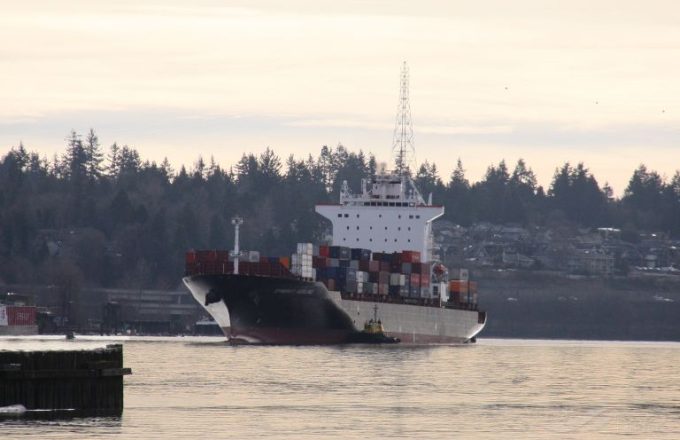
Gemini Cooperation partners Maersk Line and Hapag-Lloyd are set to axe a transpacific string as weakening trade volumes force carriers to cut capacity on this key trade.
In a customer advisory today, Hapag-Lloyd said its WC6 transpacific service, marketed as the TP9 by Maersk, would cease operations, following previously announced blank sailings on the service due to take place in weeks 40, 41 and 42.
As a result, the final sailing of the WC6/TP9 service will be the departure of the Maersk-operated 4,250 teu Synergy Keelung (pictured above) from Xiamen on 22 September, in week 39.
“Following this voyage, TP9 will remain suspended for the balance of Q4,” added a Maersk advisory. “Further information regarding the potential reinstatement of TP9 will be communicated once available.”
According to the Xeneta-owned eeSea liner database, the TP9 string deploys six vessels, ranging from 4,250 to 5,000 teu capacity on a weekly port rotation of: Xiamen-Busan-Long Beach-Xiamen.
As one of the smallest Gemini transpacific strings in terms of capacity, the TP9 has effectively acted as a ‘sweeper’ service during the tariff-induced wild swings in demand since it launched in the summer.
The main result of its suspension is that exporters out of Xiamen lose a direct mainline call to the US, and will have to revert to the original Gemini transpacific service network, which saw the port connected to the partners’ transpacific routes through the Asia Shuttle 14 service. This runs a Tianjin-Tanjung Pelepas-Singapore-Xiamen-Pusan rotation, deploying four 5,500 teu vessels.
Meanwhile, shippers in Busan can access the US west coast through Gemini’s WC2/TP8 and WC5/TP7 strings that call at Los Angeles rather than Long Beach.
The decision to remove the string appears entirely related to the supply and demand situation on the trade, rather than other external factors – all six vessels deployed on TP9 were built in South Korea and not subject to the US Trade Representative’s forthcoming 301 port fees on Chinese-built ships.
According to eeSea, there are currently 49 liner services scheduled to operate the Far East-North America west coast trade in October, amounting to 205 pro forma sailings – but subsequent blanked sailing announcements have reduced this to 184 expected sailings.
That is down from 52 this month, which is currently expected to see 188 voyages.
Meanwhile, overall transpacific capacity in September is expected to be 1.33m teu, dropping to 1.31m teu in October, when some 131,000 teu of capacity will be withdrawn.
This week also saw the final sailing of the Premier Alliance’s transpacific PS5 loop, an ad hoc service launched in June as US importers front-loaded to beat tariffs on Chinese goods, which connected Qingdao and Ningbo with Long Beach, using six 4,600-4,900 teu ships.
The Premier Alliance carriers – ONE, Yang Ming and HMM – announced this week they had rejigged their PS4 and PS6 services to cover ports dropped by the PS5 withdrawal.
The PS5 rotation is: Qingdao-Ningbo-Long Beach-Oakland-Kobe-Qingdao.
For uninterrupted access, sign in or sign up to The Daily News, Premium or The Loadstar Enterprise Plan.
Comment on this article