Loadstar Leader: Trump Hormuz toll plan catastrophic for box shipping
It has often been observed since the end of February that the US and Israeli ...


WMT: VERTICAL INTEGRATION IN LOGISTICSJBHT: HERE WE GOPG: STEADYEXPD: NEW RECORD BA: DELIVERIESMAERSK: BEAR CAMP MUSINGSCHRW: HIGHER HIGHS ON THE RADARWTC: 'ONE RECORD'HLAG: EARNINGS GUIDANCE UPGRADE AAPL: GLOBAL SMARTPHONE SHIPMENTS VW: THE IMPACT VW: MASSIVE JOB CUTS CONFIRMEDEXPD: BULLISH
WMT: VERTICAL INTEGRATION IN LOGISTICSJBHT: HERE WE GOPG: STEADYEXPD: NEW RECORD BA: DELIVERIESMAERSK: BEAR CAMP MUSINGSCHRW: HIGHER HIGHS ON THE RADARWTC: 'ONE RECORD'HLAG: EARNINGS GUIDANCE UPGRADE AAPL: GLOBAL SMARTPHONE SHIPMENTS VW: THE IMPACT VW: MASSIVE JOB CUTS CONFIRMEDEXPD: BULLISH
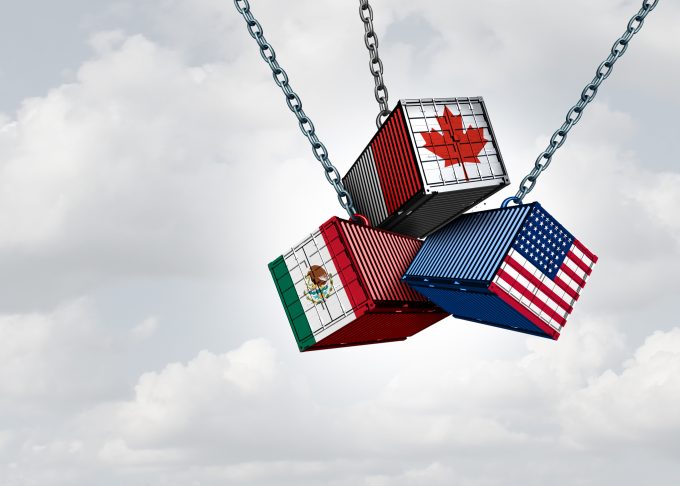
US president Donald Trump has continued his tariff onslaught, and shippers have been warned that sourcing alternatives “do not necessarily exist”.
On 4 February, President Trump promised 25% tariffs on goods from Canada and Mexico, which, he explained, was to curb illegal immigration and fentanyl smuggling.
After Mr Trump claimed to have agreed concessions from the two neighbours, the date of implementation was postponed to 4 March, while deals were finalised. And earlier this week, he indicated this deadline would be pushed back a further 30 days, to 2 April.
But yesterday, a swift u-turn meant the tariffs will be applied from 4 March under the International Emergency Economic Powers Act.
On his social media site, Truth Social, President Trump said: “Drugs are still pouring into our country from Mexico and Canada at very high and unacceptable levels. A large percentage of these drugs, much of them in the form of fentanyl, are made in, and supplied by, China.
“We cannot allow this scourge to continue to harm the US, and therefore, until it stops or is seriously limited, the proposed tariffs scheduled to go into effect on 4 March will, indeed, go into effect, as scheduled.”
Additionally, he revealed that goods from China would be hit with an additional 10% tariff on that date – in addition to the existing 10% tariff.
In response, Maersk has told customers: “We strongly advise you to verify details with official sources before making business decisions.”
The Danish carrier said the tariff changes could be creating uncertainty in supply chains, but assured its customers that its global trade and customs consultancy could provide “strategic sourcing and contingency planning advice” on action businesses should take now, including tariff mitigation and cash-flow strategies and sourcing advice.
However, Trade Data Service (TDS) warned that “alternative sources do not necessarily exist”.
It has found that that some 44% of US imports are concentrated in terms of origin country, including office equipment, oil products, machinery, electrical equipment, chemicals, pharmaceuticals, toys, and mobile phones and other hi-tech items.
“Mexico, Canada, China, and the EU feature as prominent sources, and therein lies the problem,” said TDS. “Where alternative non-dutiable sources exist for imports, or where imports only account for a small share of overall supply, the impact on consumer and export prices may be minimum.
“Where import penetration is high and alternative sources do not exist, the impact on consumer prices and export competitiveness is severe,” it warned.
For example, Mexico, China, and Canada accounted for 50% of the US’s automotive import value last year, with most of the remainder from Japan, South Korea, and Germany. Taiwan, Mexico and China account for 70% of its computers and electronics imports, with Vietnam and South Korea most of the remainder.
“A similar picture emerges for groups such as other electrical equipment, apparel, furniture, other manufactured items – all are highly dependent on imports and most of those imports are coming from the US’s top trading partners,” concluded TDS.
For uninterrupted access, sign in or sign up to The Daily News, Premium or The Loadstar Enterprise Plan.

Comment on this article
Stan Wraight
February 28, 2025 at 4:46 pmTrump and his minions are lying through their teeth, and it is so obvious that drugs and illegal immigration are the false reasons he used to override congressional votes on these matters. It’s all for publicity and to cater to his base.
Here are the facts: Citing U.S. Customs and Border Protection data, the White House has asserted that 43 pounds of fentanyl was intercepted at the border last fiscal year, marking a “massive 2,050 per cent increase” compared with the year prior, when two pounds of the deadly synthetic drug was seized.
U.S. President Donald Trump has invoked the 43-pound figure as grounds for threats of punishing trade measures, including 25-per-cent tariffs on almost all Canadian goods.