Transpacific the top earner as a strong Q2 boosts OOCL revenue
OOCL’s second-quarter trading update has reinforced signs of a stronger-than-expected container shipping market, the carrier ...


PLD: TRADING UPDATE ON THE WAY KNIN: UPSIDEJBHT: STRONG TRADING UPDATE DSV: EVERY LITTLE HELPSJBHT: CEO REMARKS WMT: VERTICAL INTEGRATION IN LOGISTICSJBHT: HERE WE GOPG: STEADYEXPD: NEW RECORD BA: DELIVERIESMAERSK: BEAR CAMP MUSINGSCHRW: HIGHER HIGHS ON THE RADAR
PLD: TRADING UPDATE ON THE WAY KNIN: UPSIDEJBHT: STRONG TRADING UPDATE DSV: EVERY LITTLE HELPSJBHT: CEO REMARKS WMT: VERTICAL INTEGRATION IN LOGISTICSJBHT: HERE WE GOPG: STEADYEXPD: NEW RECORD BA: DELIVERIESMAERSK: BEAR CAMP MUSINGSCHRW: HIGHER HIGHS ON THE RADAR
The transpacific trade continues to descend into something akin to chaos – with major deepsea carriers readjusting schedules and services while niche operators launch new strings.
And unless carriers on the trade begin to announce new blank sailings for this month, July is shaping up to be the largest month in terms of eastbound Transpacific capacity ever offered, with the eeSea liner database currently showing that carriers collectively are expected to offer just under 2.57m teu of slots.
According to eeSea figures, the “highest actual capacity we saw during the covid peak was in April 2022, at 2.14m teu, compared to the current forecasted capacity in July.
“However, Q3 – Q4 2024 performed notably high too, peaking at 2.39m teu in August, and again in 2.37m teu actual capacity in December,” eeSea head of operations Destine Ozuygur told The Loadstar.

Source: eeSea (click to expand)
The mounting capacity this month comes against a backdrop of a 40% decline in spot rates in the second half of June as huge questions continue to hover over demand levels in the midst of tariff uncertainty.
With the 9 July deadline looming for the potential reintroduction of hugely onerous tariff levels, and Trump’s stated intention of having new trade deals signed off by the 4 July holiday (two days from now and with little to report so far), shippers and their forwarders clearly have no idea what sort of duties goods loaded in Asia now will face when they arrive in the US.
A range of Loadstar sources contend that demand has dropped heavily over the past couple of weeks, which explains the rate declines but doesn’t explain why some carriers continue to add capacity when the trade appears so vulnerable.
Alphaliner today reports that China’s Hede Shipping will add a third service to its transpacific network. It first entered the transpacific in March last year.,
Hede’s HDS3 service will deploy three ships of between 2,700-4,400 teu capacity on a Nansha-Los Angeles-Nansha rotation which will turn in five weeks. In Los Angeles it will call at the West Basin Container terminal jointly operated by TiL, Ports America and China Shipping Terminal development.
Alphaliner also reported that Emirates Shipping Lines (ESL) is set to make a return to the trade after agreeing to participate on UWL’s Sun Chief Express (SCX) service between Vietnam and the US Pacific Northwest.
“As part of this latest cooperation between UWL and Emirates Shipping Lines, the latter will deploy three ships of 2,800 – 3,100 teu, replacing Swire Shipping as vessel provider on the Sun Chief Express,” Alphaliner writes.
The service has a port rotation of Ho Chi Minh-Shekou-Seattle-Ho Chi Minh, and was initially launched by Swire and UWL in February 2022.
Swire, in partnership with UWL, first initiated this Vietnam-Pacific Northwest service back in February 2022.
However, these remain niche services, and eeSea’s Ms Ozuygur said that much of July’s forecast bumper capacity would come from services that were reinstated last month as carriers sought to cater for an expected pre-tariff pause cargo rush.
“July is peaking because of these additional services that commenced in June, and more of those vessels will be arriving in the West Coast gateway ports and bringing that extra cap along for the ride. Some of these strings have returned for just one to two months.
“This planned capacity uptick is also bolstered by the usual ripple of delayed vessels that provide a little extra foothold against the spike in blank sailings,” she said.
Amongst the revived strings include Hapag-Lloyd’s PNX service, which had been suspended for three years and now appears to be operating as an extra loader service, with just the 8,600 teu Sofia Express sailing between China and the US east coast.
Similarly, under the Gemini agreement, Maersk and Hapag-Lloyd launched the TP9 service on 23 June, deploying six ships of 4,500 teu capacity on a Xiamen-Pusan-Long Beach-Xiamen routing.
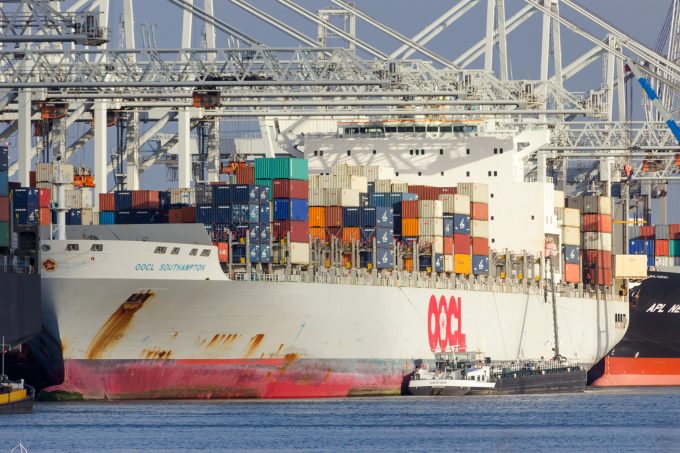
Ms Ozuygur also noted the SEA3 service operated by Cosco/OOCL, and its “see-saw of modifications”, which was originally launched on a standalone basis by OOCL this time last year and was then folded into the Ocean Alliance’s PSW11 service at the beginning of this year.
However, in the wake of the 2 April “Liberation Day” tariff announcement, the PSW11 service only operated from 1 April to 9 May this year, with just three out of six planned voyages completed.
And yet it has now transpired that Cosco and OOCL have reinvigorated the SEA3 service with the departure today of the 8,000 teu OOCL Rotterdam from Kaohsiung.
According to eeSea the service will deploy six 8,000 teu vessels on Kaohsiung-Xiamen-Yantian-Long Beach-Kaohsiung rotation – however, the following two sailings have already been blanked.
“I would expect to see more blanks in July in this situation if spot rates continue to fall, or suspension of the smaller services – this could mean the smaller carriers like HEDE or TS Lines are hit first.
“That said, we have to remember blanks can go both ways, and in uncertain times are even used in place of TBN’s [to be notified] as placeholders for possible voyages.
“It’s easier to announce a blank and then add a real sailing if demand persists against announcing a sailing, removing it and insert a blanking only to renege and reinsert the sailing once again,” she explained.
For uninterrupted access, sign in or sign up to The Daily News, Premium or The Loadstar Enterprise Plan.

Comment on this article