Hactl chief backs Bay Area cargo strategy as Cathay adds barge link
Hong Kong’s air cargo sector is increasingly looking beyond the airport for growth, with Cathay ...

VW: THE IMPACT VW: MASSIVE JOB CUTS CONFIRMEDEXPD: BULLISHCHRW: POSITIONING AHEAD OF EARNINGSAMZN: IN THE NUMBERSAMZN: PEOPLE MATTER UNTILVW: THE LAST CUT IS THE DEEPESTJBHT: GEARING UP VW: BUYING TIMER: BIG VOTE OF CONFIDENCEAAPL: BEARISH HEDGEYE AAPL: THE BEAR CASEFDX: LIFE SCIENCES ORG UNVEILEDWTC: UPS AND DOWNSWTC: ASX ANNOUNCEMENT REGARDING DSV PARTNERSHIP VW: D-DAY
VW: THE IMPACT VW: MASSIVE JOB CUTS CONFIRMEDEXPD: BULLISHCHRW: POSITIONING AHEAD OF EARNINGSAMZN: IN THE NUMBERSAMZN: PEOPLE MATTER UNTILVW: THE LAST CUT IS THE DEEPESTJBHT: GEARING UP VW: BUYING TIMER: BIG VOTE OF CONFIDENCEAAPL: BEARISH HEDGEYE AAPL: THE BEAR CASEFDX: LIFE SCIENCES ORG UNVEILEDWTC: UPS AND DOWNSWTC: ASX ANNOUNCEMENT REGARDING DSV PARTNERSHIP VW: D-DAY
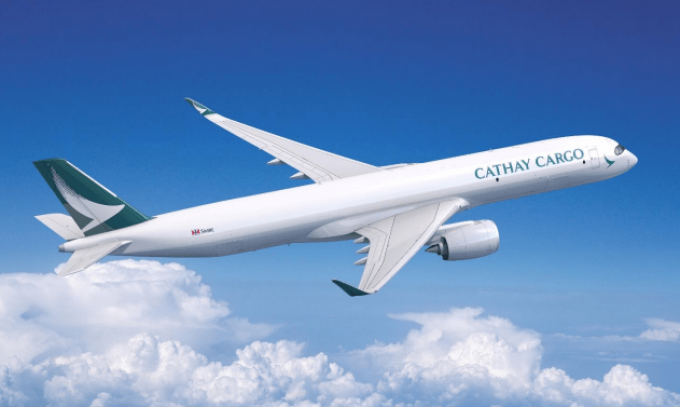
Cathay Pacific is to receive six new A350 freighters, with options on another 20 – but in the near term its cargo capacity will grow through its passenger fleet taking its share of the carrier’s freight traffic to 50%.
Despite the turbulence in the transpacific arena unleashed by Washington’s tariff gyrations, Hong Kong-based Cathay’s tonnage was up 6.3% year on year in June, which brought its cargo growth in the first half to 11.3%.
Cargo revenue in the January-June period grew 2.2%, but yield fell 3.4%.
Passenger yields also dropped, but the 1% rise in overall profit, to HK$3.65bn (US$465m), was thanks to higher passenger numbers, lower fuel costs and a “steady” cargo performance.
Washington’s move to cancel the de minimis exemption on China-origin parcels hurt Cathay’s transpacific e-commerce volumes, but the carrier saw “significant growth” from Taiwan and South-east Asia to the Americas, led by general cargo and hi-tech electronics, noted cargo director Tom Owen.
Despite the US e-commerce set-back, he remains upbeat on the sector, describing it as a key volume driver for Cathay Cargo.
“E-commerce continues to drive air cargo demand across APAC, particularly in cross-border express shipments from the Chinese mainland, Hong Kong, and South-east Asia. However, there has been some softening on the Chinese mainland to US tradelanes, given the changing trade and regulatory policies. Other tradelanes for e-commerce remain solid at the moment,” he said.
Other sectors that have remained strong are hi-tech electronics and semiconductor machinery (particularly on routes between north Asia and North America), pharmaceuticals, and perishables.
And Mr Owen was also bullish on the long-term prospects. He said: “While forecasting for the next five-to-ten years involves some uncertainty, we remain very confident of the region’s resilience and potential. South-east Asia, the Middle East, and other emerging markets will see significant growth driven by diversification in trade routes and continued investments in logistics infrastructure.”
In May, Cathay’s transhipment volumes were up 12.7%. Hong Kong’s extensive route network gives the carrier’s home base a pivotal role in global trade, said Mr Owen, noting that the airline serves more than 40 destinations with freighters and over 100 with passenger flights.
A major focus has been the development of intermodal connectivity across the Pearl River Delta and beyond, he added.
“We are integrating air, road, sea and digital infrastructure to deliver fast, reliable logistics solutions across southern China and beyond,” Mr Owen said. He highlighted Cathay’s Cargo Terminal Dongguan, a bonded facility where cargo is screened and palletised for transfer to Hong Kong.
On 6 August, Cathay placed an order for 14 B777-9 passenger planes, which boosted its orderbook for the type to 35, with options for another seven. The airline now has more than 100 aircraft on order.
And Mr Owen is looking forward to receiving the new widebody freighter, noting its 25% increase in efficiency per payload tonne, compared with current models. However, the A350F is not expected to enter the market until late 2027, so Cathay’s cargo capacity growth hinges on widebody passenger aircraft joining the fleet.
“We are seeing a steady rise in available cargo space in the bellies of passenger aircraft. Most of our growth in 2025 will come from this source,” he said. “We carry approximately 45% of our cargo in widebody passenger aircraft bellies, and this will continue to grow to about 50% as we increase passenger frequencies.”
Meanwhile, for the near future a major focus is on digital innovation. Cathay Cargo upgraded its online booking system in March, and introduced a digital tool that automates heavyweight shipment calculations.
And at its Hong Kong cargo terminal, the carrier has completed trials of autonomous electric tractors that tow cargo dollies from the facility to the airport’s west cargo apron. Moreover, the terminal has the first ground handling operation in Asia to achieve IATA security management certification, with workplace safety enhanced through the integration of AI with CCTV systems.
Listen to our recent epsiode of News in Brief to get up to speed on the latest supply-chain news!
For uninterrupted access, sign in or sign up to The Daily News, Premium or The Loadstar Enterprise Plan.

Comment on this article