155 hospitalised as toxic gas leak forces Antwerp box terminals to close
European shippers and forwarders have been warned to expect significant disruption to operations after a ...


JBHT: STRONG TRADING UPDATE JBHT: CEO REMARKS WMT: VERTICAL INTEGRATION IN LOGISTICSJBHT: HERE WE GOPG: STEADYEXPD: NEW RECORD BA: DELIVERIESMAERSK: BEAR CAMP MUSINGSCHRW: HIGHER HIGHS ON THE RADARWTC: 'ONE RECORD'HLAG: EARNINGS GUIDANCE UPGRADE
JBHT: STRONG TRADING UPDATE JBHT: CEO REMARKS WMT: VERTICAL INTEGRATION IN LOGISTICSJBHT: HERE WE GOPG: STEADYEXPD: NEW RECORD BA: DELIVERIESMAERSK: BEAR CAMP MUSINGSCHRW: HIGHER HIGHS ON THE RADARWTC: 'ONE RECORD'HLAG: EARNINGS GUIDANCE UPGRADE
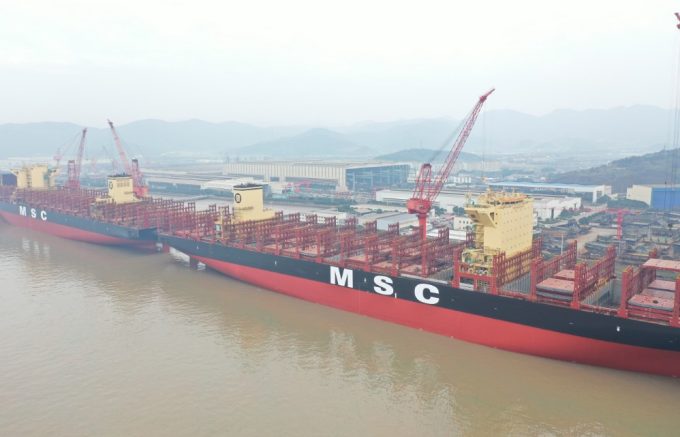
While last year more containership capacity was ordered than in any year before, the actual global fleet capacity increase expected this year will be in the 3% range – almost matching expected growth in demand, according to new analysis from Drewry.
The analyst said the 2026 newbuilding delivery schedule had been affected by a sharp decline in new orders placed during the post-pandemic slowdown of 2023, meaning global fleet growth this year will be far lower than in 2024 and 2025.
“We are estimating that the active fleet ended last year up 7 % year on year,” said Drewry’s senior manager of container research, Simon Heaney.
“Now that’s slower than the exceptional growth of 2024, when the fleet surged 11%, but it is still problematic given the compounding effect of sustained oversupply.

Source: Drewry Container Forecaster
“There was a brief pause in contracting in 2023 when there was just 1.5m teu ordered, so that’s going to translate into fewer deliveries in 2026, and combined with what we’re assuming is a pick-up in scrapping, this should temporarily slow fleet growth to around 3% this year,” he explained.
While the industry is likely to have to wait another fortnight until Container Trades Statistics releases its December volume figures – and hence the definitive numbers for full-year 2025 – it has been clear for some time that last year was another record-breaker. Several months posted 16m teu-plus volumes, a barrier first broken in May and repeated four times over the year.
However, Drewry estimated that container volumes grew 5.5% last year, as measured by port throughput numbers, to just under 1bn teu.

Source: Drewry Container Forecaster
Mr Heaney acknowledged the industry’s “remarkable resilience in the face of significant challenges”, as “emerging markets such as Latin America, South Asia, South-east Asia, and Africa experienced a large resurgence”, and Chinese exporters managed to find new markets to compensate for US cargo lost to tariff costs. But he argued that “the overall risk outlook remains tilted to the downside amid significant geopolitical and macroeconomic flux”.
“Drewry is of the opinion that container growth last year was somewhat artificially inflated by front-loading and inventory building strategies to the extent that there will be a hangover in 2026, with global growth moderating to 1.8 % in our latest forecast,” he said.
Drewry’s five-year forecasts are currently modelling 2%-3% growth a year up to 2029, the end of its forecast window, and indicating that the balance in the growth of supply and demand expected this year will be temporary.
“That respite, in our view, is going to be short-lived – the wave of contracts placed in 2024 and 2025 is going to push the annual fleet growth back up into the 6% to 9% range from 2027 through to 2029,” he said.
There is currently 11m teu in new tonnage under construction, according to Drewry, representing 33% of the current global fleet, with more than 2m teu of that accounted for by MSC, which has been the driving force behind global fleet expansion since 2020, when it set its sights on overtaking Maersk as the largest carrier.
“MSC achieved that objective in the first quarter of 2022, but has since widened the gap very aggressively through an unprecedented combination of newbuild orders and second-hand acquisitions,” Mr Heaney noted, with MSC’s market share increasing from 17% to 21%.

Source: Drewry Container Forecaster
“Against this backdrop, I think we have to look at new orders by top 10 carriers more as defensive positioning, than anything else – MSC’s ascent has triggered a quasi-arms race, one that few carriers appear willing to opt out of, even at the cost of prolonging the industry’s capacity imbalance,” he said.
However, the big unknown remains scrapping, Drewry’s capacity forecast assumes “a material acceleration in demolitions”, estimating 450,000 teu sent to scrapyards this year, rising to 700,000 teu in each of the following years.
This also takes into account the fact that 4% of box ships, for total capacity of 1.,3m teu, are over 25 years old, the traditional end of a vessel’s lifetime.
“Given the industry’s reluctance to scrap in recent years, this well may prove to be too optimistic – our forecast for this year alone is nearly equal to the total capacity that has been removed from the fleet over the past six years.
“The need to restore market balance, and particularly as Red Sea diversions unwind, only reinforces the case for capacity reduction, although strong charter earnings and weak steel prices don’t offer huge incentives to owners to scrap
“But the argument for disposal is becoming increasingly difficult to ignore; if you keep hold of these vintage containerships, it merely defers the problem and it is a major driver of what will happen to freight rates this year,” he added.
For uninterrupted access, sign in or sign up to The Daily News, Premium or The Loadstar Enterprise Plan.

Comment on this article