155 hospitalised as toxic gas leak forces Antwerp box terminals to close
European shippers and forwarders have been warned to expect significant disruption to operations after a ...


JBHT: STRONG TRADING UPDATE JBHT: CEO REMARKS WMT: VERTICAL INTEGRATION IN LOGISTICSJBHT: HERE WE GOPG: STEADYEXPD: NEW RECORD BA: DELIVERIESMAERSK: BEAR CAMP MUSINGSCHRW: HIGHER HIGHS ON THE RADARWTC: 'ONE RECORD'HLAG: EARNINGS GUIDANCE UPGRADE AAPL: GLOBAL SMARTPHONE SHIPMENTS VW: THE IMPACT
JBHT: STRONG TRADING UPDATE JBHT: CEO REMARKS WMT: VERTICAL INTEGRATION IN LOGISTICSJBHT: HERE WE GOPG: STEADYEXPD: NEW RECORD BA: DELIVERIESMAERSK: BEAR CAMP MUSINGSCHRW: HIGHER HIGHS ON THE RADARWTC: 'ONE RECORD'HLAG: EARNINGS GUIDANCE UPGRADE AAPL: GLOBAL SMARTPHONE SHIPMENTS VW: THE IMPACT
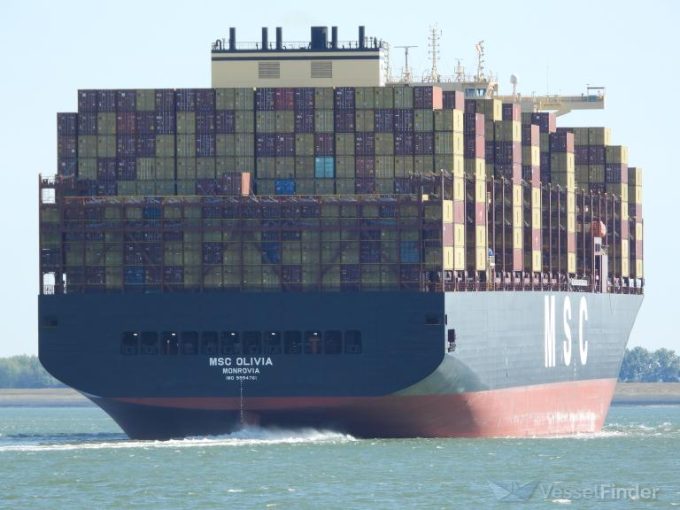
MSC appears to be doubling-down on a strategy of building market share on the transatlantic trade with a large-scale capacity injection on its strings between North Europe and North America.
The capacity addition largely comes via the introduction of its standalone round-the-world Albatross services to the US east coast, deploying 17 ships of 13,000 to 16,000 teu.
This is in a similar fashion to the way that it introduced much larger vessels on the Mediterranean-US east coast trade on the Dragon/MD4 round-the-world loop it operates with the Premier Alliance.
According to the eeSea by Xeneta liner database, the both the Dragon and Albatross services entered the transatlantic trades in August, significantly increasing the trade’s capacity.
“On the North Europe to US east coast trade, capacity reached a 28-month high this week, just shy of 60,000 teu (4 week rolling average),” a commentary from Xeneta noted late last week. “Comparing that to the 10-month low just one month ago, offered capacity is up a massive 55.5%.
“The expansion mainly comes from non-alliance capacity, up 157.1%, with Gemini alliance offering 42.3% more over the same period,” it added.
According to eeSea, the Dragon/MD4 gradually ramped up frequency – performing one transatlantic sailing in August, followed by two in September, five in October, and four expected this month. This added 9,000 teu of capacity in August, 18,000 teu in September, and up to 34,000 teu in October and November.
Meanwhile, MSC’s standalone Albatross service performed two transatlantic sailings in August, followed by four in September and October, and three this month, bringing respective capacity additions to the trade of 26,000 teu, 52,000 teu, 50,000 teu, and 39,000 teu.
Meanwhile, this chart from Xeneta shows the growing imbalance between capacity and demand on the North Europe-North America headhaul route.

Source: Xeneta
With trade and pricing data from Container Trades Statistics (CTS) available for September, it has transpired that the capacity additions did not coincide with any volume or freight rate boost.
In fact, it is quite the reverse: CTS volume date for September shows 416,500 teu shipped from Europe to North America, some 4.5% down on September 2024. And the CTS Europe-North America price index for September stood at 89, 6.3% down year on year, and 3 basis points down on August – indicating a weakening market.

Source: Container Trades Statistics
Nevertheless, Geneva-headquartered MSC is continuing to tinker with the Albatross pro forma line-up, with Alphaliner today noting that new westbound calls at Antwerp, Felixstowe, and Boston have been added, Charleston has been dropped, and a new call added at its Caribbean transhipment hub of Freeport, Bahamas, as the last port of call before vessels return to Asia via the Panama Canal.
Meanwhile, a new westbound call at Charleston has been inserted into MSC’s Ecuador-NWC-US service, although it is now the only US call in the string.
Given the tariff-induced uncertainty over demand, it is reasonable to assume a number of sailings on the trade will be blanked, which appears to have begun with last week’s announcement from the Gemini partners that they would blank every seventh sailing on their AL2 transatlantic service, beginning with the 4,150 teu Maersk Tennessee, its scheduled departure from Antwerp on 25 December delayed a week.
The AL2 structural blanking programme would continue until April, Maersk said, “in order to proactively address the severity of the winter weather across the North Atlantic, which historically has led to deterioration in reliability”.
The service deploys six vessels with an average capacity of 4,800 teu on a port rotation of Antwerp-Rotterdam-Bremerhaven-Norfolk-Houston-Norfolk.
For uninterrupted access, sign in or sign up to The Daily News, Premium or The Loadstar Enterprise Plan.

Comment on this article