Asia Pacific traffic gives Mexican freight flows a boost
With a third A330 freighter added to its fleet, Awesome Cargo started scheduled charter flights ...

KNIN: CONF CALL CLOSING KNIN: PRICING POWER KNIN: MARKET SHARE GAINS IN ROAD KNIN: AI-RELATED COST INFLATION OUTLOOKKNIN: APEX LOGISTICS IPO UPDATEKNIN: QUESTION TIMEKNIN: 'COST REDUCTION PROGRAMME IS ON TRACK'KNIN: CFO REMARKSKNIN: MONETARY IMPACT FROM AI KNIN: AI UPSIDEKNIN: STRONG ROAD UNIT DELIVERY KNIN: AIR LOGISTICS SHINESKNIN: SEA LOGISTICS PERFORMANCE KNIN: CEO REMARKSKNIN: CONF CALL F: NEW PARTNERSHIP DISCLOSEDDSV: LITTLE CHANGE
KNIN: CONF CALL CLOSING KNIN: PRICING POWER KNIN: MARKET SHARE GAINS IN ROAD KNIN: AI-RELATED COST INFLATION OUTLOOKKNIN: APEX LOGISTICS IPO UPDATEKNIN: QUESTION TIMEKNIN: 'COST REDUCTION PROGRAMME IS ON TRACK'KNIN: CFO REMARKSKNIN: MONETARY IMPACT FROM AI KNIN: AI UPSIDEKNIN: STRONG ROAD UNIT DELIVERY KNIN: AIR LOGISTICS SHINESKNIN: SEA LOGISTICS PERFORMANCE KNIN: CEO REMARKSKNIN: CONF CALL F: NEW PARTNERSHIP DISCLOSEDDSV: LITTLE CHANGE
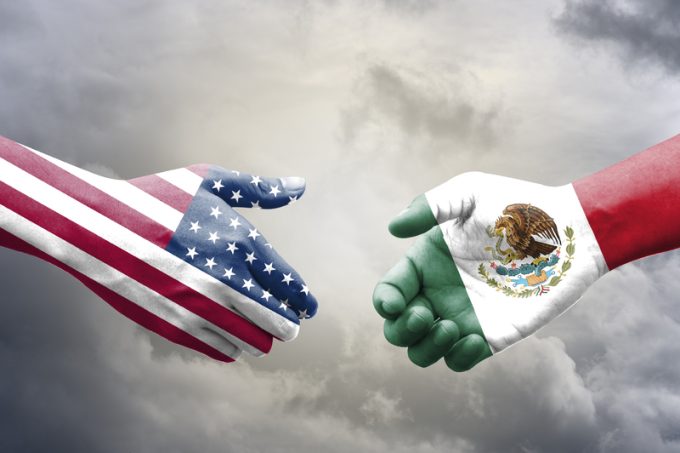
The Mexican government is approaching the looming renegotiations of the free-trade deal with the US and Canada (USMCA) with concern, but also with a considerable tailwind.
While Washington’s tariffs and other measures had an impact on northbound flows, a 3.9% increase in trade ensured that Mexico remained the largest trade partner of its northern neighbour.
Meanwhile, transpacific business has looked brighter for Mexican ports than for their northern peers. Transpacific flows at the top gateways showed a stark divergence in January.
While the ports of Los Angeles and Long Beach reported year-on-year declines in container throughput, of 12% and 11% respectively, Mexico’s largest container gateway, Manzanillo, saw its teu tally jump 8%, to a new record.
Foreign direct investment (FDI) in Mexico has not suffered from tensions with Washington – indeed, it jumped 10.8% last year, to $40.871bn, with new investment up 132.9%, to $7.38bn.
After Canadian prime minister Mark Carney declared ‘the end of an era’, the Canadian government has embarked on an aggressive push for trade diversification, signing trade agreements with new partners to reduce the nation’s reliance on the US market.
Noises in that direction have also emanated from Mexico, especially towards South America, both in terms of trade and as a bridge between the southern hemisphere and Asia. Last summer, Colombia-based Avianca placed a second A330-300P2F freighter with Aerounion and rebranded the Mexican carrier as Avianca Cargo Mexico.
Still, the Mexican government has been less strident in its pursuit of new trade partners and kept emphasising the benefits of USMCA to all three members, despite strongarm tactics from Washington, such as the US Department of Transportation’s order to end the joint-venture between Delta Air Lines and Aeromexico, and ban new US flights by Mexican airlines, to force the return of slots at Mexico City’s main passenger gateway to US carriers.
Unlike Mexico’s chief container gateways, its cargo airports suffered declining volumes for the most part last year, largely due to the measures from the US DoT.
For its confidence in the future of the relationship with the US, Mexico City can point to the rise in US trade last year as well as the fact that the largest chunk of last year’s FDI (38.8% of all money pouring in) came from the northern neighbour.
In line with this the Sheinbaum government has given strong signals that USMCA should remain largely unchanged. Following a series of 30 round-table sessions with different sectors of industry, the economy ministry issued a report stating that the treaty is regarded as “an asset that should be preserved”. Rather than renegotiate it, the partners should seek to refine the existing framework.
“The challenge is to implement it better, modernise it, and make it more inclusive,” said Vidal Llerenas, deputy minister for industry and commerce.
He stressed that the government’s push to diversify Mexico’s export markets did not indicate a weaker commitment to USMCA.
Some voices in industry have argued that the surprisingly strong growth in US trade last year constituted an argument for reducing “dependence on Asia”.
The tariff on imports from nations that do not have free-trade agreements with Mexico (which include China) the government introduced last year was a clear signal that it is treading carefully not to antagonise Washington.
If the Trump administration were to scrap USMCA in favour of bilateral trade deals with Mexico City and Ottawa, trade with Canada would not likely suffer. The Canadian Chamber of Commerce underscored its intent with a trade mission to Mexico in February, when it strengthened its ties with its Mexican counterpart.
Not surprisingly, Canadian Pacific Kansas City Rail (CPKC), the only Class I railway that serves all three USMCA countries, is upbeat on the potential of trade between Canada and Mexico.
“Today we are making this land bridge,” said CPKC Mexico president Oscar del Cueto. “To overcome the uncertainty, one must focus on that which can be controlled to strengthen the North American bloc”, he added.
For uninterrupted access, sign in or sign up to The Daily News, Premium or The Loadstar Enterprise Plan.
Comment on this article