BAL re-enters liner trades with transpacific loader
Opportunistic Chinese shipowner BAL Container Line is making a selective comeback to the transpacific trade, ...


WTC: 'ONE RECORD'HLAG: EARNINGS GUIDANCE UPGRADE AAPL: GLOBAL SMARTPHONE SHIPMENTS VW: THE IMPACT VW: MASSIVE JOB CUTS CONFIRMEDEXPD: BULLISHCHRW: POSITIONING AHEAD OF EARNINGSAMZN: IN THE NUMBERSAMZN: PEOPLE MATTER UNTILVW: THE LAST CUT IS THE DEEPESTJBHT: GEARING UP VW: BUYING TIMER: BIG VOTE OF CONFIDENCEAAPL: BEARISH HEDGEYE
WTC: 'ONE RECORD'HLAG: EARNINGS GUIDANCE UPGRADE AAPL: GLOBAL SMARTPHONE SHIPMENTS VW: THE IMPACT VW: MASSIVE JOB CUTS CONFIRMEDEXPD: BULLISHCHRW: POSITIONING AHEAD OF EARNINGSAMZN: IN THE NUMBERSAMZN: PEOPLE MATTER UNTILVW: THE LAST CUT IS THE DEEPESTJBHT: GEARING UP VW: BUYING TIMER: BIG VOTE OF CONFIDENCEAAPL: BEARISH HEDGEYE
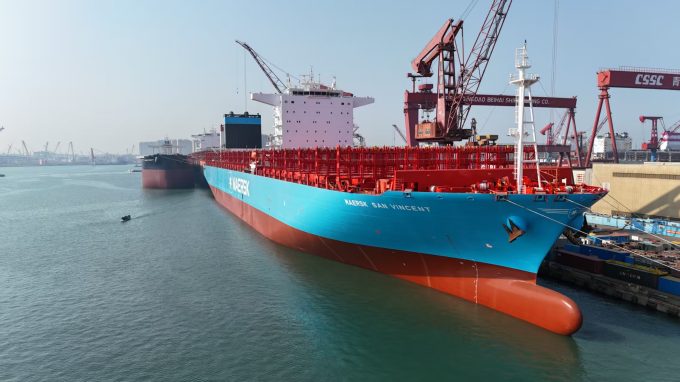
Maersk Line parent AP Moller-Maersk revealed today that it has drawn up a huge vessel retrofit plan with the owners of some 200 of its chartered vessels to “reduce the slot cost by improving fuel efficiency and cargo-carrying capacity”.
The project, involving 50 different shipowners, encompasses more than half of its chartered fleet. According to Alphaliner data, the world’s second largest shipping line currently operates a total fleet of 736 vessels amounting to a combined capacity of 4.62m teu – of this, 392 vessels are chartered-in, representing a combined capacity of 1.87m teu, equivalent to just over 40% of the carrier’s overall fleet.
“Our medium- and long-term chartered fleet makes up a significant proportion of our operations as well as of our total fuel consumption,” Ahmed Hassan, head of asset strategy and strategic partnerships at Maersk, said.
“By working closely with our partners, we aim to implement solutions that not only reduce emissions but also enhance the overall competitiveness of our fleet,” he added, noting that it would also play an important part in Maersk’s ambition to reduce its fleet’s emissions by 35% by 2030.
“While fuel transition is needed to reach our long-term goal of net-zero emissions by 2040, investments in existing fleet efficiency enhancement technologies is a powerful tool to gain significant emissions reductions in the short term,” Mr Hassan said.
“Consequently, this strong emphasis on efficiency measures can deliver tangible progress towards our 2030 goal. That goes for owned as well as chartered vessels,” he explained.
The type of projects under consideration includes replacing propellers with new models that have greater thrust, or bulbous bows with newer designs that “enhance hydrodynamic efficiency”.
“Many of these ships were designed and constructed at a time when container vessels in general were sailing at faster speeds,” Anda Cristescu, head of chartering & newbuilding at Maersk, said.
“To bring down fuel consumption, we have over the years introduced less compressed vessel schedules, but the propellers and bulbs optimized for faster speeds have been kept – there lies a big efficiency potential in replacing them,” she added.
Meanwhile, cargo capacity of the vessels is being upgraded through a range of structural and technical improvements such as elevating the wheelhouse to improve line of sight and increase intake; raising lashing bridges; strengthening the vessel’s deadweight capacity for deeper drafts; and upgrading both lashing systems and loading computer functionalities.
Altogether, Maersk said that over 1,500 individual projects had so far been completed, and another 1,000 were currently underway due for completion by 2027.
It added that the costs of the projects are “split between Maersk and the vessel owners”.
“We have from experience found that this model is a win-win,” Mr Hassan said.
“At Maersk, we can reduce both emissions and fuel costs, while the owners get the long-term value of a modernised vessel.
“Fleet renewal is often seen as new vessels replacing the old, but it is also about ensuring your existing vessels keep their competitive edge,” he added.
For uninterrupted access, sign in or sign up to The Daily News, Premium or The Loadstar Enterprise Plan.

Comment on this article