Ocean capacity is rising, demand is cooling, and 'the market is starting to turn'
Container spot freight rates on the main east-west ocean trades showed their first decline since ...


JBHT: NEW HIGHS EVERYWHEREPLD: STRONG DELIVERYJBHT: FAIR-VALUE CONSENSUS ESTIMATE AT ALL-TIME HIGH KNIN: AI TECH ADVANTAGEPLD: TRADING UPDATE ON THE WAY KNIN: UPSIDEJBHT: STRONG TRADING UPDATE DSV: EVERY LITTLE HELPSJBHT: CEO REMARKS WMT: VERTICAL INTEGRATION IN LOGISTICS
JBHT: NEW HIGHS EVERYWHEREPLD: STRONG DELIVERYJBHT: FAIR-VALUE CONSENSUS ESTIMATE AT ALL-TIME HIGH KNIN: AI TECH ADVANTAGEPLD: TRADING UPDATE ON THE WAY KNIN: UPSIDEJBHT: STRONG TRADING UPDATE DSV: EVERY LITTLE HELPSJBHT: CEO REMARKS WMT: VERTICAL INTEGRATION IN LOGISTICS

Golden Week blank sailing announcements have begun, with one major forwarder warning that carriers are expected to “strategically reduce capacity” to drive general rate increases [GRIs].
MSC announced today it plans to adjust capacity on its Asia to Europe networks between weeks 39 and 41, “due to the anticipated slowdown in demand during Golden Week holiday”.
Six of its sailings will be blanked – two to the Mediterranean and four to North Europe.
The latter trade will see the both the Swan and Brittania services blanked in week 39, with Brittania also blanked the following week, along with the Albatross.
Services blanked to the Mediterranean include Jade in week 39 and the Dragon in week 41.
But MSC assured customers: “You may continue to place bookings as usual, as we are arranging contingency plans with alternative services.”
DHL Global Forwarding said in its September update that there was “strong seasonal demand” forecast ahead of China Golden Week and year-end holidays, which was driving vessel utilisation up.
But it added that despite this, carriers were expected to “strategically reduce capacity”, and blank sailings to drive GRIs.
“Freight rates are fluctuating,” said the forwarder, and noted that both Intra-Asia and Oceania showed “tight space and rising rates”, with carriers on these trades prioritising high-yield shipments.
According to DHL, rates into Latin America also “remain volatile and elevated”, amid “growing but unpredictable demand” and “successful capacity management”.
In its supply/demand forecast, the forwarder warned that space this month would be limited on intra-Asia and on Asia to Africa, Oceania, and East Med.
And while it indicated that the two sides would be “in equilibrium for the next few months”, there could be a glut of capacity on Asia-North America in October.
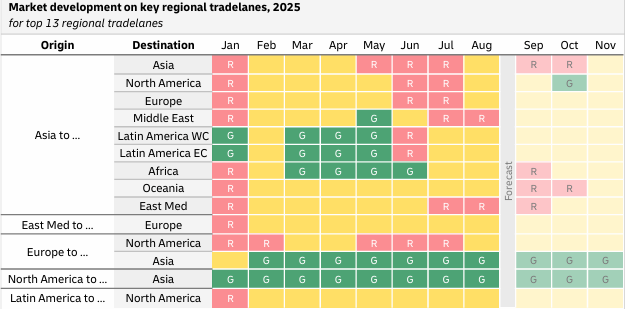
Source: DHL Global Forwarding OFR Market Update | September

But it underscored: “Short-term demand may change, given volatility around US trade policy, so caution is advised when planning.”
Destine Ozuygur, product marketing manager at Xeneta, told The Loadstar that on Far East-Europe trades there had been high-capacity utilisation and lower-than-average cancellation rates, due to Cape of Good Hope diversions and port congestion capacity absorption.
“We’re currently only forecasting 13 blanks in October out of Asia, and the majority of those would have their impact on Northern Europe in mid-late November,” she said.
“The tally for September is now 15 which is a little closer to our usual expectations.
“For comparison, we saw 39 blanks in October 2023 and 31 in 2024. We expect to see more trickle in over the next few weeks, but precisely how many is hard to say. There is a possibility it will remain historically low,” Ms Ozuygur added.
On the transpacific, she noted a similar pattern of “historically low blanked sailings”, averaging 33 a month since June, a forecasted 31 in September and 28 in October out of Asia. For comparison, Ms Ozuygur pointed out, there were 73 in October 2023 and 67 in 2024.
“Due to the shorter transit, these blanks would have an impact in North America in mid-late October or early November. That window of impact is extended into November, because MSC’s transpacific network is largely concentrated on the east coast. Again, we will expect an uptick here, but more muted than usual,” she explained.
She added that the trend of swapping-out smaller vessels in place of blanks, especially on the transpacific, was one of the reasons there had been lower cancellation rates.
“This may require more operational finesse than inserting a blank sailing, but at the end of the day, it’s saving shippers and carriers time and money, lowering cancellation rates and contributing to improved reliability.
“We have already observed Gemini practising this on the transpacific… MSC is a little harder to pin down, but we’re keeping them in our sights too.”
Listen to our recent episode of News in Brief to catch up on the latest supply chain news!
For uninterrupted access, sign in or sign up to The Daily News, Premium or The Loadstar Enterprise Plan.

Comment on this article