Zanzibar revives maritime heritage with plan for new seaport and free zone
Zanzibar appears to be eyeing the container transhipment game with plans to develop an integrated ...


PLD: TRADING UPDATE ON THE WAY KNIN: UPSIDEJBHT: STRONG TRADING UPDATE DSV: EVERY LITTLE HELPSJBHT: CEO REMARKS WMT: VERTICAL INTEGRATION IN LOGISTICSJBHT: HERE WE GOPG: STEADYEXPD: NEW RECORD BA: DELIVERIESMAERSK: BEAR CAMP MUSINGS
PLD: TRADING UPDATE ON THE WAY KNIN: UPSIDEJBHT: STRONG TRADING UPDATE DSV: EVERY LITTLE HELPSJBHT: CEO REMARKS WMT: VERTICAL INTEGRATION IN LOGISTICSJBHT: HERE WE GOPG: STEADYEXPD: NEW RECORD BA: DELIVERIESMAERSK: BEAR CAMP MUSINGS
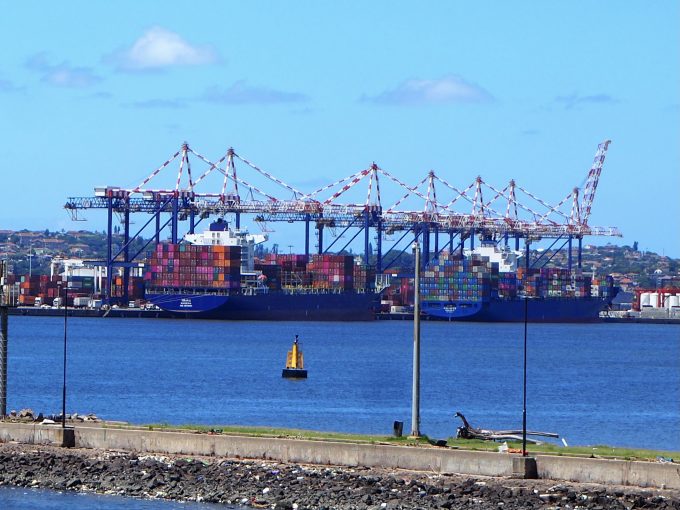
The South African government has been warned that proposals to introduce cabotage regulations to the domestic shipping industry could lead to a 40% decline in container volumes through its ports.
Proposals for a new national shipping line were published last week, part of new Merchant Shipping Bill (MSB).
“The prospective carrier, which may operate under the name South African Shipping Company (SASCO), would operate a range of vessel types, all under the South African flag,” says this week’s Alphaliner research note.
“The project will be carried out with the support of the Development Bank of Southern Africa, a government-owned development finance body.
“If the plan moves forward, it is understood the government will explore the possibility of acquiring existing companies or vessels,” it adds.
To support these plans, and the entrance of a state-owned carrier to the liner trades, the government has drawn up plans for new cabotage restrictions on foreign carriers carrying domestic cargo between South African ports.
However, in a series of public hearings to gauge reaction to the MSB on Tuesday, South African forwarders warned that a stipulation in the bill that domestic “coastwise traffic” be restricted to South Africa-flagged vessels “lacks the precision to determine whether it applies strictly to the domestic cargo movement between South African ports or whether it also encompasses deepsea vessels carrying cargo intended for multiple South African ports on a single rotation”.
In a presentation to the country’s Portfolio Committee, Dave Watts a consultant to the Southern African Association of Freight Forwarders, argued that “any restriction of foreign-flagged vessels to a single South African port of call per voyage would disproportionately affect containerised and automotive cargo, which relies heavily on scheduled multi-port calls for efficiency and cost-effectiveness”.
South Africa’s container ports last year together handled 4.3m teu, but, noting that 62% of this traffic ,some 2.65m teu, was handled by the largest, Durban, Mr Watts warned that new cabotage rules could severely reduce volumes at others, such as Cape Town, Coega, and Port Elizabeth, while potentially overwhelming Durban.
“Should deepsea carriers be limited to calling at only one South African port, Durban would likely become the sole call, due to its higher throughput and centrality to regional trade routes.
“With Durban’s terminal capacity currently capped at around 3.3m teu, it is structurally incapable of absorbing such a volume increase without substantial congestion and delay.
“Other ports would be relegated to secondary status, network resilience would reduce, and logistics costs be driven up,” he said.
In fact, the 3.3m teu capacity limit at Durban is dependent on expansion plans at the port’s Pier 2 terminal being completed, these are still in limbo while the concession for terminal operator ICTSI continues to be challenged in a KwaZulu Natal court. Meanwhile, Durban’s annual handling capacity remains around 2.7m teu
Mr Watts added that there would be a knock-on effect throughout South Africa’s supply chains, with shippers likely to face higher costs that could amount to up to $500m a year.
“As a protectionist policy by their very nature, cabotage regulations applied to marine traffic increase the cost of ocean logistics,” he said. “Our estimates indicate that, conservatively, the cost of additional freight, port and terminal charges would, at current prices, increase overall marine traffic logistics by R8.5bn annually, assuming only 40% of current volumes would be impacted.”
According to SAAFF data, demand for maritime cabotage traffic is pretty low – around 15,000 domestic containers a year typically move through Durban, but cabotage operations do help with the repositioning of empty containers for South African exporters, Mr Watts noted.
“The demand for coastal full container traffic will probably continue at a low level. However, the movement of empty containers, which depends on seasonal and operational issues, remains high, 2024 seeing 43,665 moved through the port.”
For uninterrupted access, sign in or sign up to The Daily News, Premium or The Loadstar Enterprise Plan.

Comment on this article