FedEx-CMA CGM deal hints at new battle for air cargo capacity
When CMA CGM announced its $1.4bn acquisition of FedEx Supply Chain, most attention focused on the contract logistics business ...


WMT: VERTICAL INTEGRATION IN LOGISTICSJBHT: HERE WE GOPG: STEADYEXPD: NEW RECORD BA: DELIVERIESMAERSK: BEAR CAMP MUSINGSCHRW: HIGHER HIGHS ON THE RADARWTC: 'ONE RECORD'HLAG: EARNINGS GUIDANCE UPGRADE AAPL: GLOBAL SMARTPHONE SHIPMENTS VW: THE IMPACT VW: MASSIVE JOB CUTS CONFIRMEDEXPD: BULLISH
WMT: VERTICAL INTEGRATION IN LOGISTICSJBHT: HERE WE GOPG: STEADYEXPD: NEW RECORD BA: DELIVERIESMAERSK: BEAR CAMP MUSINGSCHRW: HIGHER HIGHS ON THE RADARWTC: 'ONE RECORD'HLAG: EARNINGS GUIDANCE UPGRADE AAPL: GLOBAL SMARTPHONE SHIPMENTS VW: THE IMPACT VW: MASSIVE JOB CUTS CONFIRMEDEXPD: BULLISH

CMA CGM’s shipping line was exactly in line with the average market growth in Q1, revealed last week by CTS to be 4.2%.
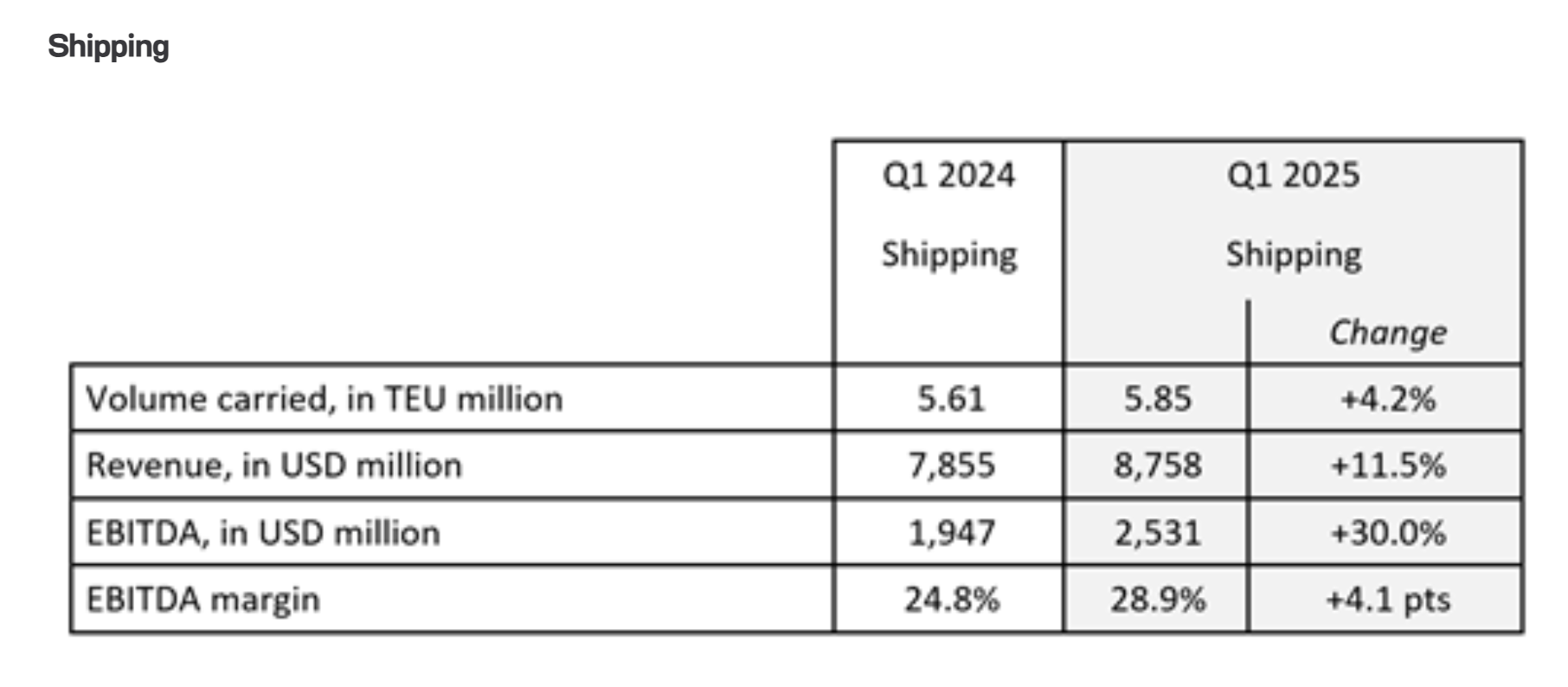
The French shipping group, which loves to slip out its results on a Friday evening, carried 5.85m teu, up exactly 4.2%, in the period, increasing revenue 11.5%, to $8.75bn.
Ebitda was up 30%, to $2.53bn, while the ebitda margin was up 4.1 percentage points to 28.9%. Average revenue per teu was $1,498, up 7.1% year on year, just above Hapag-Lloyd’s – which doubled average market growth.
CMA offered little insight into the growth, merely citing “sustained global trade and demand for freight transport in the first quarter”.
Overall, the group, which only releases limited numbers, saw revenues grow 12.1%, to $13.26bn, just shy of AP Møller Maersk’s results, while ebitda soared more than 29%, to $3.08bn. Net income was $1.12bn, up $337m.

In its logistics division, which includes Ceva, revenues rose some 10% following the integration of Bolloré Logistics in February last year. Revenues were $4.3bn, while ebitda was $399m, up 10.5%. Ebitda margin stayed flat, at 9.3%.
CMA said there had been “good momentum” in contract logistics, while there were “challenges” in finished vehicle logistics and road haulage, “particularly in Europe”.
Like other shipping groups it bunches the remainder of its activities into, in CMA’s case, “Other”, which includes CMA CGM Air Cargo, port terminals, and media. The division saw revenues up nearly 31%, to $833m, with ebitda up 91.5% to $157m – mostly driven by the consolidation of its media company, as well as “a good performance in terminals and air freight”.
CMA CGM did not offer forecasts for the year, but noted the “deteriorating geopolitical environment and the announcement of a significant increase in customs duties by countries such as the United States and China”.
It said: “If fully implemented, such measures could have a long-term impact on international trade volumes, while the Red Sea shipping disruptions observed throughout 2024 persist. Visibility of trends in global trade remains limited and depends on potential tariff policy announcements and new geopolitical developments.
“Effective capacity management, cost control, route diversification, and transformation through investment in optimisation, monitoring, and forecasting technologies are essential to maintaining competitiveness.”
Interestingly, it appears CMA CGM did not get the memo from French president Emmanuel Macron in April when he called for French businesses to suspend investment plans in the US after it imposed high tariffs on the EU.
Instead, CMA reiterated its pledge of $20bn investment in a US-flagged fleet, port and warehouse modernisation, new port infrastructure in New York, Los Angeles, Dutch Harbor, Houston, and Miami, and an air freight hub in Chicago.
In Europe, the group said, it was boosting its footprint with the acquisition of Air Belgium’s cargo operations, Ceva’s acquisition of “key region” Turkey’s Borusan Logistics, and investment in Lyon Rhône Terminal, which is “designed to support the growth of inland waterway operations and intermodal transport in France and Europe”.
It added that it was also investing €100m in a partnership with Mistral AI, to develop AI solutions for all its sectors.
Chairman and CEO Rodolphe Saadé summed up: “In an unstable geopolitical context, marked by unprecedented trade tensions, the group delivered solid performance in the first quarter, driven by the strength of our shipping activity and our long-term investments, particularly in terminals.
“While the outlook for the rest of the year remains uncertain, our direction is clear – control our costs, strengthen our positions in growth markets, and enhance our commercial agility, notably by leveraging artificial intelligence, to meet our customers’ expectations.”
Catch up with all the latest news in today’s bite-sized News in Brief podcast
For uninterrupted access, sign in or sign up to The Daily News, Premium or The Loadstar Enterprise Plan.

Comment on this article