Volatility drives US importers to continue to look for new suppliers
US containerised imports held broadly steady in June, but the underlying sourcing picture suggests importers ...


WMT: VERTICAL INTEGRATION IN LOGISTICSJBHT: HERE WE GOPG: STEADYEXPD: NEW RECORD BA: DELIVERIESMAERSK: BEAR CAMP MUSINGSCHRW: HIGHER HIGHS ON THE RADARWTC: 'ONE RECORD'HLAG: EARNINGS GUIDANCE UPGRADE AAPL: GLOBAL SMARTPHONE SHIPMENTS VW: THE IMPACT VW: MASSIVE JOB CUTS CONFIRMEDEXPD: BULLISH
WMT: VERTICAL INTEGRATION IN LOGISTICSJBHT: HERE WE GOPG: STEADYEXPD: NEW RECORD BA: DELIVERIESMAERSK: BEAR CAMP MUSINGSCHRW: HIGHER HIGHS ON THE RADARWTC: 'ONE RECORD'HLAG: EARNINGS GUIDANCE UPGRADE AAPL: GLOBAL SMARTPHONE SHIPMENTS VW: THE IMPACT VW: MASSIVE JOB CUTS CONFIRMEDEXPD: BULLISH
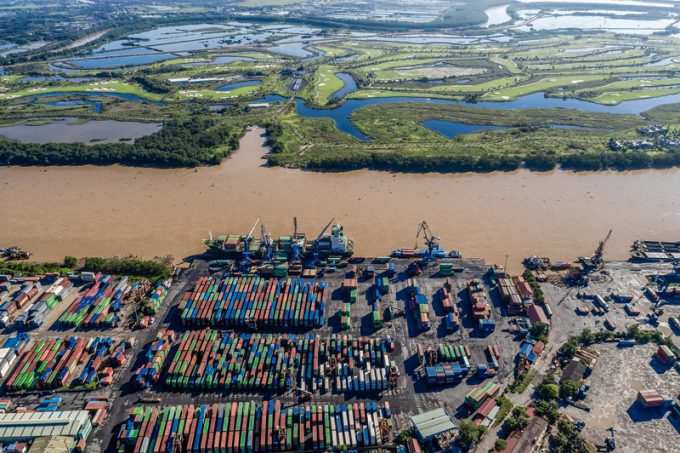
There has been a clear winner in the ‘China plus one’ sourcing strategy when looking at liner schedules, but there are questions over whether this will be a sustainable shift.
According to Sea-Intelligence data, a rapid acceleration of port calls in March 2025 meant that Vietnam’s Asia-US port-to-port connections reached more than 300 in May 2025.
By way of comparison, Vietnam’s average Asia-US P2P connections per month in 2024 was about 190, meaning its share of total Asia-US P2P connections jumped from 8-9% to 14-15%.
“This rapid growth indicates that Vietnam is emerging as the primary beneficiary of the ongoing supply chain shifts,” stated Sea-Intelligence.
“The increase in direct services suggests carriers are responding to a significant and sustained rise in demand from shippers moving production and sourcing to the country.”

Graph: Sea-Intelligence
The analyst identified the port of Haiphong as a “quickly emerging” and “critical” second gateway for US trade after Vung Tau (Cai Mep), having seen “almost exponential” growth in recent months.
In January 2025, Haiphong saw just 22 connections, which nearly quadrupled to 86 in July. Year on year, the port registered a 177% growth rate in the May-July period, also up 84% compared with the 2025 February-April period.
But Container Trades Statistics (CTS) CEO, Nigel Pusey, questioned whether sourcing away from China would be a temporary measure for US importers, or a more permanent one.
“Personally, I just wonder whether there is really the capacity in these countries to fill this sort of volume on an ongoing basis for the long-term,” he told The Loadstar Podcast.
According to CTS data, US imports from Vietnam were up 22% in July 2025 from July 2024, while Indonesian imports were up 24% and Cambodia 33%.
“What’s interesting is when the tariffs came in, they were 19% for Cambodia and Indonesia, and 20% for Vietnam.
“So it’s possible that these volumes will all start falling off again, because some of the Chinese tariffs have been paused, and now we’ve got tariffs on the countries where the sourcing switches have happened,” said Mr Pusey.
“I think there’s a number of interesting plays going on there for the rest of the year,” he added.
Listen to this clip from The Loadstar Podcast to hear Mr Pusey and The Loadstar managing editor Gavin van Marle speak about how alternative sourcing could be driving Intra-Asia demand:
Indeed, John Manners-Bell, CEO of Transport Intelligence, told The Loadstar that high tariffs on popular alternative sourcing locations would throw many global manufacturers’ China plus one strategies “into disarray”.
“Given that US policy has been to lessen its economy’s dependence on China the new tariffs would seem self-defeating,” he said.
The Sea-Intelligence analysis noted that South Korea had been a “strong candidate” to absorb a shift in sourcing on trades to the US back in April, when it registered the second-most connectivity outside of China.
According to connection data from February, South Korea represented 13% of direct connections to the US from Asia, versus Vietnam’s 9%.
The analyst deduced that South Korea lost out due to a “fundamental mismatch in economic profiles”, rather than a lack of network capability.
“The current supply chain diversification is largely driven cost-effective by a search for mass-manufacturing alternatives to China. While Vietnam offers a relatively lower-cost environment well-suited for producing apparel, furniture, and electronics assembly, South Korea is a high-cost, advanced economy specialising in high-value goods,” it explained.
And direct port calls from other origins, such as Japan, Singapore, and Taiwan, have remained “relatively stable”, according to Sea-Intelligence.
“Further underscoring that Vietnam’s recent surge is the most noteworthy change in the Asia-US shipping network,” it concluded.
If you’re looking for a quick round-up of last week’s supply-chain news, look no further than our 20 minute News in Brief Podcast!
For uninterrupted access, sign in or sign up to The Daily News, Premium or The Loadstar Enterprise Plan.

Comment on this article