Gulftainer unveils major logistics ambitions for Khor Fakkan expansion
The Emirati owner of the port of Khor Fakkan has unveiled a massive capacity expansion ...


FDX: LIFE SCIENCES ORG UNVEILEDWTC: UPS AND DOWNSWTC: ASX ANNOUNCEMENT REGARDING DSV PARTNERSHIP VW: D-DAYPLD: KEEP PUSHINGDHL: NEW AIR SERVICEDHL: GUIDANCE UPGRADE REACTIONDHL: NEW HIGH TARGET ON THE STREET DSV: EXPECTATIONS RUN HIGH KNIN: DHL GUIDANCE UPGRADE READ-ACROSSKNIN: NEW OPENINGGM: TECH UPSIDEAMZN: BIG DEBT FUNDING ON ITS WAY
FDX: LIFE SCIENCES ORG UNVEILEDWTC: UPS AND DOWNSWTC: ASX ANNOUNCEMENT REGARDING DSV PARTNERSHIP VW: D-DAYPLD: KEEP PUSHINGDHL: NEW AIR SERVICEDHL: GUIDANCE UPGRADE REACTIONDHL: NEW HIGH TARGET ON THE STREET DSV: EXPECTATIONS RUN HIGH KNIN: DHL GUIDANCE UPGRADE READ-ACROSSKNIN: NEW OPENINGGM: TECH UPSIDEAMZN: BIG DEBT FUNDING ON ITS WAY
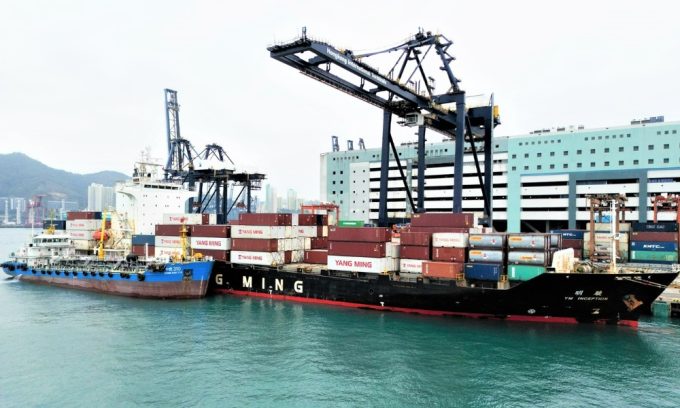
Despite the continued closure of the Strait of Hormuz, shortage of bunker fuel for containerships is not as severe as initially feared.
The waterway is a transit point for 20% of the world’s fuel supply and the restriction on tanker traffic is holding up deliveries of crude oil and petroleum products.
But one Singapore-based supplier told The Loadstar prices at the world’s largest bunkering port were stabilising after an initial spike in the early days of the US/Israel-Iran conflict.
He said: “At one point, very-low-sulphur fuel oil (VLSFO) prices crossed the $1,000 per tonne mark, but actually, there are ample stocks in Singapore.
“Some traders tried to create the impression that availability was tight to jack up prices, but in today’s environment shipping lines and operators are more cost-conscious than ever, and will be more determined in bargaining with suppliers,” he added.
Adrian Tolson, recently installed chairman of the International Bunker Industry Association, yesterday indicated that some fuel pricing in recent weeks had been questionable.
“Prices are high and remain volatile – crude and refined product markets continue to move unpredictably, and bunker pricing reflects this reality,” he said. “Suppliers have had to manage exceptional levels of price risk, while buyers are, understandably, questioning some of the pricing and margins seen during the initial stages of the disruption.
“In some cases, those increases are difficult to justify,” he added.
However, the Singapore-based supplier said competition among bunker suppliers and traders remained keen.
“We do our own price calculations, based on how much coverage our credit insurers give for each customer, the customer’s payment performance, and our own costs. Our profit margins are usually no more than 2%. If we try to hike our prices, we’d lose to a competitor.”
And shipping lines contacted by The Loadstar reported they had generally been managing well in terms of marine fuel supplies, although the volatility in bunker prices remained challenging.
“There is sufficient fuel available globally – though availability varies by region,” a Maersk spokesperson to The Loadstar. “While some parts of the world have ample fuel supplies, others may face tighter conditions.”
Manifold Times, a publication covering marine fuels, reported bunker availability as particularly tight in Gibraltar, Las Palmas, Durban, Lome, and Lagos ports, with suppliers saying customers must give them seven to 10 days’ notice to prepare bunkering operations.
With box ships continuing to reroute around the Cape of Good Hope, South Africa’s Durban port is acutely short of bunkers.
Data from marine fuel trader Integr8 shows VLSFO – the most commonly consumed marine fuel – at around $1,480 per tonne in Durban, while high-sulphur fuel oil (HSFO), which can be burned on scrubber-fitted ships, is only $10 cheaper per tonne.
In comparison, VLSFO and HSFO prices are averaging $834 and $640 per tonne respectively in Houston; $639 and $624 in Rotterdam; $742 and $684 in Hong Kong; and $722 and $636 in Singapore.
A Wan Hai Lines spokesperson told The Loadstar“ the carrier had “secured fuel supply contracts at all major bunkering ports; therefore, most refuelling arrangements proceed without issue as we receive priority supply from our contractors”, adding: “We typically evaluate pricing and other conditions to select the most favourable bunkering locations.
“That being said, in practice, arranging bunker supplies recently has become increasingly fraught. Therefore, we need to extend our lead times, avoid trouble ports, and maintain a wider range of alternative ports at all times to handle any potential issues that may arise.”
An HMM spokesperson said that while bunkering operations had not been difficult, rising fuel cost was hitting carriers’ bottom lines.
“While there has been no disruption to our supply, the sharp price increase is a major concern,” she added, indicating that further emergency fuel surcharges had not been ruled out.

For uninterrupted access, sign in or sign up to The Daily News, Premium or The Loadstar Enterprise Plan.
Comment on this article