Project44 split signals AI shift – CEO predicts pressure on CargoWise
Project44 believes AI is beginning to undermine CargoWise’s dominance of freight forwarding software, a trend ...

UPS: EARNINGS BEATWTC: REGAINING PRIDE TFII: EARNINGS BEATCHRW: PUMMELED DSV: LACK OF TRUST WEIGHSDHL: NEW HIGH DHL: E-COMM DEAL SIGNEDF: NEW PROFIT STREAMCHRW: HEALTHY CORRECTIONDSV: TIME TO BUY INWTC: NO LUCKCHRW: 'NUCLEAR VERDICT'
UPS: EARNINGS BEATWTC: REGAINING PRIDE TFII: EARNINGS BEATCHRW: PUMMELED DSV: LACK OF TRUST WEIGHSDHL: NEW HIGH DHL: E-COMM DEAL SIGNEDF: NEW PROFIT STREAMCHRW: HEALTHY CORRECTIONDSV: TIME TO BUY INWTC: NO LUCKCHRW: 'NUCLEAR VERDICT'
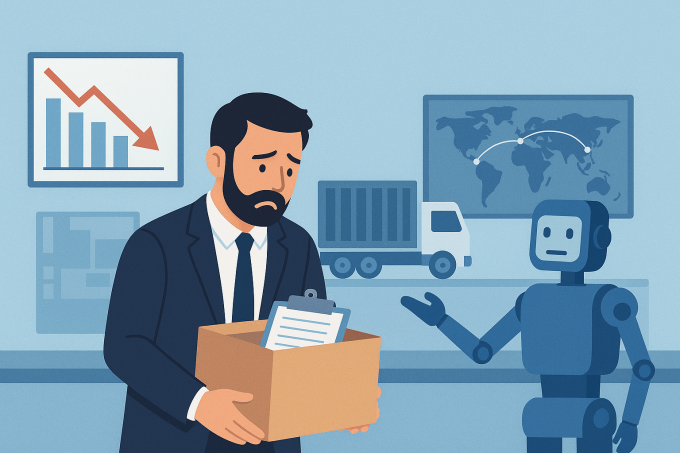
It comes as little surprise to see headlines in the Danish media that DSV’s job loss count may not be limited to 13,000.
In fact, given the current market environment, says one analyst, layoffs could rise as high as 10%, instead of the 6%-8% previously announced – some 16,250 jobs.
Kuehne + Nagel, Expeditors, UPS – they are all at it.
As ever, it’s a combination of issues. Tariffs, geopolitical uncertainty and lack of consumer confidence are leading to lower yields – so far, so normal. But this time around, the industry is also facing the rising use of AI and agentic AI, which is having a direct impact on the number of roles.
Take UPS: the introduction of AI designed to optimise delivery routes, dynamic pricing and load management will contribute to the loss of 20,000 jobs this year, it said. Others, such as DHL, are restructuring to take AI into account.
The number of jobs threatened by AI is staggering – but it’s not all bad news.
According to a recent study by MIT Center for Transportation & Logistics, some $65bn-worth of tasks can be done by AI, impacting 1.1m full-time transport jobs in the US. Some, of course, are in passenger travel – ticketing and so on – but the study notes that “cargo and freight agents and forwarders” will be “highly exposed”. It found that information-processing, decision-making, and quantitative tasks can be effectively replicated by AI.
In the main, companies claim that their use of ‘Agentic AI’, the latest buzzword, will enable them to do more, with the same job numbers.
“Agentic AI is the next step. It’s basically instructing an agent or a bot to do the work for you,” explained Flexport president Sanne Manders.
“We’ve already released the first agents in our application. ChatGPT 5 has an agentic mode in it, for instance, so you can let it schedule an appointment, or something like that. That’s a great use case, scheduling appointments, doing research. Having bots or agents that work on their own based on a framework they’re operating in – that’s going to be the future of logistics.
“And yes, it will take cost out of the business; we’re talking significant amounts.
“You know, for the industry as a whole, it will mean job losses. But we think we can put our AI advantage into growth, and then it will not lead to job losses.”
Flexport has recently completed its first fully automated, human-less, customs clearances (“well, someone is reviewing it”).
“There is not a single product that we’re launching without AI right now. And, actually, we will have a big product launch mid –October, which will be full of AI, again.
“We want our operators to be able to just talk to the supply chains they’re managing.”
There have, of course, been job revolutions before – industrial, automation – and the jobs market has adapted to the disruption.
The US transportation sector paid $290bn in wages in 2024 – the MIT study found that automating the six largest AI-exposed tasks could result in annual cost reductions of between $1bn and $4bn, in fact only up to 1.3% of those wages. And the study concluded that, actually, best practice would not be to layoff workers, but to train them for new tasks.
“These workers typically have valuable institutional knowledge that can continue to be highly beneficial to the organisation. In addition, hiring externally tends to be more expensive than retraining existing employees,” noted the study.
“To help workers, we need to train them to use AI tools effectively so they remain competitive, and upskill or reskill them for adjacent roles where their experience is valuable,” wrote Pierre Bouquet, one of the authors of the study.
Mr Manders agreed: “I have the feeling that humans are so creative that if a shitty job is being taken away because a robot does it, they will come up with something else.”
Listen to this clip of James Coombs, CEO of Raft.ai, on popular use-cases of AI in logistics

For uninterrupted access, sign in or sign up to The Daily News, Premium or The Loadstar Enterprise Plan.
Comment on this article
Alexander Kozij
October 07, 2025 at 3:42 amAI is an amazing and powerful tool. But an organization with poor customer culture. Is still an organization that it’s core is not serious about their customer service interactions. All the AI and automation in the world won’t improve customer satisfaction for UPS.
AI will not make the interaction for the customer any better, when UPS delivers to the wrong address. And does nothing to rectify it and asks you to file a clam, instead of going back and picking the package. Going from an automated phone system with no human interaction to an ‘AI’ chat bot. Doesn’t solve the problems clients are driven to call that need resolution. Spending money on technology to perpetuate a mindset not helpful and frustrating to clientele. Solves nothing.