Amazon chases US parcels spurned by FedEx, UPS
Amazon is stepping on the accelerator to ramp up its transport volumes. A month after ...

PLD: PROPOSAL DETAILSPLD: FINAL OFFERDSV: ROAD CEO MATTERSDSV: VOLUME PROGRESSION IN SEA FREIGHT DSV: TIME TO INCREASE THE VOLUMES IN SEA FREIGHTDSV: HEADCOUNT DISCREPANCIESDSV: TRASHEDDSV: IT IS A MATTER OF TRUSTDSV: FREE CASH FLOW QUESTIONEDDSV: QUESTION TIMEDSV: CEO ON SCHENKER INTEGRATIONDSV: CFO PREPARED REMARKSDSV: CEO PREPARED REMARKSDSV: CONF CALL FWRD: SHOOTING UPKNX: TRADING UPDATE ON THE WAY GM: TRADING UPDATE OUTUPS: REMEMBER THE TAILWINDS
PLD: PROPOSAL DETAILSPLD: FINAL OFFERDSV: ROAD CEO MATTERSDSV: VOLUME PROGRESSION IN SEA FREIGHT DSV: TIME TO INCREASE THE VOLUMES IN SEA FREIGHTDSV: HEADCOUNT DISCREPANCIESDSV: TRASHEDDSV: IT IS A MATTER OF TRUSTDSV: FREE CASH FLOW QUESTIONEDDSV: QUESTION TIMEDSV: CEO ON SCHENKER INTEGRATIONDSV: CFO PREPARED REMARKSDSV: CEO PREPARED REMARKSDSV: CONF CALL FWRD: SHOOTING UPKNX: TRADING UPDATE ON THE WAY GM: TRADING UPDATE OUTUPS: REMEMBER THE TAILWINDS
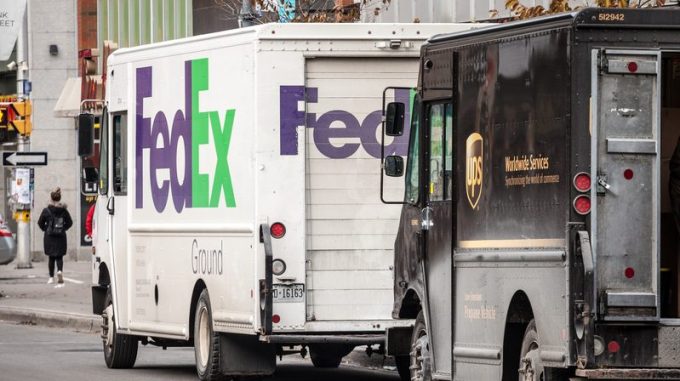
Recent actions by UPS and FedEx reflect a challenging market environment: a focus on shedding unprofitable segments in favour of higher returns has shifted to a hunt for volumes.
FedEx delivery vans are becoming a regular sight in US residential neighbourhoods on Sundays as the integrator ramped up home delivery capabilities to reach nearly two-thirds of the population on the mainland, a jump from 50%.
According to chief customer officer Brie Carere, the move came in response to demand from the largest customers.
In an earnings call with analysts, she said FedEx had already garnered incremental commitments of more than half a million packages a week tied to Sunday deliveries.
Not long ago the Sunday home delivery service covered 95% of the US population, but it began scaling this back in 2022, amid claims from contractors that the returns did not neet requirements.
Demand for FedEx’s ground home delivery and economy services rose 11% year on year in the recent quarter, Mr Carere said.
And John Haber, chief strategy officer of Transportation Insight, discerns a shift in strategy. He said: “FedEx is trying to move back into being the one that moves packages any time of the week. They’re going after volume.”
He added that FedEx stocks on Wall Street had been under pressure.
Two years ago the integrators could afford to be picky and focused aggressively on traffic that yielded higher margins. Shadows of this survive, but barely. In January, UPS chief Carol Tomé explained the decision to cut back on volumes carried for Amazon with low margins associated with this traffic. However, the overall trend has been leaning in the opposite direction – toward chasing volumes.
In mid-January, UPS announced it was taking virtually all final-mile delivery of the SurePost traffic in-house. SurePost parcels have traditionally been entrusted to the US Postal Service for final-mile delivery, owing to the thin margins associated with residential deliveries.
UPS had to raise SurePost rates last autumn after the USPS, in an effort to attract traffic higher upstream, ended its policy of giving discounted rates to parcel consolidators feeding traffic into its network for final delivery.
The game has shifted to network utilisation in order to raise margins, said Mr Haber. “There’s not a lot of organic volume growth, so you have to get volume that already exists. You need a compelling reason for customers to switch to you,” he added.
Ms Carere confirmed that utilisation was a focus for FedEx.
“This change is enabling us to better utilise our existing assets without adding capacity, while meeting the needs of our customers,” she noted about the extended Sunday home delivery push.
Both large US integrators are engaged in massive network revamps to improve utilisation and shave costs. UPS recently announced plans to close two facilities in Kansas as part of its push to trim $1bn in costs.
“An improved network is critical if they have to deliver all the SurePost traffic,” commented Mr Haber.
As the UPS decision to reduce Amazon traffic indicates, that integrator is engaged in a delicate balancing act between chasing volumes to improve utilisation on the one hand, and trying to reduce less-attractive business on the other.
UPS announced in January it planned to trim its Amazon volumes by over 50%, and claimed it had turned down a proposal to boost volumes.
“Amazon is our largest customer, but it’s not our most profitable customer,” Ms Tomé said in January. “Its margin is dilutive to the US domestic business.”
According to an earnings presentation, management was projecting then a drop of about 8.5% in average daily US volumes, while revenue per package should rise by 6%.
Meanwhile, the integrators should make better margins in the healthcare sector.
FedEx announced during its earnings call it had recently garnered nearly $400m in annual revenue in the sector, which put it on course to end the fiscal year with around $9bn in healthcare revenue.
UPS raked in $10.5bn in healthcare revenue in 2024, according to Ms Tomé. She aims to raise this to $20m by 2026 through a mix of organic growth and acquisitions.
For uninterrupted access, sign in or sign up to The Daily News, Premium or The Loadstar Enterprise Plan.
Comment on this article