Red Sea disruption drives shift to smaller, flexible cold chain networks
Ongoing disruption to key tradelanes is accelerating a shift in retail supply chains, with major ...


DSV: LEADING THE DROP RXO: CRATERINGDSV: WHAT TO LIKEDSV: BULLISH BAMZN: 'AI EDGE'HD: HERE IS HOW IT LOOKSAMZN: REG RISKMAERSK: MOST HARMED KNIN: GO GREENDSV: CHANGING OF THE GUARD CHRW: OVERVALUEDGM: NEW BIZ
DSV: LEADING THE DROP RXO: CRATERINGDSV: WHAT TO LIKEDSV: BULLISH BAMZN: 'AI EDGE'HD: HERE IS HOW IT LOOKSAMZN: REG RISKMAERSK: MOST HARMED KNIN: GO GREENDSV: CHANGING OF THE GUARD CHRW: OVERVALUEDGM: NEW BIZ
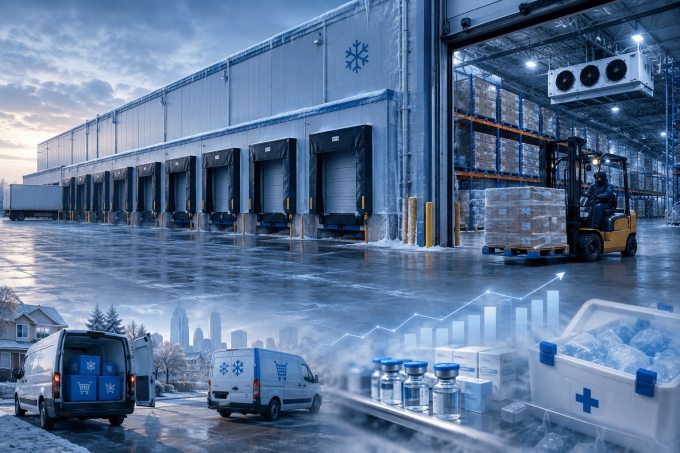
Vacancy rates in the cold storage sector are at historically high rates. The development pipeline for new facilities is at a record low, which suggests a bright future beyond the current pain.
This week Vertical Cold Storage acquired a refrigerated warehouse in Dothan, Alabama from Dothan Warehouse for an undisclosed sum. It is the second temperature-controlled facility that Vertical has bought in the town in two years. While the first warehouse caters primarily to the poultry sector, the new one is focused on peanut shelling and storage. Dothan is located in the heart of the US peanut production region.
Depending on your lens, this may be a brilliant strategic move, or the worst time to buy cold storage property. According to a report published in March by commercial real estate service firm Newmark, the US vacancy rate has hit a 20-year high.
Notwithstanding some improvement, recent financial results of the top players have been bleak, and comments from their top emphasised cost control and discipline. Americold reported a 0.1% year-on-year rise in revenues to $629.9m (down 1.9% on a constant currency basis) and a net loss of $13.6m.
CEO Rob Chambers noted that the result was above expectations and stressed that “our teams remain tightly focused on pricing discipline, cost control and delivering excellent service to customers”.
Lineage Logistics reported a $51m net loss for the quarter, while revenues grew less than 1% to $1.3bn.
Propelled by a rapid expansion triggered by the pandemic, absorption has lagged the growth in capacity. According to Lineage, in the fourth quarter of 2025, available space was up 15%, whereas demand had grown 5%.
Demand continues to be burdened by high food prices that strain consumers’ budgets and slow consumption growth, Newmark’s report highlighted.
“Weak consumer sentiment, heightened uncertainty, and significant volatility have weighed on category growth and impacted consumer purchase patterns, resulting in a slower pace and higher cost of volume recovery than initially expected,” its authors wrote.
At the same time, warehouse operators and their clients have been struggling with higher costs, largely due to Washington’s tariffs and the inflation they triggered, a survey by Lineage of 1,000 clients from the food and beverage sector shows. According to Newmark, average cold storage rents have risen over 100% since 2020.
On a positive note, the facility development pipeline has shrunk to its lowest level in 20 years, Newmark reported.
Its analysts see the market at an inflection point. Going forward, they see demand outpace capacity expansion, despite the cost pressure.
In Lineage’s customer survey, 72% reported rising demand for refrigerated and frozen foods.
Newmark’s analysts identified the rise of online grocery shopping, which expanded 32% last year, as a principal driver of growing demand for cold storage capacity, noting that home delivery is more cold chain-extensive than in-store shopping.
The cold chain needs of the ever-growing pharma industry is a second catalyst for rising demand, they noted. In addition, they pointed to population growth, especially in areas like Dallas/Fort Worth, that is pushing up demand for cold storage facilities.
While cold storage executives are looking forward to more favourable market conditions, the improvement will take time to unfold, Newmark’s report warned. As current construction projects are being completed, supply will continue to outpace absorption in the near term, they wrote.
The wait will likely be longer for owners and operators of older cold storage infrastructure. According to Newmark, there is a clear bifurcation separating modern and older warehouses. Whereas the vacancy rate of modern buildings was 2.7% in the last quarter of 2025, it reached 7.6% for legacy warehouses.
Of the vacancies last year 73% were for older buildings.
For uninterrupted access, sign in or sign up to The Daily News, Premium or The Loadstar Enterprise Plan.

Comment on this article