Cargo carriers split on freighter strategy as Boeing delays extend
Cargo carriers are increasingly diverging on long-term fleet strategy as Boeing delays deepen, forcing ageing ...


HON: DEALS ON THE MENUEXPD: NEW RECORD XPO: THE REBOUNDCAT: PAYOUT UPDHL: LIGHTHOUSEMAERSK: ANOTHER UPGRADEFWRD: HEALTHY CORRECTION R: RYDER CEO SAYS R: AMAZON LTL ANNOUNCEMENTPLD: EV INFRASTRUCTURE PUSHDHL: RAMPING UP 'NEW ENERGY LOGISTICS' GXO: NEW WINAMZN: LTL SERVICE UPDATEGM: ENERGY PROVIDER MODEL
HON: DEALS ON THE MENUEXPD: NEW RECORD XPO: THE REBOUNDCAT: PAYOUT UPDHL: LIGHTHOUSEMAERSK: ANOTHER UPGRADEFWRD: HEALTHY CORRECTION R: RYDER CEO SAYS R: AMAZON LTL ANNOUNCEMENTPLD: EV INFRASTRUCTURE PUSHDHL: RAMPING UP 'NEW ENERGY LOGISTICS' GXO: NEW WINAMZN: LTL SERVICE UPDATEGM: ENERGY PROVIDER MODEL
Feedstock is beginning to percolate back into the freighter conversion sector after a year of delay, with Airbus confident the market is perking up.
Speaking to The Loadstar in Dubai on the sidelines of IATA’s World Cargo Symposium (WCS)last week, head of freighter marketing at the French aircraft manufacturer Crawford Hamilton said it was a good sign in an otherwise uncertain moment.
Mr Hamilton said Airbus saw no need to revise earlier predictions for growth over the next two decades.
“What we see with short-term disruption, whether a big event like 9/11 or Covid, or other things, the long-term outlook remains unchanged. What we see is a growing market and we are seeing growth of just over 3% for that 20-year period.
“Short-term impacts could move the things by a year or two, but we’re confident.”
After a surge in freighter deliveries in 2023, last year saw a major slowdown, the conversion market particularly impacted as carriers sought to hold onto their passenger aircraft amid the post-pandemic tourism return.
Over the course of 2024, the global freighter fleet remained largely flat as a consequence of a halt in the number of narrowbody deliveries, which, Mr Hamilton said was in part the result of oversupply over the Covid era. He noted that “on the small end, we have seen an oversupply for a while, and we saw quite a lot of converted aircraft stuck on the ground” – although he said these had since been “sucked back up”.
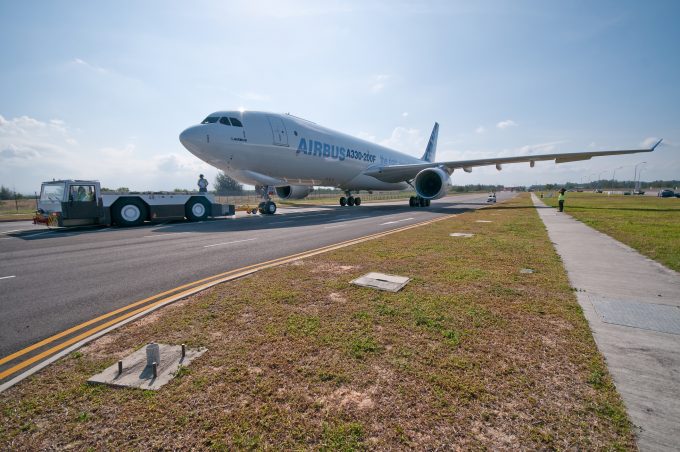
Medium-sized offerings, such as Boeing’s 767, have proved harder to find as a result of reduced feedstock, with Airbus seeing an opportunity to further push its A330s.
“We have got some nice new operators on the A330 side and are seeing good penetration into the Chinese market at the moment, with two very good offerings, and an increasingly good market share there,” he said.
“We now have 110 new conversions operational, which sort of went unnoticed, but there has been a move towards A320 and the A330 conversions, too.”
On the situation between China and the US, and the impact on Boeing – the Chinese state ordering its companies to stop deliveries of parts for Boeing – Mr Hamilton would not be drawn, but given the growing presence of Airbus in China, the situation adds to its hand.
One area where it seems to have dropped off is on the green front; it recently reportedly suspending the development of a hydrogen aircraft.
That decision followed investment of more than $1.7bn in a project it claimed would lead to an operational zero-emission hydrogen-powered jet within 15 years, but comes as a number of companies rethink their green plans.
Check out for a round-up of the last week in the supply chain!

For uninterrupted access, sign in or sign up to The Daily News, Premium or The Loadstar Enterprise Plan.

Comment on this article