China reprisal puts Panama-registered box ships on course for new flags
More than 100 containerships have reflagged from Panama to other registries in response to China’s ...

GM: TRADING UPDATE OUTUPS: REMEMBER THE TAILWINDS PLD: NEW RELEASEPLD: OUCHVW: NEW PARTNERS SOUGHTEXPD: AIRCRAFT ON GROUND SERVICESTSLA: JUST AS VW STRUGGLESBA: NEW BIG ORDERBA: THE ORDERBOOK GROWSPLD: PUSHING FOR A DEAL PLD: TIME TO DEALEXPD: ANOTHER ALL-TIME HIGH CHRW: NEW RECORD DSV: AHEAD OF EARNINGS RELEASE JBHT: NEW HIGHS EVERYWHERE
GM: TRADING UPDATE OUTUPS: REMEMBER THE TAILWINDS PLD: NEW RELEASEPLD: OUCHVW: NEW PARTNERS SOUGHTEXPD: AIRCRAFT ON GROUND SERVICESTSLA: JUST AS VW STRUGGLESBA: NEW BIG ORDERBA: THE ORDERBOOK GROWSPLD: PUSHING FOR A DEAL PLD: TIME TO DEALEXPD: ANOTHER ALL-TIME HIGH CHRW: NEW RECORD DSV: AHEAD OF EARNINGS RELEASE JBHT: NEW HIGHS EVERYWHERE
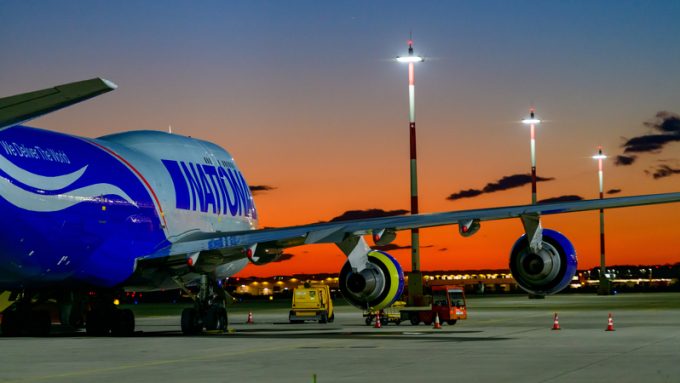
The US has been urged to extend its proposed ban on Chinese airlines overflying Russia to include all foreign cargo-only carriers.
The Trump administration last week “tentatively” proposed prohibiting seven Chinese airlines from using Russian airspace between China and the US – giving carriers just two business days to comment, it wants the ban to become effective 30 days after a final order.
While the Chinese oppose the ban, also demanding (and being refused) a longer comment and transition period, US carriers have been in favour. And freighter operator National yesterday requested the ban be widened to include Middle Eastern carriers.
Noting that the ban on passenger carriers is a “glaring omission, with significant competitive consequences for US cargo operators”, National urged the Department of Transportation “to follow through on the logic of its decision” and prohibit all foreign cargo-only operators from Russian airspace.
“National has suffered significant competitive harm from the use of Russian airspace by foreign all-cargo carriers,” it said.
“For the past several years, National has been forced to avoid Russian airspace on flights to or from China, adding to both the hours required to complete a flight and to operating costs. The inability to overfly Russia hinders all of National’s cargo operations to and from China and the South-east Asia region, but is especially problematic for services continuing on to, or originating in, Europe.
“National flights between China and Europe are forced to follow roundabout routes with navigational waypoints that significantly increase fuel costs, pilot duty time and flight hours, none of which would be incurred if National had access to Russian airspace.
“Not so National’s foreign competitors. The resulting advantage for foreign all-cargo operators has created significant competitive challenges for National as it has been underbid by non-US airlines that can offer all-cargo services between the same points at a lower cost and with faster delivery times.
“And it’s not just Chinese all-cargo carriers that wield this competitive advantage. Other foreign carriers do as well, such as Qatar, Etihad and Emirates.”
National has cut capacity this year on the transpacific by nearly 40% over 2024, while its Asia-Europe routes are down 33% – although up 11% eastbound. It has shifted its capacity to north-south routes, which face no overflight restrictions, with 550% growth on Europe-Africa routes, 130% growth on the transatlantic, some 70% growth on North-South America, and triple-digit growth on intra-South America and Europe-South America.
The DoT’s original filing claimed its air traffic agreements provided “for far more liberal all-cargo service route rights, and the nature of the competitive playing field inherent to all-cargo services in the US-China market is distinctly different as compared to that of combination services”.
However, it added that it “retains the right to reconsider our decision”.
But National argued: “One would have thought that a determination of such far-reaching consequences for America’s all-cargo operators would have been accompanied by additional analysis or quantitative market data. None was provided. In the absence of a developed and well-supported rationale for applying a bilateral guarantee to protect one set of US carriers, but not another, the department’s tentative decision to ban the use of Russian airspace by China’s combination carriers alone is arbitrary and capricious.”
It also said the proposal was “prejudicial”, while unlimited access to Russian airspace “undoubtedly helps to prop up the Russian economy at a time when Russia is subject to widespread and severe US economic sanctions”.
And it pulled its CRAF card: “The department’s tentative decision also has the perverse effect of eroding the profit margin of US carriers like National, which are members of the Civil Reserve Air Fleet (CRAF), by allowing their foreign competitors continued access to Russian airspace on flights to the US.”
It concluded: “The only way to level the all-cargo playing field across the board is for the department to place the same restrictions it is proposing for Chinese combination airlines on every foreign carrier with US traffic rights.”
The Chinese carriers named in the proposal are: Air China; Beijing Capital; China Eastern; China Southern; Hainan Airlines; Sichuan Airlines; and Xiamen Airlines.
For uninterrupted access, sign in or sign up to The Daily News, Premium or The Loadstar Enterprise Plan.
Comment on this article