From Robinson to Expeditors & UPS via K+N & DSV – the ladder is burning
Jobs most at risk in T&L? AI, layoffs and the broken talent pipeline

PLD: TRADING UPDATE ON THE WAY KNIN: UPSIDEJBHT: STRONG TRADING UPDATE DSV: EVERY LITTLE HELPSJBHT: CEO REMARKS WMT: VERTICAL INTEGRATION IN LOGISTICSJBHT: HERE WE GOPG: STEADYEXPD: NEW RECORD BA: DELIVERIESMAERSK: BEAR CAMP MUSINGS
PLD: TRADING UPDATE ON THE WAY KNIN: UPSIDEJBHT: STRONG TRADING UPDATE DSV: EVERY LITTLE HELPSJBHT: CEO REMARKS WMT: VERTICAL INTEGRATION IN LOGISTICSJBHT: HERE WE GOPG: STEADYEXPD: NEW RECORD BA: DELIVERIESMAERSK: BEAR CAMP MUSINGS
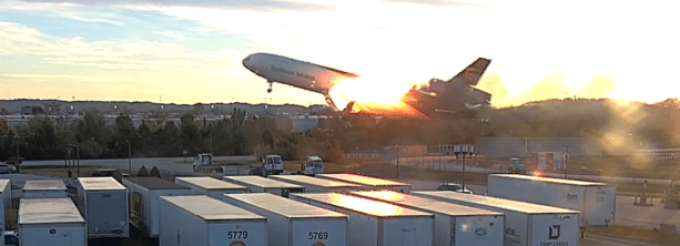
UPS’s aircraft maintenance is expected to come under serious scrutiny, after a senior aviation lawyer said the UPS freighter crash in Louisville on 4 November was “completely preventable.”
Veteran aviation attorney Robert Clifford pointed to new findings from federal investigators that metal-fatigue cracks had developed in a key engine-mount structure before the accident.
The National Transportation Safety Board (NTSB)’s report on UPS Airlines Flight 2976 by an MD-11 freighter, confirmed that the jet’s left engine and pylon tore away from the wing during take-off from Louisville Airport, sending the aircraft out of control and into an industrial area seconds later.
All three crew members and 11 people on the ground were killed, and 23 others on the ground were injured.
The report identified fatigue cracks in the aft mount lug of the left engine pylon and related structures, which likely built up over numerous flights and ultimately caused one side of the pylon’s supports to fail, overstressing the remaining attachment points. The 34-year-old aircraft had recently undergone heavy maintenance in Texas before returning to service.
Mr Clifford, founder and senior partner of Chicago’s Clifford Law Offices, has been retained by people who were injured or lost relatives in the crash. He argued that the structural failures pointed to problems that should have been identified earlier, through inspections and oversight.
“The age of the aircraft suggests that this plane was old, tired and well beyond its useful life, even though the owner and the operators continued to push it into service, certainly triggering questions about profit over safety,” he said.
“The NTSB investigation reveals fatigue fractures … Metal fatigue can happen over time and should be detected upon proper safety investigations and inspections.
“The failure to properly detect the fatigue fractures could easily be the reason why there was an ultimate failure of the pylon used to attach the engine to the wing.
“The victims of this crash can rightly point to all associated with the ownership, operation, and maintenance of this aircraft, as well as oversight and supervision by the Boeing Company, and possibly General Electric, regarding the engines.”
Since the accident, MD-11Fs and DC-10s have been grounded pending further investigation. Mr Clifford said there was a direct comparison with the 1979 crash of American Airlines Flight 191, when a McDonnell Douglas DC-10 lost its left engine during take-off from Chicago O’Hare and crashed, killing 271 people on board.
In that case, the NTSB ultimately blamed improper maintenance.
The UPS investigation is ongoing and the NTSB has not issued a final determination of probable cause. A full report is expected in about a year, following further analysis of recovered wreckage, flight data and cockpit voice recordings, and the aircraft’s maintenance and inspection history.
But following Mr Clifford’s remarks, UPS will certainly be under scrutiny.
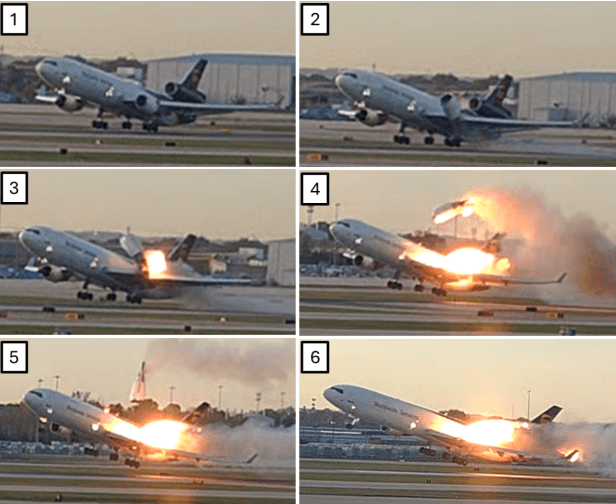
Still images from an airport surveillance video showing the left engine and left pylon separation from the left wing. (Source: UPS/NTSB)
For uninterrupted access, sign in or sign up to The Daily News, Premium or The Loadstar Enterprise Plan.

Comment on this article